
Quick Answer
Most retirement questions start as one number: "I have $600,000," or "this calculator says I have an 85% chance." Neither answers the questions that actually decide whether retirement works: how much of your income survives taxes and healthcare costs, what happens in the years before Medicare and Social Security, and whether a withdrawal today weakens a phase ten years from now.
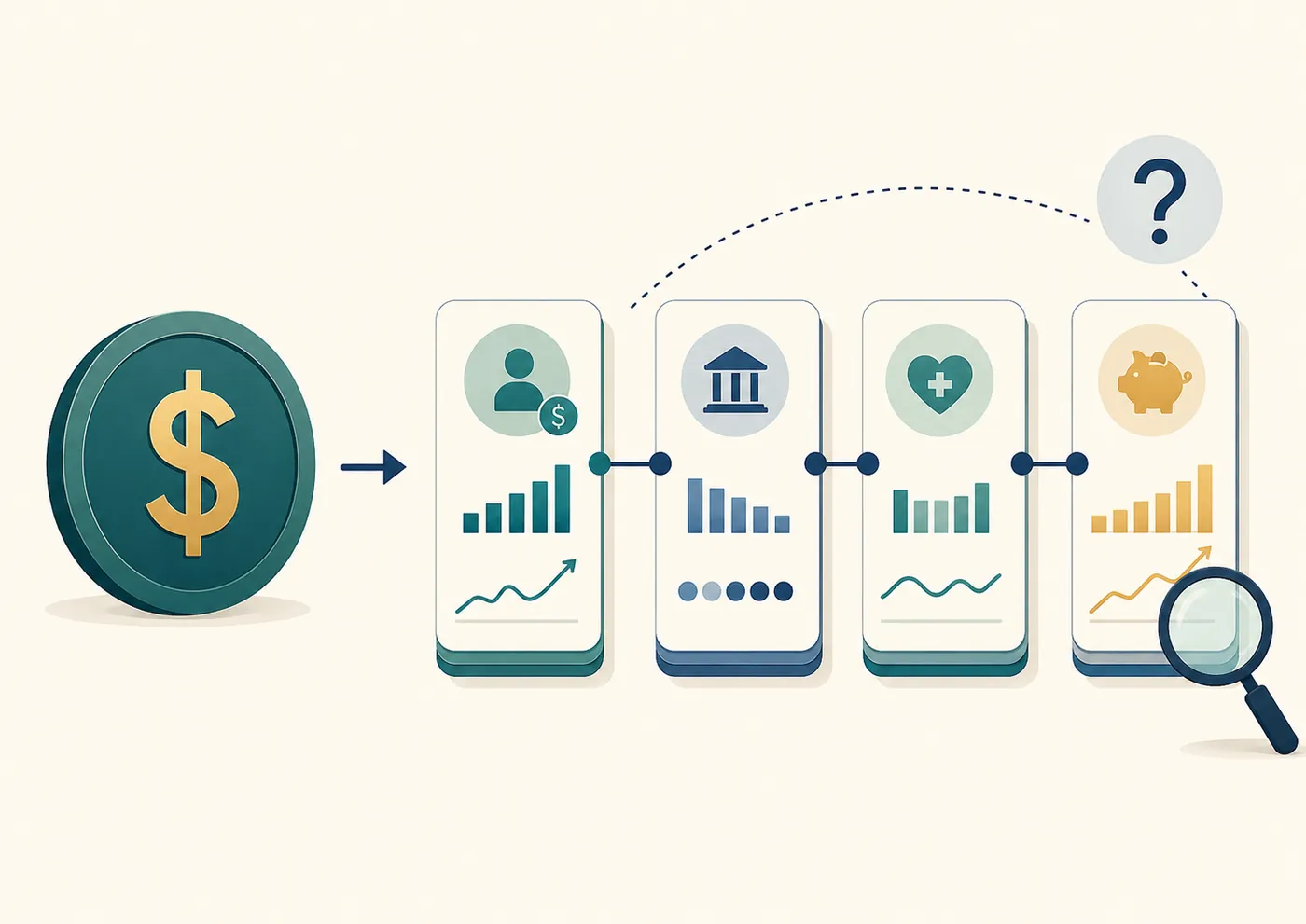
A better goal is a retirement plan you can question: a working model, organized as a timeline, that shows net and real income, taxes, healthcare costs, and ending balances phase by phase, so you can change one assumption and immediately see the effect on the rest of the plan.
This is the first article in a series based on the free companion eBook Build a Retirement Plan You Can Question. It sets up the idea; the rest of the series works through each moving part.
📘 Free companion eBook: this series is drawn from Build a Retirement Plan You Can Question. Get the full framework free.
Key Takeaways
- "Can I retire?" is really several smaller questions, and a savings total cannot answer them.
- A single "probability of success" score hides where a plan is actually weak.
- A useful plan is a working model: it shows how income, taxes, healthcare, withdrawals, growth, and timing interact.
- The point is not to predict the future perfectly. It is to organize your assumptions clearly enough to test them, compare choices, and find the weak points before you rely on the plan.
- Start with a baseline built from reasonable estimates, then test alternatives. Do not wait for perfect inputs.
"Can I Retire?" Is Not One Question
Most people begin retirement planning with a simple question: Can I retire? But that question actually contains several harder ones:
- Can I create enough monthly income, and will it still be enough after taxes?
- What happens before Medicare begins at 65? What happens when Social Security starts?
- Will my savings last if investment returns are lower than expected?
- Should I draw from cash, a 401(k), an IRA, a Roth account, or a taxable brokerage account first?
- Will a withdrawal today create higher taxes or healthcare costs later?
- Can I safely spend more, or do I need to spend less?
A savings total by itself cannot answer any of these. Neither can a rough monthly estimate. Those questions are about how income, taxes, healthcare costs, withdrawals, investment growth, and timing work together, which means you need something that models the whole timeline, not a single figure.
Why One Number Falls Short
Two "one number" answers are especially common, and both leave out too much.
The savings total. "I have $600,000" tells you what you have, not what it produces, which is why preparing for retirement is really about designing the income those balances have to deliver. The same $600,000 can generate very different spendable income depending on the account mix (a dollar in a traditional IRA is taxed differently from a dollar in a Roth or in cash), when Social Security starts, and how healthcare is handled before Medicare.
The probability score. Many calculators reduce a plan to a single "chance of success" percentage. That can be reassuring, but a high score can hide a weak phase: a tight stretch before Social Security, a future tax spike when required minimum distributions begin, or income that looks fine in dollars but erodes in real terms. A percentage tells you whether a plan tends to survive; it does not tell you where it is fragile or what to change. That is also why it helps to understand how a single Monte Carlo or backtest number is built before you lean on it.
The goal is not to find the one perfect number. No planner, spreadsheet, calculator, or advisor can predict the future. The goal is to organize the information clearly enough that you can test your assumptions, compare choices, and see where the weak points are before you rely on the plan.
A Plan You Can Question Is a Working Model
A retirement plan you can question shares a few traits.
It is a timeline, not one average year. Retirement unfolds in stages: before Medicare, once Social Security starts, once required minimum distributions begin. Each stage has its own income sources, costs, and tax situation, and the ending balance of one stage becomes the starting balance of the next.
It separates the kinds of income. Gross income is not spendable income. It shows net income (after taxes and healthcare), real income (after inflation), and the difference between reliable income (Social Security, pensions) and flexible income (your portfolio). A plan that looks comfortable in gross dollars can be much tighter once you see how much is actually spendable.
It watches the balance that carries the plan forward. A phase can hit its income target and still weaken the next phase by drawing down the wrong account too fast.
It makes taxes and healthcare visible. Both change the result. A withdrawal that looks harmless can raise your tax bill, reduce an ACA subsidy before Medicare, or trigger an IRMAA surcharge after it.
It is easy to review. This is the heart of it: when you change a withdrawal, a claiming age, or an inflation assumption, you should see what happens to taxes, healthcare costs, ending balances, and later phases without rebuilding everything. A plan you have to reconstruct every time you ask a question is a plan you will stop questioning.
A spreadsheet can do this if it is built very carefully. A calculator can give a useful first estimate. But the more moving parts you have, the more valuable a structured, reviewable model becomes.
What This Looks Like in the Planner
The AI Retirement Income Planner was built around exactly this idea. It is a single HTML file that opens in your browser, with no account and no sign-up, and your figures stay on your own device rather than being uploaded to a server.
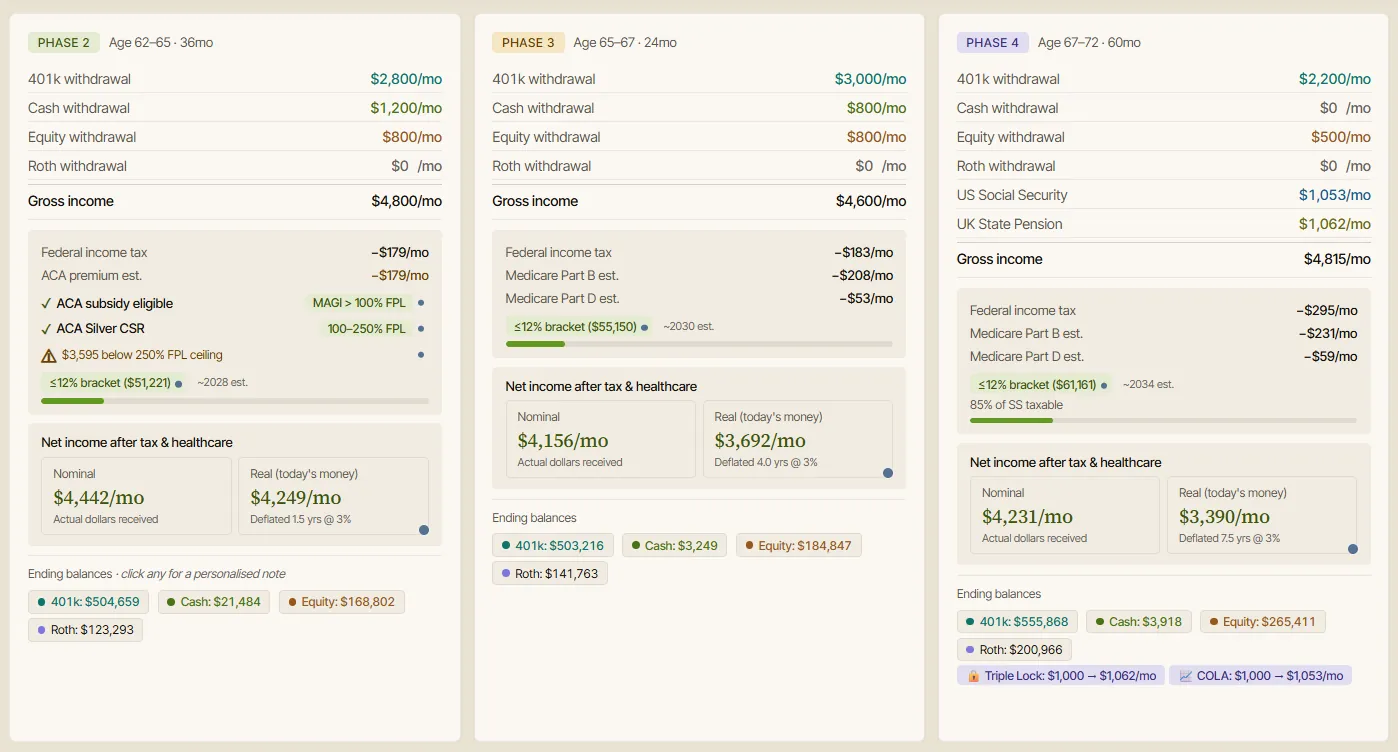
Inside, the plan is a working model:
- The Overview tab shows retirement as a set of phase cards. Each card lays out that phase's income sources, withdrawals, estimated taxes and healthcare costs, net income, real income, and ending balance. Change a number and the affected phases recalculate.
- You can save up to three plan snapshots and compare any one of them against your current plan in a side-by-side table (a baseline, an improved version, a conservative version), so you can see exactly what a change did. There is even an "Ask AI about this comparison" button that explains why two versions differ.
- The Confidence tab reviews the plan from several angles at once (income adequacy, tax-bracket efficiency, ACA and IRMAA exposure, portfolio survival, RMD pressure, and more), so a single reassuring number never hides a weak spot.
- If you add your own API key, an optional AI chat can read the plan you have entered and answer questions about it, but it works on top of the planner's real calculations, not instead of them.
The planner does not make decisions for you. It gives you a structured way to review options, which is the whole point of a plan you can question.
Start With a Baseline, Not Perfection
The most common mistake is waiting for perfect information. You may not know exactly what healthcare will cost, which year you will claim Social Security, or what future tax brackets will be. That uncertainty is normal, and it is not a reason to delay.
Build a first version from reasonable estimates and save it as a baseline. Then test alternatives:
- Unsure whether to claim Social Security at 62 or 67? Save both and compare.
- Unsure whether inflation runs 3% or 4%? Test both.
- Unsure whether healthcare costs $500 or $900 a month before Medicare? Test both.
A retirement plan does not need to be perfect to be useful. It needs to be clear enough that you can review it, and honest enough that you keep questioning it.
The next articles in this series work through the pieces one at a time, starting with the foundation: why retirement income is best planned as a timeline of phases.
FAQ
Isn't a "chance of success" percentage good enough?
It is a useful summary, but it is only a summary. A single percentage can look healthy while a specific phase is fragile, for example a tight bridge before Social Security or a future tax spike when RMDs begin. A plan you can question shows you where the risk is and lets you test a fix, not just the odds.
Do I need special software, or can I use a spreadsheet?
A carefully built spreadsheet can work. The practical issue is review speed: retirement planning is an adjustment process, and a structured tool lets you change one assumption and see the effect on taxes, healthcare, and later phases immediately. The more moving parts, the more that matters. If you are weighing the options, retirement planning software without a subscription compares the one-time-purchase tools against the subscription ones.
What is the single most useful first step?
Build a baseline. Enter your balances, income sources, spending target, and rough tax and healthcare assumptions, review it phase by phase, and save it. Everything else, from testing changes to comparing scenarios to reviewing plan health, becomes easier once a baseline exists.
Where can I get the full framework?
This series summarizes it, but the complete step-by-step framework is in the free companion eBook, Build a Retirement Plan You Can Question. You can download it here.
Source Links
- Consumer Financial Protection Bureau, Planning for Retirement: https://www.consumerfinance.gov/consumer-tools/retirement/
- Investor.gov, Retirement Toolkit: https://www.investor.gov/additional-resources/retirement-toolkit
- AI Retirement Income Planner: https://airetirementincomeplanner.com/
Educational Disclaimer
This article is for general education only. It is not financial, tax, investment, legal, healthcare, Social Security, Medicare, estate, or retirement advice. Any projections depend on assumptions that can change, and no plan can guarantee future results. Verify important numbers and rules with official sources and a qualified professional before acting.