
Quick Answer
Inflation is easy to underestimate because it works slowly. A price rise this month changes nothing. A few years of it barely registers. But over the twenty or thirty years a retirement can last, it can steadily rewrite what your income actually buys, and a plan that looks stable in dollars can weaken badly in real spending power.

That is why a good plan shows more than future dollar amounts. It shows real income: income measured in today's purchasing power. A plan can display $5,000 a month at 62 and $5,500 at 80 and look like an improvement, when in real terms the later figure buys less. The dollar amount went up and the spending power went down. Real income is the number that reveals it.
This is the seventh article in our framework series drawn from the free companion eBook. The previous one covered how healthcare costs move with income, and before that, how taxes change the shape of retirement income.
📘 Free companion eBook: this series is drawn from Build a Retirement Plan You Can Question. Get the full framework free.
Key Takeaways
- Nominal is not real. Nominal income is the future dollar figure; real income adjusts it for inflation. They answer different questions, and both belong on screen.
- Inflation compounds. At roughly 3% a year, prices about double over 24 years, so the longer the retirement, the more it matters.
- Not every expense rises equally. Healthcare and some other costs can climb faster than general inflation, so a single number is a simplification.
- Fixed income loses ground. A level pension or annuity feels smaller each year, which is why it matters how much of your floor is inflation-protected.
- Rising dollars can mislead. Nominal income can rise while real income falls, so a plan that looks like it is improving may actually be shrinking.
- A real-income decline can be fine, if it is a choice. Intentional higher spending early and less later is a plan. An unnoticed decline is a risk.
Nominal Income Versus Real Income
Nominal income is the dollar figure shown in a future year. Real income adjusts that figure back to today's purchasing power. Both are useful because they answer different questions. Nominal asks how many dollars will arrive? Real asks what will those dollars be worth compared with now?
Say you want the equivalent of $4,500 a month in today's money. If inflation averages 3%, the dollar amount needed to buy the same goods rises every year. After ten years you need meaningfully more than $4,500 to stand still; after twenty, more again. So a plan that pays a flat $4,500 a month forever looks steady on paper while the retiree's actual lifestyle slowly contracts. That gap between the stable dollar and the shrinking basket is exactly what real income, alongside gross and net income, exists to expose.
Inflation Compounds
Inflation compounds the same way investment returns do. A single 3% rise sounds mild, but when prices rise 3% every year, each increase builds on an already-higher base. That compounding is what makes inflation a retirement issue rather than a rounding error. As a rough planning reminder, not a forecast, 3% average inflation roughly doubles prices over about 24 years. A lifestyle that costs $4,000 a month today could cost far more late in a long retirement.
The practical consequence is that the length of the plan changes how seriously inflation must be taken. A short retirement is less exposed. A plan built to last to 90 or 95 has many more years for prices to climb, which ties inflation directly to longevity: a longer life is a good outcome, and it also means more years of rising costs to fund.
Not Every Expense Rises Equally
Treating inflation as one perfect number is a simplification, and a useful one, but it is worth remembering it is a simplification. Some costs can rise faster than general inflation, healthcare and insurance among them, while others fall or vanish, such as a mortgage that gets paid off or work costs that disappear. Some appear later, like home repairs or care needs.
This is why healthcare deserves its own inflation assumption in a plan rather than being folded into the general rate. It is also why the real-income question should be asked expense by expense as well as in total: a general assumption keeps you honest about future dollars buying less, but your personal mix of expenses may rise faster or slower than the headline figure.
Fixed Income Loses Ground
Some retirement income is fixed. A pension may pay the same amount for life. Many annuities have no inflation adjustment. Withdrawals planned as flat dollar amounts behave the same way. Fixed income has real value because it is predictable, but predictability comes at the cost of purchasing power: a level $2,000 a month is comfortable early and tighter later.
This is where cost-of-living adjustments matter. Social Security includes a COLA, which makes it valuable as part of an inflation-protected income floor, and it behaves very differently from a level pension. A retiree whose reliable income is mostly inflation-linked carries less purchasing-power risk than one whose floor is mostly fixed. The decision of when to claim Social Security is partly a decision about how large that inflation-adjusted base will be. For UK State Pension income, the Triple Lock plays a similar role, and a retiree with both a US and a UK benefit is blending two different adjustment rules, sometimes in two different currencies.
Real Income by Phase, and the Floor
A phase-based plan should show whether real income holds up across the whole timeline, not just on average. For each phase the questions are: what is the nominal income, what is the real income, does real income fall sharply later, and is any fall intentional. A plan can show rising nominal income and falling real income in the same phases, which is common when later withdrawals are flat.
The income floor, the amount that covers essential expenses, deserves special attention here, because it should be reviewed in real terms. If essentials cost $3,500 a month today, they will not stay $3,500 in future dollars once housing, food, and healthcare climb. A retiree may happily trim travel or dining later, but not essential care or housing, so a plan that protects discretionary spending early while letting essential purchasing power erode later is one that needs a second look.
Lifestyle Spending Is Not Level
Inflation is not the only reason spending changes over time. Many retirees do not spend the same amount every year. Spending often runs higher early, on travel, hobbies, and home projects, eases through the middle years, then rises again later as healthcare and care costs grow. This pattern is sometimes called the retirement spending smile, and while not everyone follows it, it is worth planning around.
The useful question is whether the income pattern matches the intended lifestyle pattern. Inflation-adjusted income does not have to be perfectly level if your real spending needs are not level. A retiree who wants to travel hard from 62 to 70 may deliberately plan higher early spending and a lower real income later, which is a sound plan when it is chosen on purpose rather than discovered by accident.
Real Returns, Cash, and Currency
Inflation should be read alongside your investment-return assumption, because the number that matters is the real return, the return after inflation. A 7% portfolio return with 3% inflation is a very different plan from 7% with 5% inflation. A plan that pairs optimistic returns with low inflation can look comfortable and be fragile, which is why it helps to test a slightly higher inflation rate and a slightly lower return together and see whether the ending balance and the real income floor still hold.
Cash has a split role. It is essential for emergencies, near-term spending, and avoiding forced sales in a downturn, but it loses purchasing power when its yield trails inflation. Holding too little creates short-term risk; holding too much creates long-term inflation risk, so idle cash should have a defined job. And for retirees spending abroad, inflation gets a currency layer: income may arrive in dollars or pounds while expenses are paid in another currency, and exchange-rate moves can amplify or soften local cost changes, which is a core part of comparing retirement in the US versus abroad.
When a Real-Income Decline Is Acceptable
A falling real income is not automatically a failure, and a rising nominal income is not automatically a success. Both statements point to the same discipline: judge the plan by real spending power and by intent. If real income declines later but essential expenses stay covered, healthcare is protected, there is a reserve for surprises, and the retiree is comfortable with a more modest later lifestyle, then a planned decline is perfectly reasonable. The risk is the unnoticed decline, where later phases weaken while the nominal figure keeps rising and hides it. The remedy is simply to look at real income, every phase, and decide. Real income is the last of the individual angles, and the next article in this series brings them together to check a plan from several angles at once.
How the Planner Shows Real Income
The AI Retirement Income Planner treats real income as a first-class number, right next to the nominal figure. On every Overview phase card, the net income line shows the nominal amount and, directly beneath it, the same income in today's money, so you never see future dollars without seeing what they are worth now. The card computes it by deflating the nominal figure back to the phase midpoint at your inflation rate, and a small popover on that line spells out the calculation ("deflated N years at 3%") so the number is transparent rather than a black box.
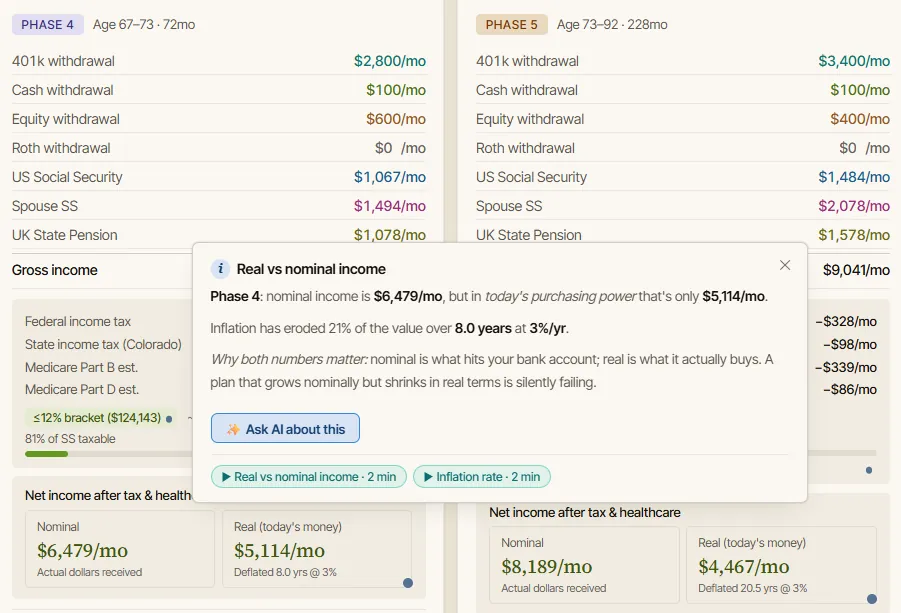
The assumptions that drive it are all yours to set on the Edit values tab: a general inflation rate (default 3%), a separate healthcare-inflation rate so medical premiums can climb faster than CPI, a Social Security COLA, and, for UK State Pension income, a Triple Lock rate, with matching cost-of-living settings for US, Canadian, and Australian pensions. Because reliable income grows by its own COLA while flat withdrawals do not, the phase cards let you see purchasing power diverge across the timeline. The Scenarios tab lays out real net income by phase so a later phase that looks fine in dollars but thin in real terms stands out, and the Stress test can raise the inflation assumption (on its own or alongside lower returns) to show which phase weakens first. The planner also compares your average real income against your income-floor goal, so an erosion below essentials is flagged rather than buried. Because it is one connected model, nudging an inflation rate or a COLA updates the real figures, the ending balances, and the plan-health view together, so you can see whether later phases stay livable.
Questions to Ask About Inflation
For each phase, a short checklist keeps inflation connected to the plan:
- What is the nominal monthly income, and what is the real monthly income?
- Does real income stay above the essential floor?
- Which income sources adjust with inflation, and which are fixed?
- Are healthcare costs assumed to rise faster than general inflation?
- What happens if inflation runs higher than expected, or returns run lower at the same time?
- Does the plan still work if it is extended by five or ten years, and is any real-income decline intentional?
FAQ
What is the difference between nominal and real retirement income?
Nominal income is the dollar figure a plan shows for a future year. Real income adjusts that figure for inflation so it is expressed in today's purchasing power. They answer different questions: nominal tells you how many dollars arrive, real tells you what those dollars are worth compared with now. A plan can show rising nominal income and falling real income at the same time, which is why both belong on screen.
How much does inflation really matter over a retirement?
More than most people expect, because it compounds. At roughly 3% a year, prices about double over 24 years, so a lifestyle that costs $4,000 a month today could cost far more late in a long retirement. The longer the plan needs to last, the more inflation matters, which is why longevity and inflation are closely linked and why inflation-adjusted reliable income is valuable.
Does Social Security keep up with inflation?
Social Security includes a cost-of-living adjustment, which makes it behave very differently from a level pension and gives it real value as part of an inflation-protected income floor. It does not guarantee that every retiree's personal costs are fully covered, and the assumed COLA in a plan should be cautious and reviewed periodically, but a benefit that adjusts over time helps protect later-life income, especially for retirees with little other inflation-linked income.
Is it a problem if my real income falls later in retirement?
Not necessarily. Some retirees intentionally spend more early, while they are active, and less later. If essential expenses stay covered, healthcare is protected, and the decline is understood and chosen, a falling real income can be part of a sound plan. The real risk is an unnoticed decline, where later phases weaken while the nominal figure keeps rising and hides it, which is exactly what reviewing real income phase by phase prevents.
Where can I get the full framework?
This series summarizes it, but the complete step-by-step framework is in the free companion eBook, Build a Retirement Plan You Can Question. You can download it here.
Source Links
- U.S. Bureau of Labor Statistics, Consumer Price Index: https://www.bls.gov/cpi/
- Social Security Administration, Cost-of-Living Adjustment (COLA): https://www.ssa.gov/cola/
- Consumer Financial Protection Bureau, Planning for Retirement: https://www.consumerfinance.gov/consumer-tools/retirement/
- Investor.gov, Inflation and the time value of money: https://www.investor.gov/financial-tools-calculators/calculators/inflation-calculator
- AI Retirement Income Planner: https://airetirementincomeplanner.com/
Educational Disclaimer
This article is for general education only. It is not financial, tax, investment, legal, healthcare, Social Security, Medicare, or retirement advice. Inflation rates, COLAs, and personal costs change, and any projection depends on assumptions that may not hold. Verify important numbers and rules with official sources such as the Bureau of Labor Statistics and the Social Security Administration and a qualified professional before acting.