
Quick Answer
Two retirees can have the exact same gross income and keep very different amounts of it. Two plans can withdraw the same total over a full retirement and pay very different lifetime tax, purely because of when and from where the money was taken. That is the whole point of this article: taxes are not a year-end surprise to be tidied up later. They are part of the income plan itself.
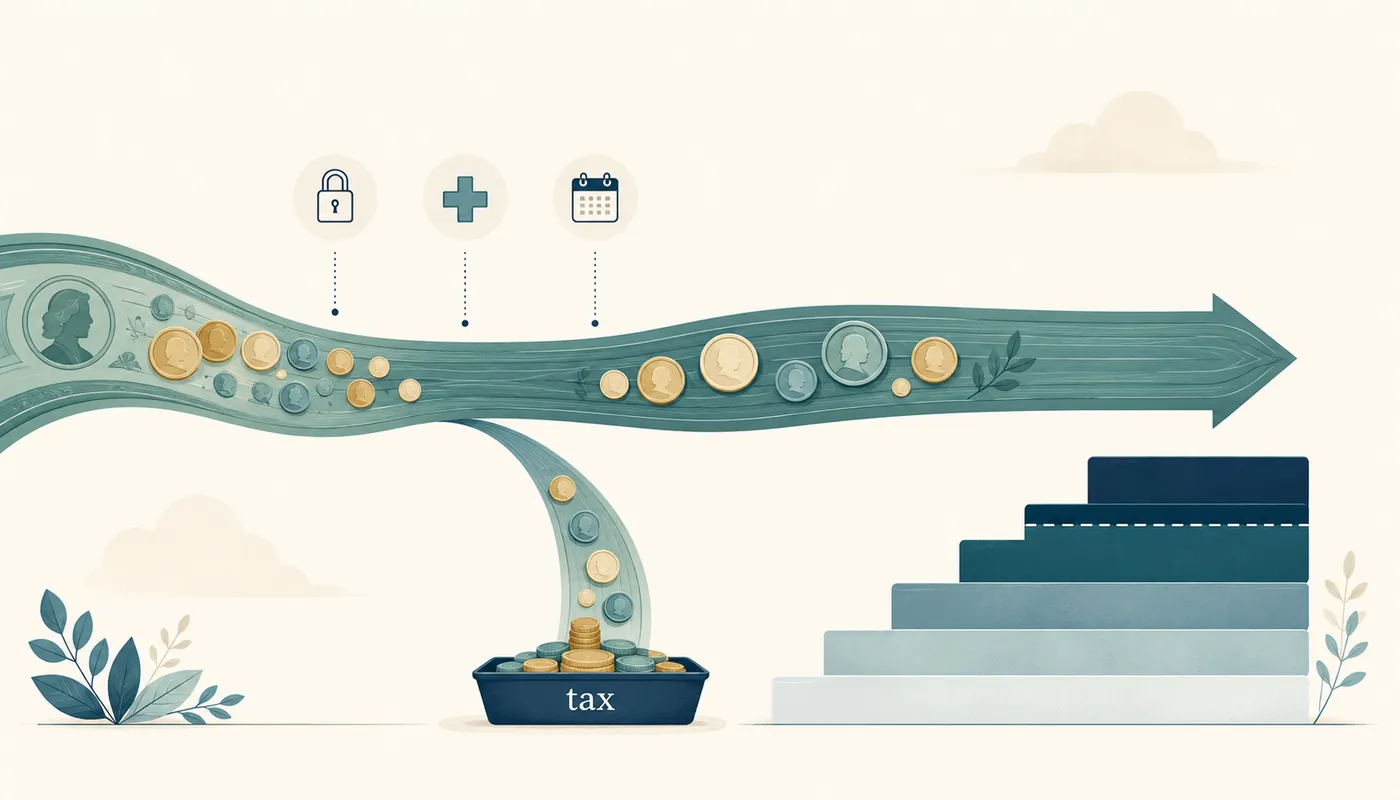
A withdrawal is never only a withdrawal. It may be taxable income. It may push more of your Social Security into the taxable range — and so, surprisingly, can interest that is itself tax-free, which is the municipal bond trap. It may lift the income figure that decides your healthcare costs. It may shrink or swell a future required withdrawal. The goal is not to pay the least possible tax every single year, which is rarely the strongest plan. The goal is to understand when tax is paid, why, and whether the timing supports everything else. Federal tax is only the first layer, too: state taxes in retirement sit on top of all of this and vary enormously by where you file, and the rates behind any of it go stale, so it is worth knowing how to update the tax rates in a plan.
This is the fifth article in our framework series drawn from the free companion eBook. The previous one covered the ending balance that carries the plan forward, and it ended by pointing here, because taxes often decide how much of that balance is truly spendable.
📘 Free companion eBook: this series is drawn from Build a Retirement Plan You Can Question. Get the full framework free.
Key Takeaways
- Cash flow is not taxable income. The money you spend and the amount you are taxed on are related but different, because different sources are taxed differently.
- Account type sets the tax result. A dollar from a traditional 401(k), a Roth, cash, or a brokerage account has a completely different tax footprint, so the same spending can produce very different bills.
- Timing is a lever. Low-income years, often the gap between leaving work and starting Social Security or RMDs, can be used on purpose rather than left idle.
- Taxes interact. One withdrawal can raise your bracket, tax more of your Social Security, and change your healthcare costs at the same time, so the true cost can exceed the tax alone.
- RMDs arrive on a schedule. A traditional account left untouched keeps growing, and the required distributions that start at 73 (75 if you were born in 1960 or later) can force taxable income whether you need the cash or not.
- The lowest-tax plan is not automatically the best plan. Tax efficiency is one input among spendable income, flexibility, healthcare, and peace of mind.
Cash Flow Is Not the Same as Taxable Income
The first idea to hold on to is that the money you spend and the money you are taxed on are two different numbers.
Cash flow is what lands in your account to spend. Taxable income is the figure used to calculate your tax. Imagine a retiree who spends $5,000 in a month by combining $2,000 of Social Security, $1,500 from a traditional IRA, $1,000 from cash savings, and $500 from a brokerage sale. The cash flow is a clean $5,000. The taxable income is nothing like it. The cash withdrawal adds no taxable income because it is already after-tax money. The brokerage sale is taxable only on its gain portion, not the whole $500. The IRA withdrawal is usually fully taxable as ordinary income. And the Social Security is only partly taxable, depending on everything else.
A plan that looks only at cash flow misses all of this. A tax-aware plan asks a longer question: how much spending do I need, which source provides it, how much taxable income does that source create, and what thresholds does that taxable income then touch.
Account Type Sets the Tax Result
Because the source matters so much, the account mix behind your balance largely decides your tax bill. The same total can behave in opposite ways:
- Traditional 401(k) / IRA: usually pre-tax, so withdrawals are taxed as ordinary income and they feed required minimum distributions later.
- Roth: qualified withdrawals are generally tax-free, invisible to the income measures that drive healthcare costs, and free of RMDs, which makes Roth money most valuable in the years you most need to control income.
- Cash: already after-tax, so spending it usually adds no taxable income, though interest earned is taxable.
- Taxable brokerage: mixed, because only the gain is taxed on a sale, and the type of gain matters.
A retiree with $500,000 entirely in a traditional IRA is in a very different tax position from one with $500,000 split across traditional, Roth, cash, and brokerage. Same balance, very different after-tax flexibility, which is exactly why the order you withdraw from your accounts is a genuine planning decision rather than an accident of habit.
Timing Is a Lever: The Low-Income Years
Many retirees have a stretch of unusually low taxable income after leaving work but before Social Security, pensions, or RMDs begin. On the surface that looks ideal, because low income means low current tax. It can also be a wasted opportunity.
Picture a retiree who leaves at 62 with enough cash to fund a year of spending and a large traditional IRA sitting untouched. Do nothing and that IRA keeps growing until the required distributions start, at which point the forced withdrawals may create more taxable income than they ever wanted. So a better question than how do I pay the least tax this year is: does this year offer a useful chance to control tax across the whole retirement timeline? Sometimes the answer is to reduce income now. Sometimes it is to deliberately accept a little tax now, by taking an extra traditional withdrawal or converting some to Roth, to defuse a bigger bill later. The low-income year should be reviewed, not ignored.
Bracket Space, Marginal Rate, and Effective Rate
The federal system uses a standard deduction and then taxes income in layers. Not every dollar is taxed at the same rate. Being "in the 12% bracket" does not mean all your income is taxed at 12%. It means your next dollar might be, depending on how much room is left before the top of that bracket. That room has a name worth knowing: bracket space, the amount of extra taxable income you can add before crossing into the next rate.
Two terms make this practical. Your marginal rate is the rate on the next dollar. Your effective rate is the average across all your income. A retiree can have a modest effective rate and still face a high marginal rate on the very next withdrawal, and that next withdrawal might also tax more of their Social Security or raise a healthcare cost. Retirement decisions are usually made at the margin, so the useful question is nearly always what happens if I add one more thousand dollars to this year rather than what is my average rate.
The Social Security Interaction
Social Security is not a fixed island. How much of it is taxed depends on your other income, which means an ordinary withdrawal can do two jobs at once: it is taxable itself, and it can push more of your Social Security into the taxable range. That interaction can make the real tax cost of a withdrawal higher than the sticker rate suggests.
For some households the effect is small. For others it is significant, particularly where a modest extra withdrawal drags a chunk of previously untaxed Social Security into tax. The planning move is not to fear withdrawals, but to measure how each one affects the full calculation, Social Security included. This interaction also matters when a spouse dies and the survivor moves to single brackets, one of the pressures behind the widow's tax cliff.
RMDs: The Bill That Arrives on a Schedule
Required minimum distributions are mandatory withdrawals from certain pre-tax accounts once you reach the applicable age: 73 for people born from 1951 to 1959, and 75 for anyone born in 1960 or later. They can create taxable income whether or not you need the cash.
Here is the trap. A traditional account left untouched for years is often celebrated because the balance keeps growing. That growth can also build a larger forced withdrawal later, and large RMDs ripple outward into federal tax, the taxable share of Social Security, and Medicare surcharges. None of this means traditional accounts should always be drained early. It means the RMD phase should be looked at before it arrives. The single most useful question is: if I do nothing now, what does the RMD phase look like later? If the answer is future tax pressure, earlier withdrawals or Roth conversions become worth testing.
Roth Conversions: How Much, Which Years, at What Cost
A Roth conversion moves money from a pre-tax account into a Roth. The converted amount is generally taxable in the year you convert, and future qualified Roth withdrawals are generally tax-free. The purpose is never to dodge tax in the conversion year. It is to decide whether paying some tax now buys a better after-tax plan later.
A conversion tends to help when current taxable income is low, future RMDs look large, there is room in a lower bracket, or a surviving spouse may later face higher single-filer rates. It tends to hurt when it pushes income into a high bracket, inflates healthcare costs before or after 65, or when there is no spare cash to pay the tax. So the honest question is not are Roth conversions good or bad. It is how much, in which years, and at what tax cost, and the same conversion can be sensible in one phase and unhelpful in the next.
Taxes and Healthcare Are Linked
One more reason a withdrawal can cost more than its tax: healthcare. Before Medicare, extra income can raise your ACA premiums and reduce cost-sharing help. After 65, it can trigger IRMAA surcharges on Medicare. An additional traditional IRA withdrawal might increase your taxable income, your federal tax, and the income figure that healthcare programs read, so the same dollars can be taxed once and surcharged again. That combination is important enough to be the subject of the next article in this series, on how healthcare costs move with income. For a head start, our guide to a retirement calculator that models taxes and healthcare together shows why the two belong in one view. For now, the point is simply that taxes and healthcare should be reviewed together, not in separate rooms.
Tax Efficiency Is Not the Only Goal
It is worth saying plainly: the lowest-tax plan is not automatically the strongest plan. A retiree who refuses a withdrawal purely to avoid tax may live with needless financial stress. One who hoards Roth money for tax reasons may burn through cash too fast. One who delays all income to stay in a low bracket may build a future RMD problem. Tax efficiency matters, but it sits alongside spendable income, future balances, healthcare cost, inflation protection, flexibility, estate goals, and peace of mind. The stronger plan is the one that supports your actual goals with the trade-offs in plain view.
How the Planner Shows Taxes
The AI Retirement Income Planner treats tax as part of the income calculation, not a separate report. Every phase card on the Overview tab shows that phase's estimated tax and net income next to its gross withdrawals, and it displays the inflation-adjusted tax brackets, deductions, and thresholds used for that phase, so you can see the tax being applied where the income is earned. Many cards also surface a small bracket headroom note, telling you roughly how much more income fits before you cross from the 12% band into the 22% band, which turns "bracket space" from an abstract idea into a number for your plan.
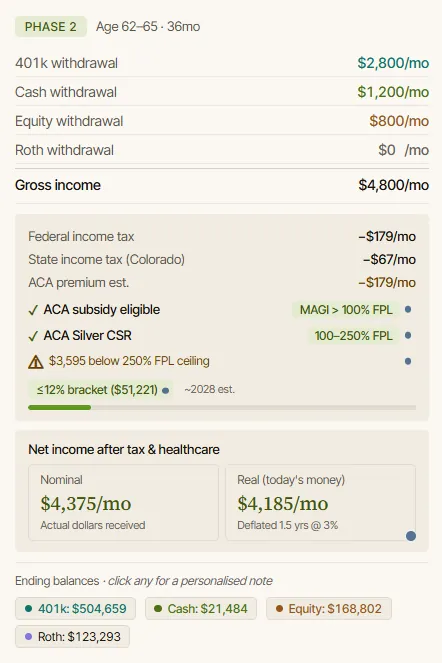
The dedicated Tax & ACA tab is the reference desk. A jump-to-topic list walks through exactly how each calculation runs: tax brackets (10/12/22/24%, configurable and inflated forward to each phase), the standard deduction, IRMAA and ACA thresholds, and the Social Security provisional-income rule the planner uses (broadly, below about $25k of provisional income none of the benefit is taxed, between roughly $25k and $34k up to half is, and above that up to 85% is). You do not have to take these on faith, because the tab spells out the mechanism behind every figure on your cards.
Two features make the tax timeline actionable. In the Edit values tab, each phase has its own Roth conversion field, so you can model converting a set amount per year and immediately see the tax it adds now against the pre-tax balance and future RMD it removes later; plans built in the companion Roth Conversion Optimizer import straight in. And a configurable RMD start age (73 by default, or 75 if you were born in 1960 or later) drives an RMD estimate on the relevant phases. On the Confidence tab, the Plan Health Score runs a Tax Bracket Efficiency check that flags any phase pushing taxable income across the 22% ceiling, and especially past the 32% line above $200k, with a plain suggestion to smooth income across phases or use Roth conversions in the lower-income years. Because the whole thing is one connected model, raising a withdrawal shows the extra income, the extra tax, any healthcare knock-on, and the lower ending balance together, so you weigh the full trade rather than one side of it.
Questions to Ask About Taxes in Each Phase
For every phase, a short checklist turns tax from a surprise into an input:
- What is my gross income, and what part of it is actually taxable?
- Which account types am I drawing from, and am I using low-bracket space efficiently?
- Am I pushing income into a higher bracket than I need to?
- Does this phase change my ACA or IRMAA costs?
- Does it increase the taxable portion of my Social Security?
- Does it reduce future RMD pressure, and does it keep enough Roth and cash flexibility in reserve?
You do not need perfect answers. You need the numbers laid out phase by phase and by account, so the choice between paying tax now and paying it later is one you make on purpose.
FAQ
What is the difference between cash flow and taxable income in retirement?
Cash flow is the money you actually have to spend. Taxable income is the figure your tax is calculated on. They differ because sources are taxed differently: cash withdrawals add no taxable income, Roth withdrawals are generally tax-free, traditional 401(k)/IRA withdrawals are usually fully taxable, brokerage sales are taxable only on the gain, and Social Security is partly taxable depending on your other income. Two retirees with identical spending can therefore have very different taxable income.
At what age do required minimum distributions start?
RMDs from traditional pre-tax accounts begin at 73 for people born from 1951 to 1959, and at 75 for anyone born in 1960 or later. They are mandatory whether or not you need the money, and a large untouched traditional balance can produce a bigger forced withdrawal, which is why the RMD phase is worth reviewing years before it starts. The planner sets the RMD start age from your birth year, or uses the age you enter, and estimates the required amount on the affected phases.
Are Roth conversions always a good idea?
No. A Roth conversion is taxable in the year you convert, so it helps most when current income is low, future RMDs look large, there is room in a lower bracket, or a surviving spouse may later face higher rates. It can backfire if it pushes you into a high bracket, raises ACA or IRMAA healthcare costs, or if you lack the cash to pay the tax. The useful question is how much to convert, in which years, and at what cost, which is something to test across the whole timeline rather than decide once.
How much of my Social Security is taxable?
It depends on your provisional income, which is broadly your other income plus part-time earnings plus half of your Social Security. As a rough guide used in the planner, below about $25k of provisional income none of the benefit is taxed, between roughly $25k and $34k up to half becomes taxable, and above that up to 85% can be. Because other withdrawals raise provisional income, they can increase the taxed share of your Social Security, which is why it should be measured rather than assumed.
Where can I get the full framework?
This series summarizes it, but the complete step-by-step framework is in the free companion eBook, Build a Retirement Plan You Can Question. You can download it here.
Source Links
- IRS, Retirement Topics, Required Minimum Distributions (RMDs): https://www.irs.gov/retirement-plans/retirement-topics-required-minimum-distributions-rmds
- IRS, Roth IRAs: https://www.irs.gov/retirement-plans/roth-iras
- IRS, Topic No. 751 and Social Security benefit taxation overview: https://www.ssa.gov/benefits/retirement/planner/taxes.html
- IRS, Tax Withholding and Estimated Tax (Publication 505): https://www.irs.gov/forms-pubs/about-publication-505
- Consumer Financial Protection Bureau, Planning for Retirement: https://www.consumerfinance.gov/consumer-tools/retirement/
- AI Retirement Income Planner: https://airetirementincomeplanner.com/
Educational Disclaimer
This article is for general education only. It is not financial, tax, investment, legal, healthcare, Social Security, Medicare, estate, or retirement advice. Tax rules, thresholds, and personal circumstances change, and any projection depends on assumptions that may not hold. Verify important numbers and rules with official sources such as the IRS and a qualified professional before acting.