
Quick Answer
A good retirement plan is one you can question, and the quality of a review depends on the quality of the questions. Broad questions like "am I okay?" produce vague answers. Specific questions, ones that point at a phase, an account, a threshold, or a single assumption, produce answers you can act on. This article is a structured checklist of more than fifty such questions, grouped into the same themes the framework uses: timeline, income, income floor, real income, ending balances, taxes, healthcare, Medicare, account order, Social Security, Roth conversions, withdrawal strategy, stress tests, and annual review.
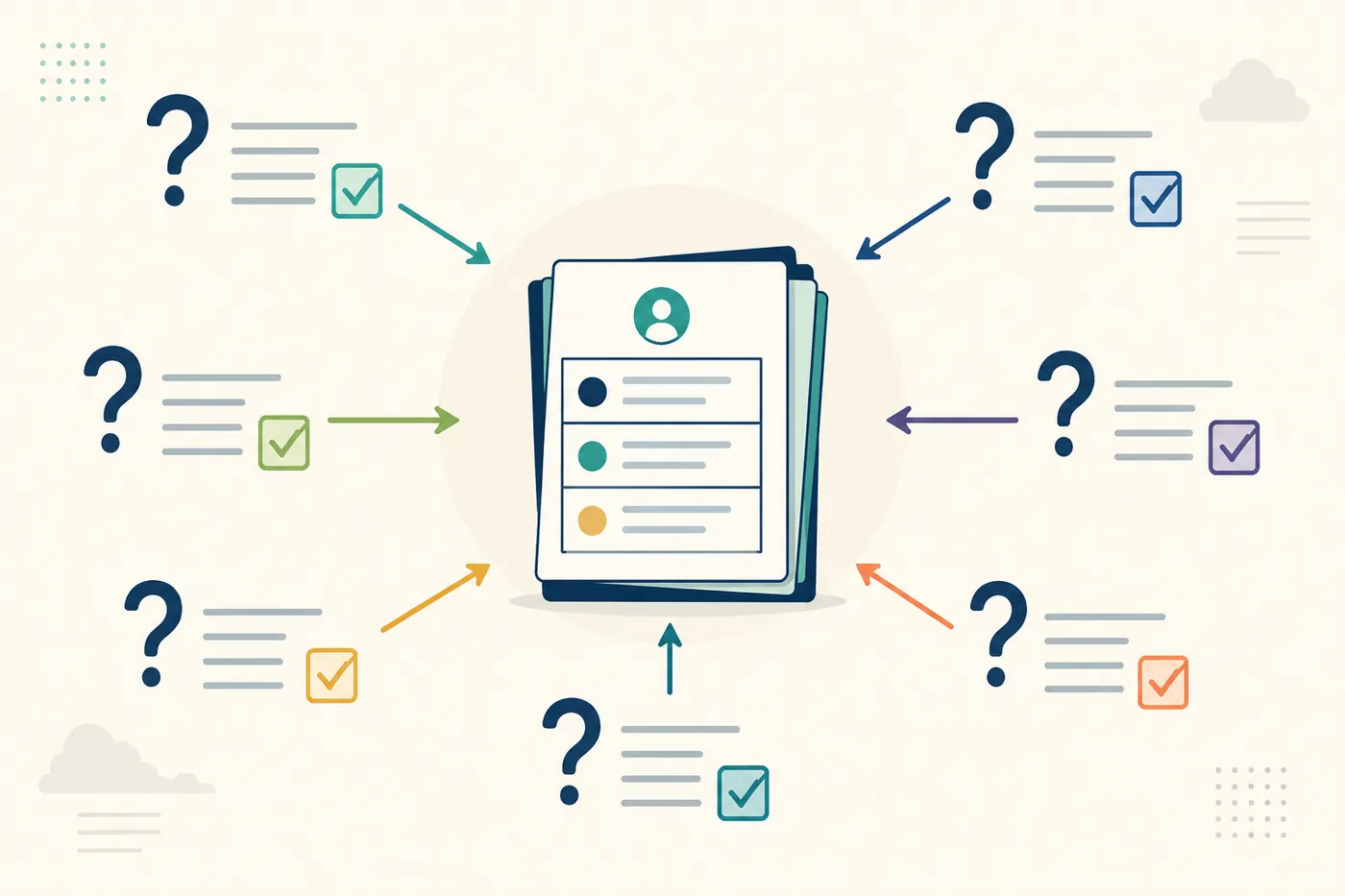
Use them however you plan. Run them against your own model, work through them with the companion planner, or take the ones that apply to you into a conversation with a financial, tax, or retirement professional. You do not need to answer all of them. A handful of the right questions, aimed at your weakest phase, is worth more than a long list you skim.
This is a companion resource to our framework series drawn from the free companion eBook, and it pairs naturally with the worked case study, which shows these questions being asked one at a time about a single plan.
📘 Free companion eBook: this series is drawn from Build a Retirement Plan You Can Question. Get the full framework free.
Key Takeaways
- Specific beats broad. Name a phase, an account, a threshold, or an assumption, and the answer becomes actionable.
- Ask by theme, not at random. Timeline, income, taxes, healthcare, and durability each deserve their own pass.
- Focus on the weakest phase first. Most plans improve fastest when you aim your best questions at the phase under the most pressure.
- Judge trade-offs, not single numbers. The best questions compare the whole plan across two versions, not one figure in isolation.
- Turn questions into saved scenarios. A question worth asking is usually worth testing as a separate version you can compare.
How to Use This List
Work in themes rather than reading top to bottom. Start where your plan feels least settled, ask the two or three questions in that section that actually apply to you, and if a question does not have a clear answer, that is the signal to test it as a scenario. The best questions share a shape: they name something specific, and they ask about a trade-off rather than a verdict. "Would a $10,000 Roth conversion at 66 push me into IRMAA?" is answerable. "Should I do Roth conversions?" is not.
Timeline Questions
Retirement is easier to review as a timeline of phases, so start by mapping when things change.
- What are the main phases of my retirement, and which one begins when I retire?
- Which phase begins when Social Security starts, when Medicare starts, and when required minimum distributions start?
- Which phase has the most moving parts?
- Which phase is most sensitive to taxes, and which to healthcare cost?
- Which phase depends most heavily on portfolio withdrawals?
Income Questions
- Does each phase produce enough net monthly income for my expected lifestyle?
- Which phase has the lowest net income, and which has the highest?
- Is my income front-loaded, back-loaded, or steady, and does that match how I want to live?
- How much of my income is reliable, and how much depends on flexible withdrawals?
- Which income sources begin later, and which stop or change later?
If you are not sure which box a pension, an annuity, or a part-time paycheck belongs in, where to enter each type of retirement income walks through it.
Income Floor Questions
Your income floor is the essential spending that must be covered no matter what, so separate it from the total.
- What is my essential monthly spending, and how much of it is covered by Social Security, pensions, or other reliable income?
- How much of the floor depends on portfolio withdrawals?
- Does the floor stay covered after inflation, and if investment returns come in lower?
- Would delaying or claiming Social Security earlier strengthen the floor?
- Which discretionary expenses could I cut if I had to?
Real Income and Inflation Questions
- What is my real monthly income in each phase, and does it fall later in retirement?
- If real income declines later, is that decline intentional or accidental?
- Does real income stay above my essential spending floor across the whole plan?
- Which income sources adjust with inflation, and which are fixed?
- What happens if inflation runs one point higher than expected, or if inflation is higher and returns are lower at the same time?
- Does the plan still hold if I extend it to 90, 95, or 100?
Ending Balance Questions
The ending balance of each phase becomes the starting balance of the next, so watch it phase by phase.
- What is the ending balance in each phase, and which phase has the weakest one?
- Does each ending balance comfortably support the next phase?
- Is any portfolio decline intentional, or an accidental drawdown?
- Am I leaving too little for later retirement, or more than needed because spending is too cautious?
- What account types make up the ending balance, and how much of it is pre-tax versus Roth, cash, or taxable brokerage?
Tax Questions
- What is my taxable income in each phase, and which phase has the highest?
- Which phases have unused low tax-bracket space, and am I staying within my target bracket?
- Does Social Security taxation change the effective cost of a withdrawal?
- Would earlier traditional withdrawals reduce future RMD pressure?
- Am I minimizing this year's tax in a way that creates a bigger tax bill later?
- Are my tax values current and verified?
Healthcare Questions Before Medicare
Before 65, income drives the cost of ACA coverage, so MAGI becomes a planning lever.
- Will I use ACA marketplace coverage before Medicare, and what is my expected MAGI during those years?
- Am I trying to preserve premium tax credits or cost-sharing reductions, and which withdrawals raise my MAGI?
- Could cash, Roth, or brokerage withdrawals reduce MAGI pressure?
- Would part-time work or a Roth conversion create an ACA problem?
- What happens if premiums come in higher than I assumed, and have I checked actual plan options and networks?
Medicare and IRMAA Questions
- When does Medicare begin, and what premiums and supplemental costs should I include?
- Am I close to an IRMAA threshold in any phase?
- Could a Roth conversion, large capital gain, or big withdrawal trigger IRMAA?
- Will future RMDs push me into Medicare premium surcharges?
- Would spreading income across years help, and is crossing a threshold ever worth it for the benefit of the transaction?
Account Order Questions
- Which account should fund the early-retirement bridge before Social Security?
- Should cash be used before taxable withdrawals, and should Roth be preserved for later flexibility?
- Should traditional accounts be drawn earlier to reduce future RMD pressure?
- How much cash should stay as a reserve, and does my withdrawal order support ACA and IRMAA planning?
Social Security Questions
- What happens to the whole plan if I claim Social Security at 62, at full retirement age, or delay to 70?
- How much portfolio withdrawal does delaying require, and does delaying improve later real income?
- Does claiming earlier protect the portfolio, and how does timing affect my taxes?
- How does my claiming choice affect a spouse or survivor, and does health or life expectancy change the decision?
- Which claiming age fits the full plan best, not just the biggest monthly check?
Roth Conversion Questions
- Do I have low-income years before RMDs begin, and how much bracket space is available for conversions?
- Would conversions affect ACA costs before 65 or IRMAA after, and is there cash available to pay the tax?
- Would small annual conversions work better than one large conversion, and which phase is best for them?
- How much future RMD pressure does a given conversion reduce, and what should I verify before converting?
Withdrawal Strategy Questions
There is no single best rule, so compare strategies by fit rather than by the highest number.
- Which withdrawal strategy best fits this plan, and how does my current plan compare with the 4% rule?
- Would variable percentage withdrawals fit my spending flexibility, or would guardrails help me manage market risk?
- Would a bucket strategy make the plan easier to actually follow?
- Should essential and discretionary spending use different strategies?
- Would I really stick to this strategy during a bad market?
Stress Test Questions
- What happens if returns are lower, inflation is higher, or healthcare costs rise faster than expected?
- What happens if I live longer than planned, or a large one-time expense lands?
- What happens if part-time income stops, or currency rates move against me?
- Which phase fails first under stress, and which single change improves resilience the most?
AI Chat Questions
If you use the planner's optional AI review, start broad, then narrow. A useful first prompt is deliberately open:
Summarize this plan and flag the main risks.
Then follow up with sharper, plan-aware questions, the same ones you would ask a human reviewer:
- Which phase is weakest, and why? Which assumption has the biggest effect on this plan?
- Am I using low tax-bracket space efficiently, and could any withdrawals affect ACA costs or push me toward IRMAA?
- Would Roth conversions help before RMDs begin, and which withdrawal strategy fits this plan best?
- Suggest one conservative improvement and one income-improving change, then tell me what could go wrong with each.
- Which values should I verify before relying on this result?
The point is to ask better questions and review the answers yourself rather than accept them. Save your baseline before applying anything, and apply only the changes you understand and agree with.
Annual Review Questions
Once a year, and after any major life event, refresh the plan and ask what has changed.
- What changed since the last version, and are balances, tax values, and healthcare values updated?
- Are my spending and inflation assumptions still realistic?
- Has my Social Security, pension, retirement date, or risk tolerance changed?
- Which scenario should become the new baseline?
If you are already retired, the annual retirement plan review checklist turns these four questions into a full pass over balances, spending, income, withdrawals, taxes, healthcare, RMDs, cash, debt, and survivor planning.
How the Planner Helps You Ask These
The AI Retirement Income Planner is built so that most of these questions have somewhere to land. The Overview tab answers the income, real-income, and ending-balance questions phase by phase. The Confidence tab runs a Plan Health review that flags the tax, healthcare, income-floor, and survivor questions automatically. The Drawdown tab compares withdrawal strategies. The Scenarios and Stress test tools answer the durability questions, and Saved plans lets you turn any question into a separate version to compare. If you add your own Claude API key, the optional AI Chat tab turns the review questions above into one-click starter prompts, and every flagged check carries an "Ask AI about this" button that pre-writes a plan-aware question for you.
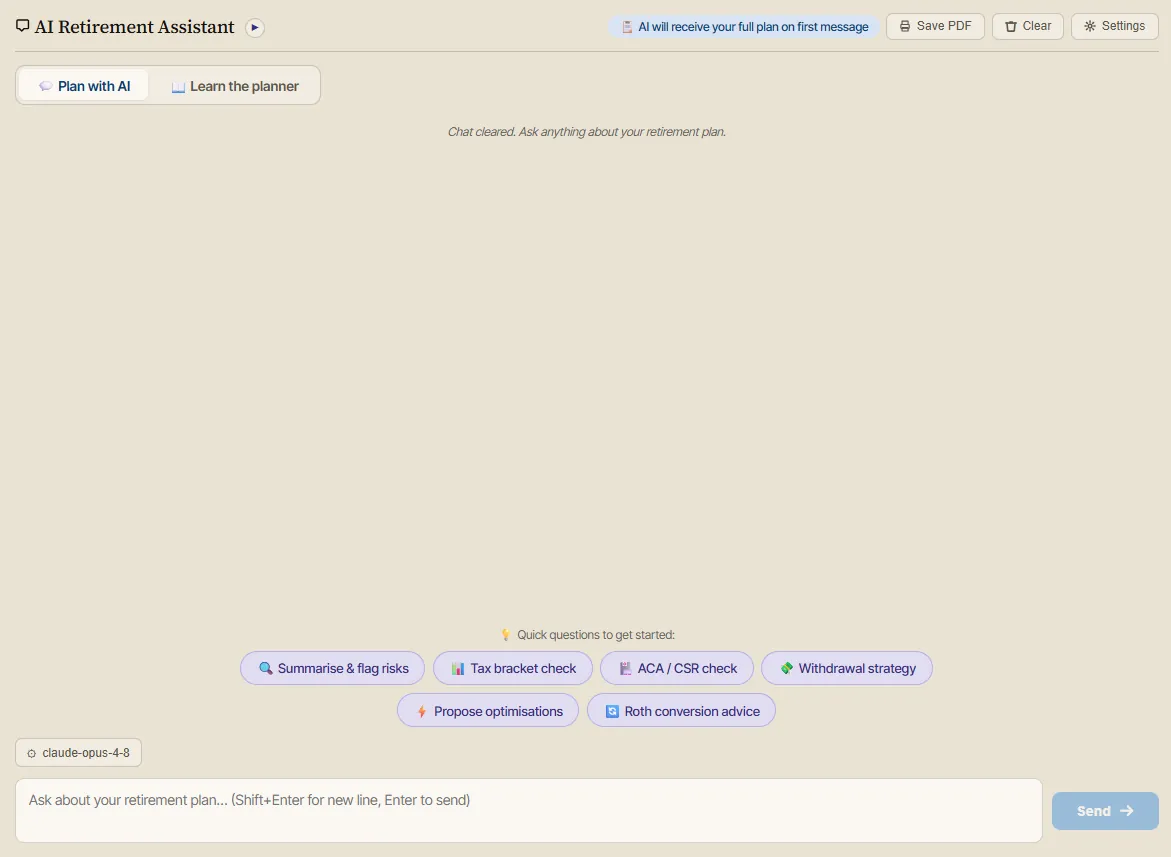
None of this decides anything for you. It gives your questions a structured place to be answered, which is the whole point of a plan you can question. For a full walkthrough of these questions applied to one plan from start to finish, read the retirement plan case study.
FAQ
What makes a good question to ask a retirement plan?
Specificity. A good question names a phase, an account, a threshold, or a single assumption, and it asks about a trade-off rather than a yes-or-no verdict. "Would a modest Roth conversion from 65 to 73 reduce my future RMD pressure without pushing me into IRMAA?" is answerable and useful. "Should I do Roth conversions?" is neither. When a question is specific, you can test it, see the effect on the whole plan, and decide, which is what turns a plan into something you can actually improve.
Do I need to answer all fifty-plus questions?
No. This is a menu, not a test. Most plans have one or two phases under the most pressure, and aiming a handful of the right questions at those phases is far more valuable than skimming the whole list. Start where your plan feels least settled, ask the questions in that theme that apply to your situation, and treat any question without a clear answer as a prompt to test a scenario. A short, focused review beats a long, shallow one.
Can I use these questions with a financial or tax professional?
Yes, and they work well for that. Bringing specific, organized questions to a professional makes the conversation far more productive than arriving with "am I going to be okay?" The more you have already structured your plan by phase and identified your weakest points, the more a qualified planner, CPA, or tax adviser can focus on verifying assumptions and applying the rules to your exact situation rather than starting from scratch.
How do these questions relate to the planner's Plan Health check?
They overlap on purpose. The Confidence tab's Plan Health review automatically checks many of the themes here, income adequacy, tax-bracket position, ACA and IRMAA exposure, portfolio survival, income floor, and survivor resilience, and flags the ones that need attention. This list goes broader, covering timeline, account order, Social Security timing, Roth conversions, and annual review, and it gives you the wording to follow up on any check the planner raises, including through the optional AI review.
Where can I get the full framework?
This checklist is drawn from the appendix of the free companion eBook, Build a Retirement Plan You Can Question, which also includes the full input checklist and the complete framework the question list supports. You can download it here.
Source Links
- Consumer Financial Protection Bureau, Planning for Retirement: https://www.consumerfinance.gov/consumer-tools/retirement/
- Investor.gov, Retirement Toolkit: https://www.investor.gov/additional-resources/retirement-toolkit
- Social Security Administration, Retirement Benefits: https://www.ssa.gov/benefits/retirement/
- Medicare.gov, Costs: https://www.medicare.gov/basics/costs/medicare-costs
- AI Retirement Income Planner: https://airetirementincomeplanner.com/
Educational Disclaimer
This article is for general education only. It is not financial, tax, investment, legal, healthcare, Social Security, Medicare, or retirement advice. It is a list of review questions, not answers, and the right answer for you depends on your own circumstances and assumptions. Verify important numbers and rules with official sources and a qualified professional before acting.