
Quick Answer
Every retirement income plan needs a withdrawal strategy. It does not have to be complicated or perfect, but it should be intentional, because without one, withdrawals turn reactive: more when the portfolio looks strong, less only after a loss, or nothing at all out of fear. A strategy gives the plan a starting rule and a way to adjust.

There is no single rule that fits everyone. The right approach depends on your income sources, account mix, risk tolerance, tax and healthcare situation, life expectancy, spending flexibility, and temperament. This article walks through the main strategies, the 4% rule, variable percentage withdrawal, guardrails, buckets, and floor-and-upside, and, just as importantly, how to compare them without simply picking the one that pays the most.
This is the ninth article in our framework series drawn from the free companion eBook. The previous one covered checking your plan from several angles, the review that tells you whether a chosen withdrawal level is actually sustainable.
📘 Free companion eBook: this series is drawn from Build a Retirement Plan You Can Question. Get the full framework free.
Key Takeaways
- A strategy beats improvising. Any intentional rule with a way to adjust beats reacting to each market move.
- The 4% rule is a reference point, not a plan. It is a useful benchmark, but it knows nothing about your taxes, Social Security timing, or healthcare.
- Flexible strategies trade stability for resilience. VPW and percentage-of-portfolio adjust to the market, which protects the portfolio but makes income vary.
- Guardrails are a middle path. They keep spending steady between boundaries and only adjust when markets move far enough to matter.
- Buckets and floor-and-upside organize the money. They give each part of the portfolio a job and separate essential income from discretionary spending.
- Read a comparison by fit, not by size. The strongest strategy is the one that fits your plan and your temperament, not the one with the highest headline income.
Why You Need a Strategy at All
In working years, income comes from a paycheck and spending is shaped by a budget. In retirement, income can arrive from many sources at once, Social Security, pensions, traditional and Roth accounts, cash, brokerage, annuities, rental income, part-time work, and you have to decide how much to draw from the flexible assets and when. That single decision ripples into taxes, healthcare costs, future balances, and long-term risk.
A withdrawal strategy does not remove uncertainty. Markets, inflation, tax rules, and personal needs all still change. What it gives you is a starting rule and a disciplined way to adjust, so the plan responds to conditions instead of to emotions.
The 4% Rule: a Reference Point, Not a Plan
The 4% rule is the best-known guideline: withdraw 4% of the starting portfolio in year one, then raise that dollar amount with inflation each year. On a $500,000 portfolio that is $20,000 in the first year, about $1,667 a month before tax. Its appeal is simplicity: it ties spending to portfolio size, includes inflation, and is easy to understand.
Its limits come from the same simplicity. The 4% rule does not know your tax situation, whether Social Security starts in five years, whether you need ACA coverage before Medicare, or whether you mean to spend down by 85 or preserve assets to 100. It works best as a benchmark. If your planned withdrawals run far above 4%, that deserves an explanation (a pension covering essentials, a short horizon, a deliberate spend-down, or a level that is simply too aggressive). If they run well below, you may have room to spend more, retire earlier, or reduce risk. It is a comparison tool, not the plan itself, and our guide to how much you can safely spend puts it in context.
Variable Percentage Withdrawal (VPW)
VPW takes a different approach: instead of a fixed inflation-adjusted dollar amount, you withdraw a percentage of the current balance, and that percentage can rise as you age and your remaining horizon shortens. The result adapts naturally to both age and market performance. If the portfolio does well, withdrawals rise; if it falls, they fall, which sharply reduces the risk of draining it too fast.
The strength is adaptability. A fixed strategy can hold spending steady even when the portfolio is under pressure, which feels comforting but can be risky if it stays too high too long. VPW responds instead. The weakness is the flip side: income varies, which is fine for discretionary spending but stressful if that money covers essentials. VPW fits retirees who accept that income is meant to move, and it works especially well layered on top of a reliable floor, funding travel and extras from investments while Social Security and pensions cover the basics.
Guardrails: a Middle Path
A guardrail strategy starts from a planned withdrawal and only adjusts when the portfolio drifts far enough from its expected path. If it performs well, spending can rise; if it performs poorly, spending is trimmed; between those boundaries, income stays relatively stable. That gives you a balance between fixed and fully variable withdrawals, without re-deciding your spending every year.
The real value is behavioral. During a strong market a retiree can be tempted to spend too freely; during a weak one, to panic and cut too deeply. Guardrails set the adjustment rules in advance, so responses are planned rather than emotional, for example, increasing spending after strong growth, freezing inflation raises after weak returns, or trimming the discretionary layer when the withdrawal rate climbs too high. We cover the mechanics in depth in our guide to retirement withdrawal guardrails.
The Bucket Strategy
The bucket strategy divides assets by time horizon or purpose. A simple version uses three: a cash bucket for short-term spending and downturn protection, a moderate bucket for medium-term needs, and a growth bucket for the long term and inflation protection. The point is to avoid selling growth investments during a bad market: if stocks fall, you draw from cash while the growth bucket recovers.
Its strength is clarity. It answers which money pays bills soon, which supports the next several years, and which is invested for later, and that can reduce anxiety during downturns because each part of the portfolio has a job. But buckets still need maintenance: cash must be replenished, investments rebalanced, withdrawals kept sustainable, and taxes and healthcare thresholds still apply. Buckets are a useful way to organize a portfolio, not a complete plan on their own.
Floor and Upside
The floor-and-upside strategy separates essential income from optional spending, which is powerful because the two do not share the same risk tolerance. The floor covers necessities, housing, food, utilities, insurance, healthcare, from reliable sources like Social Security, pensions, annuities, cash, or conservative withdrawals. The upside funds discretionary spending, travel, gifts, hobbies, from flexible assets like investments, brokerage, or Roth accounts.
To use it, list your essential expenses, then your reliable income, and compare the two. If reliable income covers essentials, the plan has a strong floor and the rest of the portfolio can be used flexibly. If it does not, the gap must be covered by the portfolio and deserves careful review, perhaps with more cash, part-time income, a delayed retirement, or a conservative withdrawal plan to shore up the floor. This maps directly onto the reliable-versus-flexible income distinction at the heart of a phase-based plan.
Match the Strategy to You
A withdrawal strategy has to be usable, not just mathematically acceptable, so it should fit three things at once. First, your temperament: someone who wants stable income may prefer fixed withdrawals or a strong floor, while someone comfortable adjusting may prefer VPW or guardrails, and an anxious investor may prefer buckets and a larger cash reserve. A strategy that looks good on paper but keeps you awake at night will fail in practice.
Second, your income sources: a retiree with strong Social Security and a pension has more freedom to use flexible or variable withdrawals for the rest, while one relying on investments for essentials needs a more conservative, structured approach. Third, your taxes and healthcare: a pure percentage strategy may fight with bracket management, a bucket strategy has to account for which account type holds each bucket, and both ACA thresholds before Medicare and IRMAA after can make the source of a withdrawal matter as much as the amount. The best strategies are usually layered, one rule for the essential floor, another for discretionary spending, with account selection driven by tax and healthcare timing.
How to Read a Comparison
When you compare strategies, the mistake is to look only at the highest income, because higher income usually carries higher risk. Instead, read across several dimensions at once: starting income, later income, real income after inflation, ending balance, portfolio survival, income variability, tax and healthcare impact, stress-test result, and fit with both essential spending and your personal comfort.
A lower-income strategy can be the stronger choice if it protects the plan, and a higher-income one can be perfectly acceptable if your spending is flexible and you understand the risk. The best comparison is never simply which strategy pays most. It is which strategy fits the plan.
How the Planner Compares Strategies
The AI Retirement Income Planner has a dedicated Drawdown tab built for exactly this comparison. It lets you switch between the main approaches, applied to your own plan rather than a generic example: a 4% Rule view (with an adjustable rate slider so you can test other percentages), Variable percentage (VPW), Three buckets, Floor and upside, Guardrails, and a Monte Carlo view. Each one reads your actual balances, income sources, and phase structure, so a strategy that sounds reasonable in the abstract is shown behaving the way it actually would once your taxes, healthcare, and income mix are included.
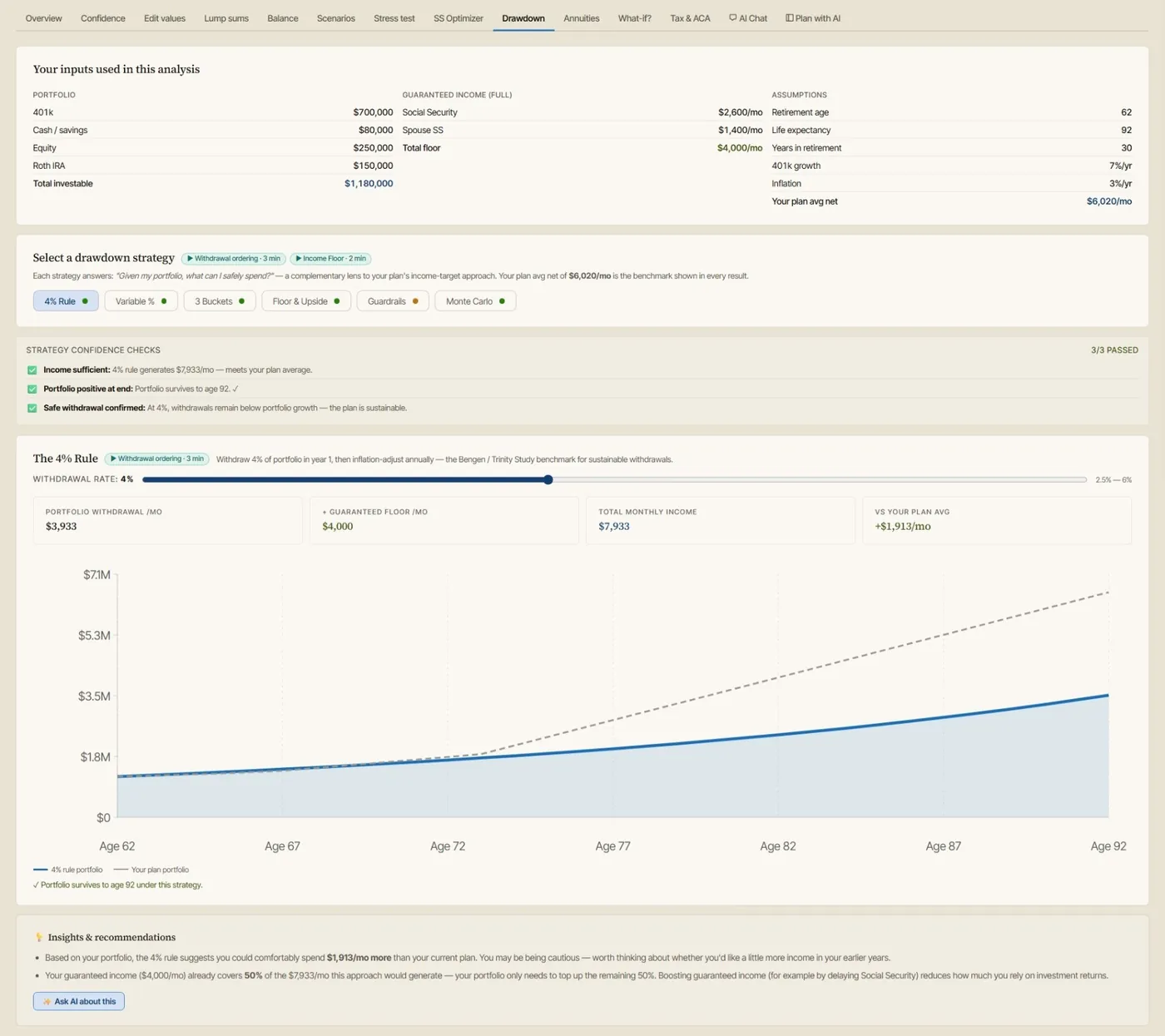
Each strategy view lays out its own plain-language insights, and a per-strategy "Ask AI about this drawdown strategy" button hands those points, with your real numbers, to the optional AI chat to expand on. The Monte Carlo view stress-tests a strategy across many return sequences rather than one smooth average, so you see how much it leans on good early markets. Because the whole thing runs on one connected model, you can compare approaches the way the last article suggested, by fit rather than by headline income, seeing each strategy's effect on real income, ending balance, and resilience side by side. Most strong plans end up combining methods anyway, a reliable floor, cash for near-term stability, guardrails or VPW for the discretionary layer, and the planner lets you see how those pieces behave together before you commit to them. Once you have compared them, the next article in this series is about asking better questions of the plan and reviewing it with AI. If you would rather push on a strategy than read about it, stress-testing a drawdown strategy walks through doing exactly that.
FAQ
Is the 4% rule still a good retirement withdrawal strategy?
The 4% rule is a useful benchmark rather than a complete strategy. It gives a simple, inflation-adjusted starting point tied to portfolio size, which is handy for a quick estimate or a sanity check. But it knows nothing about your taxes, when Social Security starts, whether you need ACA coverage before Medicare, or whether you plan to spend down or preserve assets. Use it to compare against your actual plan, not as the plan itself.
What is the difference between guardrails and VPW?
Both adjust spending to the market, but differently. VPW withdraws a percentage of the current balance every year, so income moves up and down continuously with the portfolio. Guardrails keep spending relatively steady between set boundaries and only adjust when the portfolio drifts far enough from its expected path. Guardrails tend to feel more stable year to year, while VPW is more continuously responsive. Which fits depends on how much income variability you are comfortable with.
What is a floor-and-upside strategy?
Floor-and-upside separates essential income from discretionary spending because they have different risk tolerances. The floor covers necessities like housing, food, and healthcare from reliable sources such as Social Security, pensions, annuities, and conservative withdrawals. The upside funds wants like travel and hobbies from flexible assets. The approach works well when you clearly know the difference between needs and wants, and it lets the discretionary layer flex with markets without threatening essentials.
Do I have to pick just one withdrawal strategy?
No, and many strong plans deliberately combine them. A common pattern is to cover essentials with a reliable floor, hold cash for near-term stability, use guardrails or VPW for discretionary spending from investments, and let tax and healthcare timing drive which account each withdrawal comes from. The practical question is what the main rule is for each layer of spending, and then to review the whole thing at least once a year as circumstances change.
Where can I get the full framework?
This series summarizes it, but the complete step-by-step framework is in the free companion eBook, Build a Retirement Plan You Can Question. You can download it here.
Source Links
- U.S. Securities and Exchange Commission, Investor.gov Retirement Toolkit: https://www.investor.gov/additional-resources/retirement-toolkit
- Consumer Financial Protection Bureau, Planning for Retirement: https://www.consumerfinance.gov/consumer-tools/retirement/
- FINRA, Retirement Income and Withdrawal Strategies: https://www.finra.org/investors/investing/investment-accounts/retirement-accounts
- AI Retirement Income Planner: https://airetirementincomeplanner.com/
Educational Disclaimer
This article is for general education only. It is not financial, tax, investment, legal, healthcare, Social Security, Medicare, or retirement advice. Withdrawal strategies carry risk, and any projection depends on assumptions that may not hold. Verify important numbers and decisions with official sources and a qualified professional before acting.