
Quick Answer
A retirement plan is not a document you finish and file away. It is a working model, built on what you know today: your current balances, retirement age, income sources, tax and healthcare assumptions, inflation estimate, return assumptions, and spending needs. Some of those inputs will change, and a plan stays useful only when it can be updated to match.

The goal is not to rebuild everything constantly. It is to review the most important inputs at regular intervals, save versions so you can see what changed, and occasionally re-anchor the whole plan to where you actually are now. This article lays out a practical annual-review habit, what to update first, and how the planner makes keeping a plan current a quick job rather than a chore.
This is the eleventh article in our framework series drawn from the free companion eBook. The previous one covered asking better questions and reviewing with AI, and a good review is exactly what turns an annual update into a decision.
📘 Free companion eBook: this series is drawn from Build a Retirement Plan You Can Question. Get the full framework free.
Key Takeaways
- A plan is a working model. It reflects today's inputs, and today's inputs change, so the plan needs periodic updating to stay useful.
- Review at least once a year. The annual review should be simple enough that you will actually do it, because a reviewed rough plan beats a detailed one left to rot.
- Update the highest-impact values first. Balances, spending, tax and healthcare values, and return and inflation assumptions move the plan most.
- Save versions. A baseline and a revised version let you see exactly what changed and why, and roll back if needed.
- Replan from today when the old start no longer fits. Re-anchor to your current age and actual balances rather than continuing an outdated projection.
- Some life events cannot wait. A retirement-date change, a death in the family, a move, or a large market swing should trigger a review right away.
Why Plans Go Out of Date
The most obvious reason a plan drifts is investment performance. Grow faster than expected and you may have room to spend more, retire earlier, or reduce risk; grow more slowly and you may need to trim spending, work longer, or revise assumptions. But performance is only one input. Tax brackets and deductions update, Medicare premiums and IRMAA thresholds change, ACA and FPL values shift, Social Security COLA changes every year, exchange rates move, and personal spending, health, and family responsibilities all evolve. A plan that ignores these can still look precise while its precision stops being useful.
The Annual Review Habit
A good plan should be reviewed at least once a year, and the review does not need to be elaborate. It should answer a handful of practical questions: what changed since the last version, do the updated balances still support the plan, are the tax and healthcare values still current, does the plan still produce enough net and real income, are any phases now weaker, do new warnings appear, and should withdrawals, Roth conversions, or Social Security timing be adjusted. The most important quality of the review is that it is simple enough that you will actually do it. A plan reviewed regularly is far more useful than a highly detailed one ignored for years.
What to Update First
Start with the values that move the plan most, rather than trying to touch everything. In rough order of impact those are your current age and account balances, retirement and plan-end ages, spending target, Social Security and pension estimates, healthcare costs, return and inflation assumptions, and the tax, ACA, and IRMAA parameters. Two things are worth stressing. When you update balances, update them by account type, because a plan weighted toward Roth has different flexibility than one weighted toward pre-tax accounts, exactly as the account mix behind an ending balance drives its future tax. And separate essential spending from discretionary, since the first defines your income floor and the second is where you flex if the plan tightens. Tax and healthcare values matter most when a decision sits near a threshold, so verify those before relying on a Roth conversion or an ACA-sensitive withdrawal.
Save a Baseline, Then Compare Versions
Before making meaningful changes, save a copy of the current plan as a baseline, then update and save the new version separately, with names that tell the story (2026 baseline, 2026 updated balances, conservative case, Roth conversion test). Versioning is a simple but powerful habit, because a plan update is most useful when compared against the version before it. After updating, ask what changed in net income, real income, ending balances, tax estimates, and healthcare costs, whether any new warning appeared, and which single assumption caused the biggest difference. Without that comparison it is hard to tell whether the plan moved because of balances, taxes, inflation, or spending, and comparing versions side by side is what prevents that confusion.
Replanning From Today
A plan built several years ago can still be useful, but eventually it should be re-anchored to current reality. If you are already partway through, the past phases have happened, so there is no reason to keep projecting from an old starting point. Replanning from today begins again from your current age and actual current balances, which is usually far more useful than continuing an outdated projection.
It is worth doing when you retired earlier or later than expected, when balances have moved significantly, when spending or Social Security timing changed, when returns differed from your assumptions, when you have moved or plan to, or simply when you are already retired and want a current view. A fresh plan anchored to where you are beats a precise projection anchored to where you used to be.
Update After Major Life Events
Some changes should not wait for the annual review. A retirement-date change, job loss, new part-time work, marriage or divorce, the death of a spouse, a major health diagnosis, a move to another state or country, a home sale, a large inheritance, a big market swing, a pension or Social Security claiming decision, Medicare enrollment, or a large Roth conversion can all change income, taxes, healthcare, risk tolerance, and spending at once. When an event materially changes the plan, review it right away rather than discovering the effect months later.
Review Plan Health After Updates
Do not assume an update is neutral. A new tax bracket can change your Roth conversion room, a new FPL value can shift ACA planning, a new IRMAA threshold can change Medicare exposure, a new balance can change withdrawal sustainability, and a higher inflation assumption can weaken real income. So after updating, run the review again and ask whether the health score changed, which check moved, which phase caused it, whether the change came from updated values or a planning decision, and whether it needs action. This is the same multi-angle review from earlier in the series, just repeated on the new numbers, which is why checking the plan from several angles becomes an annual habit rather than a one-time task.
Keep It Practical
It is easy to overcomplicate maintenance. You do not need to update every number every week, rebuild after every market move, or chase precision for assumptions that are uncertain anyway. For most people a workable rhythm is a full review once a year, a quick balance update every few months if you like, a review after major life events, a tax and healthcare refresh when new values matter, and scenario testing before any big decision. The purpose is to stay informed, not to manufacture constant anxiety.
How the Planner Keeps a Plan Current
The AI Retirement Income Planner is built to be re-run, not filed away. The Replan control re-anchors the whole plan to today: it takes your current age and actual balances as the new starting point and advances the age-related inputs accordingly, so a projection from a few years ago becomes a plan that starts from where you are now. You can hold several versions at once in the saved-plan slots (three of them), which is exactly enough to keep a baseline, an improved version, and a conservative version side by side, and the Saved-plans view lets you compare them and even hand the comparison to the optional AI.
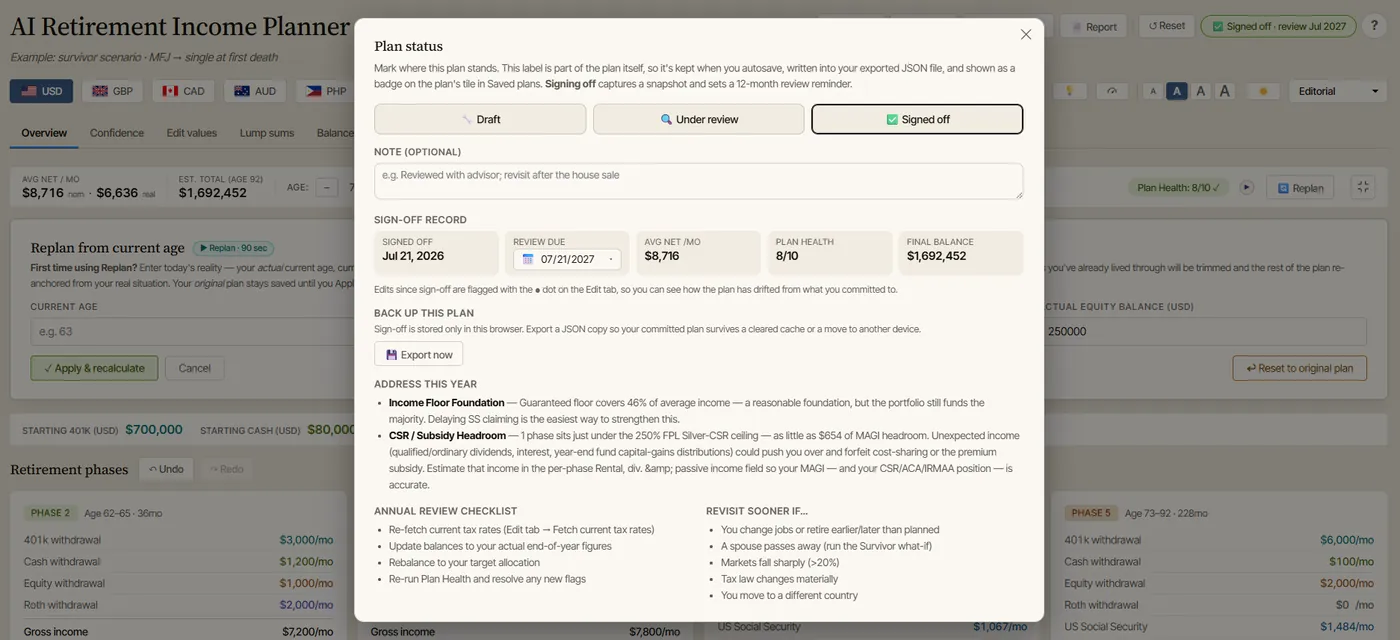
Two features make the annual habit stick. A plan-status chip moves a plan through draft, under review, and signed off; signing off captures a snapshot of your inputs and key numbers, sets a 12-month review date, and tracks any drift since then, so a reminder appears when the review is due and edited fields are flagged against the signed-off baseline. And an "Fetch current tax rates" button on the Edit tab refreshes the tax brackets, deductions, FPL, and IRMAA thresholds for you (with a before-and-after you review), while a built-in help-content audit checks the planner's prose claims against current rules, so keeping values current is a quick step rather than a research project. Change-since-baseline markers show at a glance which fields you have edited, and because the whole model recalculates on every change, a mid-year balance update or a fresh assumption immediately reflows income, taxes, healthcare, ending balances, and Plan Health. You do the review; the planner does the arithmetic.
A Simple Annual Review Checklist
Once a year, this sequence keeps the work organized: save the current plan as last year's version; update your current age and balances; update income sources, spending, tax values, healthcare values, and inflation and COLA assumptions; update currency rates if relevant; review each phase card; check net and real income; review ending balances and Plan Health; review your tax bracket position, ACA or IRMAA exposure, and RMD pressure; stress-test lower returns and higher inflation; then save the updated baseline. It is not about precision for its own sake. It is about staying informed enough to make good decisions with the numbers as they actually are. If you are already retired and want that sequence written out line by line, the annual retirement plan review checklist takes it item by item, from balances and spending through to survivor planning and stress tests. If you have not built a plan yet, the next article in this series walks through your first planning session step by step.
FAQ
How often should I update my retirement plan?
At least once a year is a sensible baseline, plus a quick balance check every few months if you like and an immediate review after any major life event. The annual review does not need to be complicated; it should be simple enough that you actually do it. A rough plan that is reviewed regularly is more useful than a detailed one that is left untouched for years while balances, tax rules, and healthcare costs drift away from it.
What does "replanning from today" mean?
Replanning from today re-anchors the plan to your current age and actual current balances instead of continuing to project from an old starting point. If you are already partway through retirement, the earlier phases have already happened, so there is no reason to keep modeling them. A fresh plan built from where you actually are is usually more useful than an older projection, especially after you retired earlier or later than planned, balances moved, or your assumptions turned out differently.
Why should I save versions of my plan?
Because a plan update is most useful when you can compare it to the version before it. Saving a baseline, then a revised version, lets you see exactly what changed in income, balances, taxes, and health checks, trace which assumption caused the difference, and roll back if the revision looks worse. Version control turns the plan into a traceable process rather than a single file you overwrite and can no longer reason about.
Which values should I update first each year?
Start with the ones that move the plan most: current age and account balances (updated by account type, not just the total), your spending target split into essential and discretionary, and the tax, healthcare, return, and inflation assumptions. Values matter most when a decision sits near a threshold, so verify tax brackets, FPL levels, and IRMAA thresholds carefully whenever a Roth conversion or an income-sensitive healthcare decision depends on them.
Where can I get the full framework?
This series summarizes it, but the complete step-by-step framework is in the free companion eBook, Build a Retirement Plan You Can Question. You can download it here.
Source Links
- Consumer Financial Protection Bureau, Planning for Retirement: https://www.consumerfinance.gov/consumer-tools/retirement/
- IRS, Retirement Topics, Required Minimum Distributions (RMDs): https://www.irs.gov/retirement-plans/retirement-topics-required-minimum-distributions-rmds
- Social Security Administration, Cost-of-Living Adjustment (COLA): https://www.ssa.gov/cola/
- Investor.gov, Retirement Toolkit: https://www.investor.gov/additional-resources/retirement-toolkit
- AI Retirement Income Planner: https://airetirementincomeplanner.com/
Educational Disclaimer
This article is for general education only. It is not financial, tax, investment, legal, healthcare, Social Security, Medicare, or retirement advice. Rules, thresholds, and personal circumstances change, and any projection depends on assumptions that may not hold. Verify important numbers and rules with official sources and a qualified professional before acting.