
Quick Answer
A retirement plan can look strong from one angle and weak from another. It may produce plenty of monthly income while leaning too hard on portfolio withdrawals. It may keep this year's tax low while building a future required-distribution problem. It may preserve a large ending balance while leaving the retiree with far less income than the plan could actually support. No single number tells the whole story.

That is why the strongest way to review a plan is from several angles at once, and to treat it like a system rather than a scoreboard. Income matters, but so do taxes, healthcare, ending balances, inflation, account mix, and how the plan holds up when assumptions turn against it. The goal is not a perfect score. It is to find the areas that need attention before you rely on the plan.
This is the eighth article in our framework series drawn from the free companion eBook. The previous one covered inflation and real income, the last of the individual angles before we bring them together here.
📘 Free companion eBook: this series is drawn from Build a Retirement Plan You Can Question. Get the full framework free.
Key Takeaways
- One number cannot judge a plan. A high balance, a low tax bill, or a strong income figure can each hide a problem in another area.
- Review the plan as a system. The angles overlap on purpose, so a change that helps one can hurt another, and the review is where you see the trade.
- Green, amber, red is enough structure. Green looks workable, amber deserves review, red needs attention before you rely on the plan.
- Not every check must be green. Some amber items are deliberate choices, so a plan can be complete without a perfect score.
- Change one thing at a time. Adjusting several assumptions at once makes it impossible to see which change caused which result.
- Use scenarios. A baseline, an improved version, and a conservative version separate preference from risk.
Why One Good Number Is Not Enough
It is tempting to reduce retirement to a single figure: a savings target, a withdrawal rate, a monthly income number, a probability of success, a final balance. Each is useful, and each is incomplete on its own.
A high final balance can look safe while hiding underspending or an unrealistic return assumption. A low tax bill can look efficient while missing a chance to reduce future required-distribution pressure. A strong monthly income can look comfortable while depending on withdrawals that weaken later phases. A low withdrawal rate can look conservative while failing to fund the life the retiree actually wants. Even a high probability score can reassure while masking a tax or healthcare issue that bites in real life. A plan should be checked like a system, not judged by one output.
The Angles Worth Checking
A practical review covers several categories, and they deliberately overlap:
- Income adequacy, by phase, not just on average: does net income cover essentials and the intended lifestyle in every phase?
- Real income and inflation: does purchasing power hold up, or does it fall below the essential floor later?
- Ending balances: does each phase leave enough for the next, and in what account mix?
- Tax bracket efficiency: is taxable income being shaped on purpose, or pushed into higher brackets by accident?
- ACA and healthcare sensitivity, and IRMAA exposure: is income near a threshold that changes healthcare cost?
- Required-distribution pressure: will a large pre-tax balance force taxable income later?
- Withdrawal sustainability: is the withdrawal reasonable over the whole timeline, not just this year? Measuring withdrawals against current balances is the angle that catches a plan drawing down faster than it looks.
- Stress-test resilience: does the plan survive lower returns, higher inflation, or a weak early market?
- Account mix and flexibility: are the assets usable, with enough Roth and cash for tax-sensitive years?
The overlap is the point. Increasing traditional withdrawals can improve current income and reduce future RMD pressure while raising tax or healthcare costs. Using Roth money protects taxable income but spends future flexibility. Holding more cash improves short-term safety but can lose ground to inflation. A good review shows the trade rather than hiding it.
Green, Amber, and Red
A simple way to review a plan is to sort each area into green, amber, or red. Green means the area looks workable under the current assumptions. Amber means it deserves review. Red means it needs attention before you rely on the plan. This does not grade the plan as a whole. A plan can be mostly green with one amber issue that is either perfectly acceptable or an easy fix, and a red flag does not mean retirement is impossible, only that something needs adjustment, more information, or a different assumption.
The value of this structure is that it reduces overwhelm. Instead of trying to judge everything at once, you ask which areas are green, which need review, and which need action, then work through them one at a time.
Change One Thing, Then Re-Check
When you improve a plan, change one major assumption at a time where you can. If you adjust retirement age, Social Security timing, withdrawal amounts, returns, inflation, healthcare costs, and Roth conversions all at once, it becomes impossible to tell which change produced which result. A cleaner rhythm is to start from a baseline, change one item, review income, taxes, healthcare, ending balances, and plan health, save the result if it is useful, then test the next change. It makes the whole process easier to understand and easier to compare.
Baseline, Improved, Conservative
A strong review usually runs more than one scenario. A baseline shows the plan as currently expected. An improved version applies adjustments that appear to help. A conservative version applies more cautious assumptions, such as lower returns, higher inflation, and higher healthcare costs.
For example: baseline is retire at 62, claim Social Security at 67, current spending; improved adjusts withdrawals to use tax brackets more efficiently and reduce future RMD pressure; conservative lowers returns and raises inflation and healthcare costs. These scenarios separate preference from risk. If the baseline works but the conservative fails, the plan needs flexibility. If both work, confidence improves. If the improved version creates a tax or healthcare issue, the adjustment may need to be smaller. Saving them as versions also lets you compare them side by side, and even ask AI about the comparison.
Do Not Chase the Score
A health score is a useful tool, but it should not become the goal. The aim is not to force every indicator green at any cost. A retiree may deliberately accept an amber warning because it supports a personal goal: spending more in early retirement while healthy, crossing an IRMAA threshold for a worthwhile Roth conversion, or planning a controlled drawdown rather than preserving a large legacy. Those can be sound choices. The real question is always whether the trade-off is understood. A plan can be mathematically neat and personally wrong, and it can carry a warning that is perfectly acceptable once you understand it. Use the score to point you toward the review, then decide for yourself.
How the Planner Does This
The AI Retirement Income Planner builds this whole review into its Confidence tab, which runs up to 14 automated checks and rolls them into a 0 to 100 Plan Health score plus a plain-English completeness verdict. The checks are grouped into four categories, Solvency, Income stability, Tax and healthcare, and Survivor and legacy, and each carries a tier that reflects how much it matters:
- Essential (plan viability): Income Adequacy, Portfolio Survives to End.
- Recommended (resilience): Stress Test Resilient, Income Floor Foundation, Survivor Income Resilience, RMD Compliance.
- Optimization (efficiency, not failure): Tax Bracket Efficiency, ACA Subsidy Protected, IRMAA Not Triggered, CSR / Subsidy Headroom.
- Optional (only if you set that goal): Income Goal, Legacy Goal.
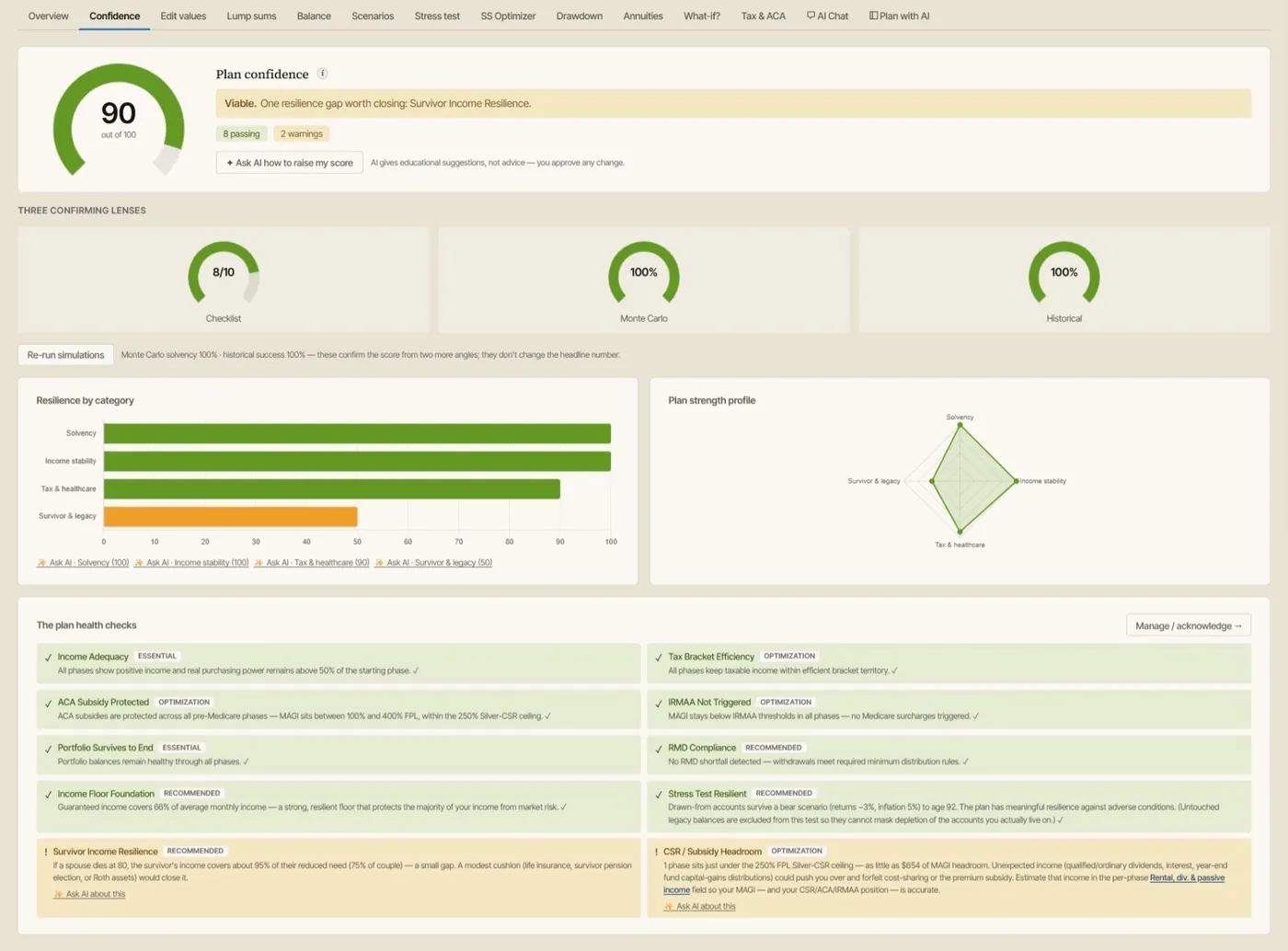
Each check is marked green, amber, or red with a plain-language reason, and, by design, the completeness verdict is independent of the raw number: the Essential checks gate viability, so a plan can read as complete without every Optimization or Optional item green. That matches the "do not chase the score" idea directly. When a check is amber or red, a per-check "Ask AI about this" button hands that exact issue, with your real numbers, to the optional AI chat to explain and propose fixes, and you can acknowledge an amber item you have accepted on purpose so it stops nagging without pretending it is green. Two heavier tools sit alongside the checks to confirm resilience from another direction: a Monte Carlo simulation and a historical backtest, which probe how the plan holds up across many return sequences rather than one smooth average, and the Stress test tab pushes returns, inflation, and one-time costs to see which phase weakens first. For a full step-by-step walkthrough of the tab, see our guide to using Plan Health in the planner.
A Simple Review Order
You do not have to follow a fixed order, but one that works is: check each phase has positive net income, then that real income stays acceptable, then that ending balances carry from phase to phase, then your tax bracket position, then any ACA or healthcare-sensitive years, then Medicare and IRMAA exposure, then future RMD pressure, then withdrawal sustainability, then stress-test the plan, and finally review account mix and flexibility. It simply helps organize the work so nothing important gets skipped. Once the plan checks out from several angles, the next question is how to draw it down, which the next article in this series covers by comparing withdrawal strategies.
FAQ
Why is one number not enough to judge a retirement plan?
Because each single figure captures only one angle. A high ending balance can hide underspending or optimistic returns; a low tax bill can miss a chance to reduce future required distributions; a strong income figure can depend on withdrawals that weaken later phases; even a high probability-of-success score can mask a tax or healthcare problem. Reviewing the plan across several angles at once shows how the pieces interact, which is what a single number cannot do.
Do I need to make every Plan Health check green?
No. Checks are tiered by importance. Essential checks gate whether the plan is viable, Recommended checks add resilience, and Optimization and Optional checks are about efficiency or personal goals rather than failure. A retiree may deliberately leave an amber item, such as accepting a healthcare-cost threshold to fund a Roth conversion, when the trade-off is understood. A plan can be complete without a perfect score.
What is the difference between the score and the completeness verdict?
The score is a 0 to 100 number that summarizes how many checks pass and how strong the plan looks. The completeness verdict is a separate, plain-English judgment that focuses on whether the Essential viability checks hold, so it does not simply track the number. This is deliberate: a plan can have a modest score because it leaves some optimization items amber and still be a complete, workable plan.
Why change only one assumption at a time?
Because changing several at once makes cause and effect impossible to read. If you alter retirement age, Social Security timing, withdrawals, returns, inflation, and conversions together, you cannot tell which change drove which result. Starting from a baseline, changing one item, reviewing the effect, and saving useful versions makes the process understandable and makes scenarios easy to compare.
Where can I get the full framework?
This series summarizes it, but the complete step-by-step framework is in the free companion eBook, Build a Retirement Plan You Can Question. You can download it here.
Source Links
- Consumer Financial Protection Bureau, Planning for Retirement: https://www.consumerfinance.gov/consumer-tools/retirement/
- Investor.gov, Retirement Toolkit: https://www.investor.gov/additional-resources/retirement-toolkit
- U.S. Securities and Exchange Commission, Investor Alerts and Bulletins: https://www.sec.gov/investor/alerts
- AI Retirement Income Planner: https://airetirementincomeplanner.com/
Educational Disclaimer
This article is for general education only. It is not financial, tax, investment, legal, healthcare, Social Security, Medicare, or retirement advice. Any confidence score or projection is an educational estimate, not a guarantee, and depends on assumptions that may not hold. Verify important numbers and rules with official sources and a qualified professional before acting.