
Quick Answer
A retirement income plan has two jobs. The first is to produce enough income for the phase you are in now. The second is to leave enough behind for the phase that comes next. Most plans obsess over the first job and barely look at the second, which is how a plan ends up looking comfortable today and fragile later.
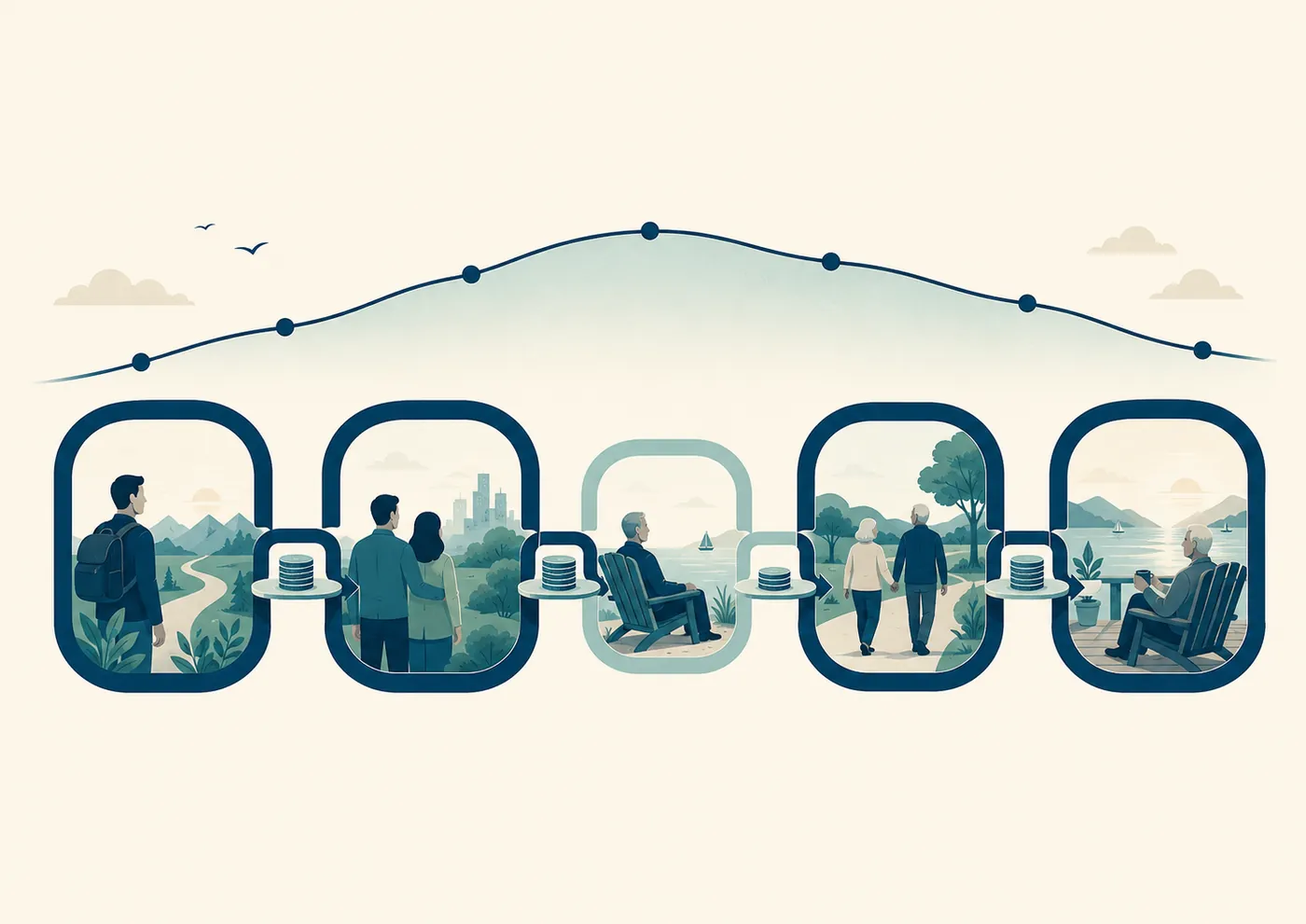
The number that connects those two jobs is the ending balance: what is left at the end of a phase, which becomes the starting balance of the next one. Read it phase by phase and a plan stops being a single income figure and becomes a chain you can inspect, where you can see whether this year is supporting the future or spending it.
This is the fourth article in our framework series drawn from the free companion eBook. The previous one covered gross, net, and real income, and reliable versus flexible income.
📘 Free companion eBook: this series is drawn from Build a Retirement Plan You Can Question. Get the full framework free.
Key Takeaways
- A plan has two jobs: create income now and leave enough for the next phase. The ending balance is where the second job shows up.
- Retirement is a chain of balances. One phase's ending balance is the next phase's starting balance, so a decision early on affects every phase after it.
- The ending balance is not a pass-or-fail number. A low balance can be fine; a high one can signal underspending. What matters is whether the pattern is intentional.
- The difference between a healthy plan and a fragile one is often planned drawdown versus accidental depletion, and the difference is visibility.
- Where the balance sits matters as much as how much. A dollar in a 401(k), a Roth, cash, or a brokerage account behaves very differently for taxes, RMDs, and legacy.
A Plan Has Two Jobs
It is easy to judge a retirement plan by a single question: how much income can I take this year? That question matters, but it is only half the plan. The other half is: what will be left after I take it?
Both answers are needed, because they pull against each other. Higher income this phase usually means a lower ending balance, which means the next phase starts with fewer options. Lower income this phase preserves more, but you may be living more tightly than the plan actually requires. A good plan keeps both questions on screen at once so you can weigh the trade-off instead of optimizing one and discovering the cost later.
Retirement Is a Chain of Balances
A phase-based plan works like a chain. Your starting balance in Phase 1 produces income during Phase 1. Growth, withdrawals, taxes, and healthcare costs all act on it, and whatever remains becomes the ending balance. That ending balance is the starting balance for Phase 2, which produces its own income and leaves its own ending balance, and so on to the end of the plan.
The important consequence is simple: a decision in one phase affects every phase after it.
- Draw too aggressively early and later phases begin weaker.
- Draw too cautiously early and you may preserve more than you needed to, at the cost of living smaller.
- Delay taxable withdrawals too long and future required minimum distributions can become larger than expected.
- Spend Roth money too early and you give up tax-free flexibility later.
None of these are automatically wrong. They are trade-offs, and the ending balance is where you actually see them.
Why Strong Income Can Still Hide a Problem
A phase can hit its income target and still create a problem for the future. Picture a retiree who wants $5,000 a month from 62 to 65 and funds it with large 401(k) withdrawals. On the income line, the phase is a success: the target is met. The ending balance can tell a very different story.
If those withdrawals draw the 401(k) down too fast, the retiree has fewer assets once Medicare begins. If they also lift taxable income, they can raise ACA costs before 65. And selling more early can reduce the base that would have compounded later. The income target was reached, but the plan may have paid too much to reach it.
The opposite failure is easy to miss: a retiree keeps withdrawals very low out of fear of running out, and the ending balance looks strong, but they are living well below what the plan could support. That is not automatically wrong either. It just should be a choice, not an accident. The ending balance is what makes both cases visible.
The Ending Balance Is Not Pass or Fail
There is no universal number that makes a plan good or bad. A $500,000 ending balance can be strong for one household and thin for another. A $50,000 balance can be perfectly fine in one plan and dangerous in the next. The meaning depends on everything around it:
- How much income is needed in the next phase?
- What reliable income (Social Security, pensions) begins later?
- How long does the plan need to last, and what healthcare risks remain?
- Is there a spouse or dependent, or a legacy goal?
- Might spending change with a move, downsizing, or care needs?
The number matters, but it does not speak for itself. A retiree with strong Social Security, a pension, low expenses, and no legacy goal can be comfortable running the portfolio down late in life. A retiree with no pension, high healthcare concerns, or a wish to leave assets needs a much larger cushion. Same balance, different verdict.
Planned Drawdown vs Accidental Depletion
The problem is almost never that a portfolio declines. Many sound plans are designed to spend assets down, on the reasonable view that savings exist to fund retirement, not to be preserved forever. The problem is accidental depletion: seeing enough income today while not realizing the later phases are becoming fragile.
The difference between the two is visibility. Planned drawdown means you understand how the balance is expected to fall, why it falls, and whether what remains still supports the phases ahead. Accidental depletion is the same downward line without that understanding. A phase-based view is built to keep you on the planned side of that line, by showing the decline as it happens rather than at the end.
Sequence Risk: When the Bad Years Land Matters
One of the most important risks to the ending balance is sequence-of-returns risk: the order of returns matters, not just the average. A portfolio that averages a healthy return over 30 years can still get into trouble if the poor years arrive early, while you are taking withdrawals. Selling during a downturn locks in losses and leaves fewer assets to participate in the recovery.
This is why a plan that looks fine on a smooth average return can look much weaker under a poor-early-returns scenario, and it is why cash reserves, flexible spending, delayed withdrawals, part-time income, or a guaranteed income floor can matter so much: they reduce the need to sell investments at the worst time. The goal is not to eliminate the risk, which is usually impossible. It is to see how much your plan depends on good early returns, which is exactly the kind of question a Monte Carlo or historical backtest is designed to probe.
It Is Not Just How Much Remains, but Where
Two retirees can both end a phase with $500,000 and face completely different futures, because the ending balance should be read by account type, not as one total:
- Tax-deferred (traditional 401(k)/IRA): fully taxable on withdrawal and subject to RMDs from 73 (75 if you were born in 1960 or later). A large residual here can force taxable income you did not ask for.
- Roth: tax-free, invisible to the income figures that drive ACA and Medicare costs, no RMDs, and the best asset to leave to heirs.
- Cash: low growth but high liquidity, a buffer against selling investments at a bad time.
- Taxable brokerage: flexible, but sales can trigger capital gains.
That mix is why the order you draw from your accounts is a genuine planning decision. Avoiding taxable withdrawals for years can leave a traditional account so large that later RMDs spike your tax bill; taking a little more taxable income earlier, or converting some to Roth while brackets are low, can reduce that future pressure. A useful plan shows not only whether money remains, but where it remains.
Taxes and Healthcare Move the Balance Too
Ending balances are not shaped by withdrawals and growth alone. Taxes reduce what is left, and they reshape future balances: skipping taxable withdrawals now can grow a pre-tax account into a larger RMD problem later. Healthcare thresholds work the same way. Before Medicare, extra income can raise ACA premiums; after 65, it can trigger IRMAA surcharges. A withdrawal that looks manageable before those effects can be noticeably less efficient once the full cost is counted, which is why the ending balance is best read after taxes and healthcare, not before. The next article in this series looks at how taxes change the shape of retirement income in detail.
How the Planner Shows the Ending Balance
The AI Retirement Income Planner treats the ending balance as a first-class number, not an afterthought. On the Overview tab, every phase card shows that phase's ending balance right alongside its income, and that figure is carried straight into the next phase as its starting balance, so the chain is visible as you read down the cards.
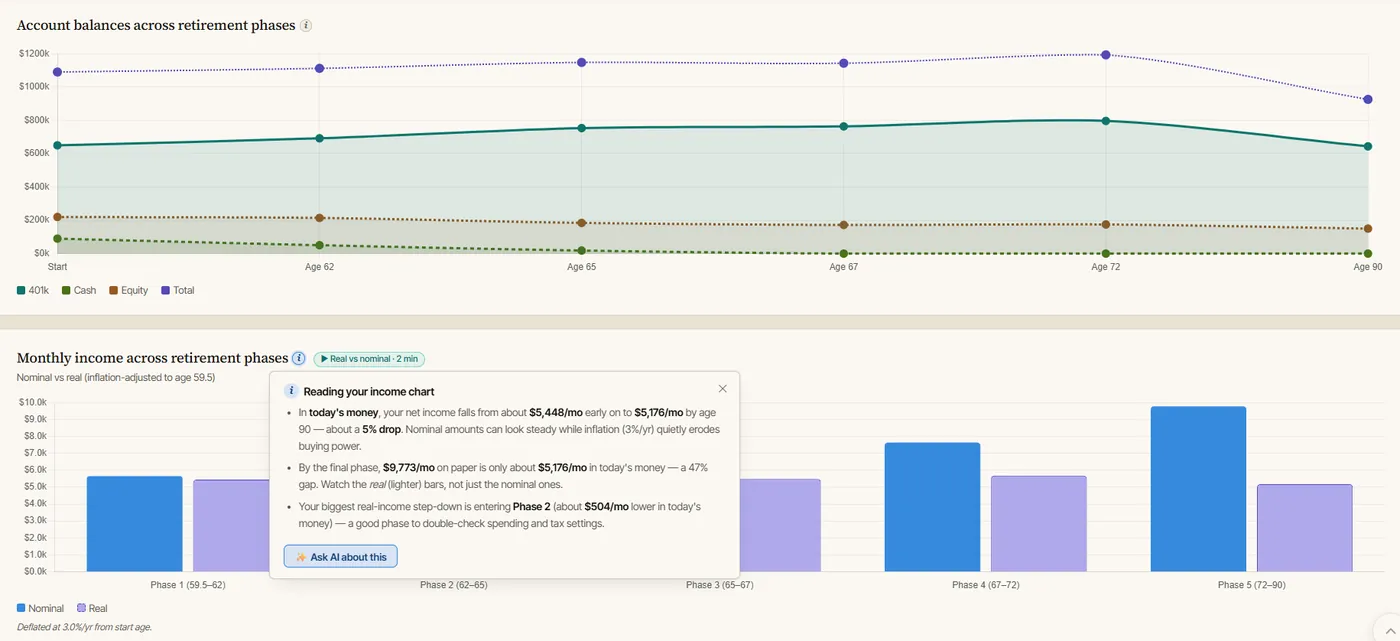
The dedicated Balance tab turns that chain into a picture. It charts your account balances across the retirement phases, so you can see which bucket is doing the work and which one empties first, and it plots your total portfolio across three return scenarios, so a single optimistic assumption never stands in for the range of outcomes. The chart also carries a short "Reading your balance chart" panel that, in plain language and using your own numbers, splits your projected remaining wealth into tax-deferred, taxable, and tax-free, warns when it is mostly tax-deferred (the RMD trap), points out which account runs out and roughly when, and flags any phase where your planned 401(k) draw looks below the likely RMD. When you want to go deeper, an "Ask AI about this" button hands those exact points to the optional AI chat to expand on with your real plan.
Two more tabs stress the balance from other directions. The Scenarios tab lays out ending balances and real net income by phase across a range of return outcomes, and the Stress test tab checks whether the plan still holds under lower returns, higher inflation, a weak early market, or a large one-time cost. And when a plan draws the portfolio down close to zero on purpose, the planner recognizes it: if guaranteed income (Social Security and pensions) covers most of the target in the final phase, it marks the depletion as by design, with the lifetime-income floor taking over, rather than raising a false alarm. Because it is one connected model, raising a withdrawal shows more income now and a lower ending balance at once, so you weigh both sides of the trade instead of one.
Questions to Ask About Every Ending Balance
For each phase, a short checklist makes the review much stronger:
- Is the ending balance positive, and large enough to support the next phase?
- How much of it is pre-tax, Roth, cash, and taxable brokerage?
- Does it lean on optimistic growth assumptions, and does it still hold under a lower-return scenario?
- Does it leave room for healthcare, inflation, and unexpected late-retirement costs?
- Is the decline intentional, or a surprise?
- Would a higher or lower withdrawal improve the overall plan?
You do not need perfect answers. You need the balance broken out phase by phase, by account, and under more than one assumption, so the trade-off between income now and flexibility later is something you decide on purpose.
FAQ
What is a "good" retirement ending balance?
There is no universal figure. A balance is healthy when it comfortably supports the phases still ahead given your reliable income, expenses, longevity, healthcare risk, and any legacy goal. The same dollar amount can be strong for one household and thin for another, which is why the ending balance should be judged in context rather than against a fixed target.
Is it bad if my portfolio is projected to run down to near zero?
Not necessarily. A planned drawdown can be sensible, especially when Social Security and pensions cover most of your essential spending later in life. What matters is that the decline is understood and that you have tested what happens if you live longer than expected, if healthcare costs rise, or if a spouse outlives the other. Accidental depletion, where later phases weaken without your noticing, is the real risk.
Why does the account mix of the ending balance matter?
Because different accounts are taxed and treated very differently. A large traditional 401(k) or IRA balance drives taxable RMDs from 73 or 75; a Roth balance is tax-free, avoids RMDs, and is the best asset to leave to heirs; cash provides liquidity; a brokerage account can trigger capital gains. Two identical totals can mean very different future tax and flexibility, so read the balance by account type, not just as one number.
What is sequence-of-returns risk?
It is the risk that the order of investment returns hurts you, not just the average. Poor returns early in retirement, while you are withdrawing, do more damage than the same poor returns later, because you sell more assets at low prices and have less left to recover. Cash reserves, flexible spending, and guaranteed income can soften it.
Where can I get the full framework?
This series summarizes it, but the complete step-by-step framework is in the free companion eBook, Build a Retirement Plan You Can Question. You can download it here.
Source Links
- IRS, Retirement Topics, Required Minimum Distributions (RMDs): https://www.irs.gov/retirement-plans/retirement-topics-required-minimum-distributions-rmds
- IRS, Roth IRAs: https://www.irs.gov/retirement-plans/roth-iras
- Consumer Financial Protection Bureau, Planning for Retirement: https://www.consumerfinance.gov/consumer-tools/retirement/
- Investor.gov, Retirement Toolkit: https://www.investor.gov/additional-resources/retirement-toolkit
- AI Retirement Income Planner: https://airetirementincomeplanner.com/
Educational Disclaimer
This article is for general education only. It is not financial, tax, investment, legal, healthcare, Social Security, Medicare, estate, or retirement advice. Any projections depend on assumptions that can change, and no plan can guarantee future results. Verify important numbers and rules with official sources and a qualified professional before acting.