
Quick Answer
Most retirement plans start with a monthly target: "I need about $4,000 a month." That is a sensible starting point, because without a spending target there is nothing to test. But the number by itself does not tell you the thing that actually matters, which is what kind of income it is.
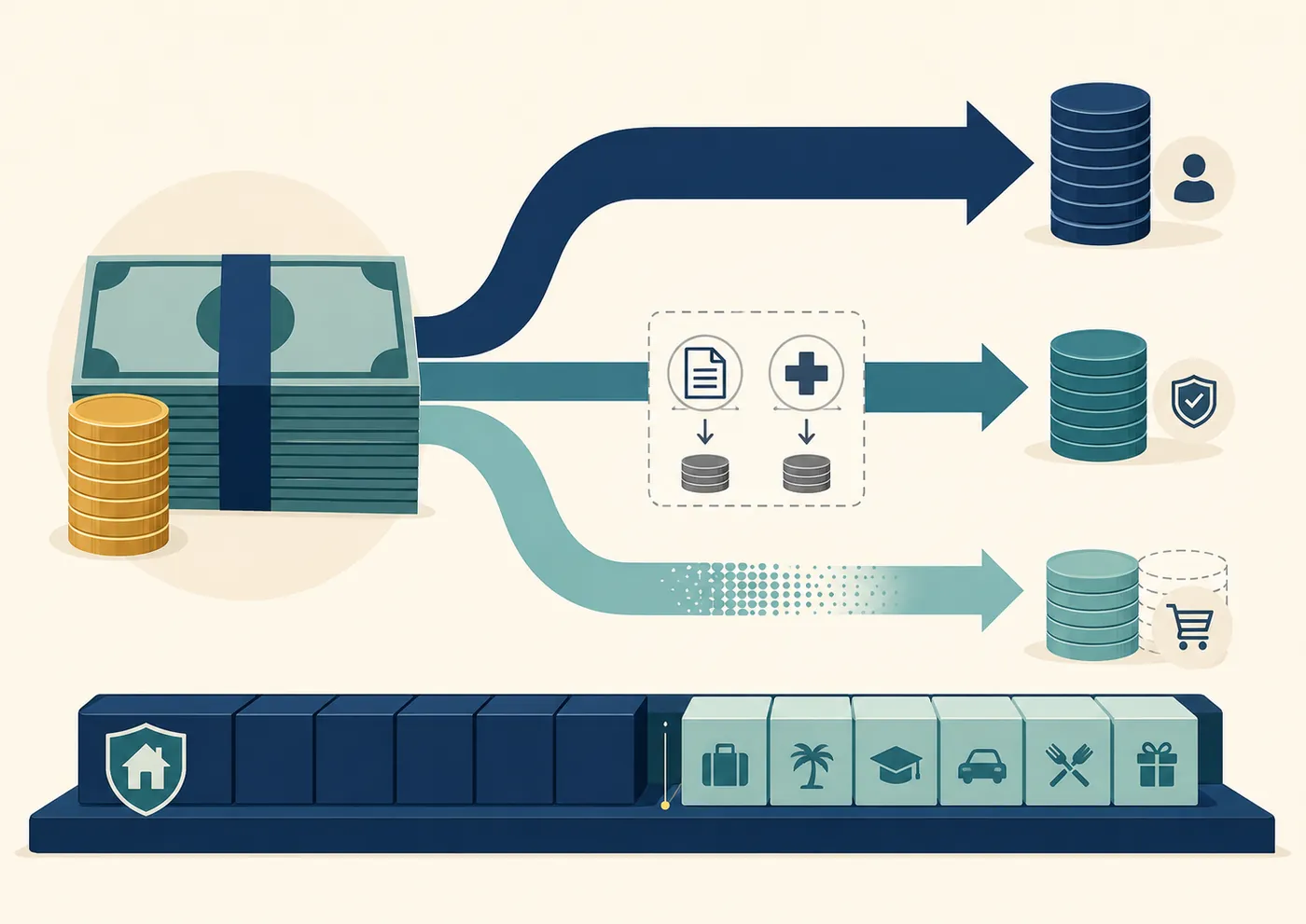
Is it gross or spendable? Taxable or tax-free? Reliable or dependent on withdrawals? Protected against inflation or losing value over time? A useful plan breaks the single number into clearer parts: gross versus net, nominal versus real, and reliable versus flexible. Once you can see those parts, the same $4,000 stops being one figure and becomes a plan you can actually evaluate.
This is the third article in our framework series drawn from the free companion eBook. The previous one covered why retirement income is best planned as a timeline of phases.
📘 Free companion eBook: this series is drawn from Build a Retirement Plan You Can Question. Get the full framework free.
Key Takeaways
- A monthly income target is only the beginning. The more useful question is what kind of income it is.
- Gross income is not spendable income. What matters for lifestyle is net income, after taxes and healthcare costs.
- The same gross amount can have very different effects depending on the source (a traditional withdrawal, a Roth withdrawal, and cash are not interchangeable).
- Separate reliable income (Social Security, pensions) from flexible income (your portfolio). Reliable income forms a floor; flexible income fills the gap.
- Nominal income is the future dollar amount; real income is what it buys in today's money. A plan can look stable in dollars while weakening in real terms.
Gross Income Is Not Spendable Income
Gross income is the total coming in before taxes, healthcare adjustments, and other deductions. Say you withdraw $3,000 a month from a traditional 401(k) and receive $2,000 from Social Security. Your gross income is $5,000 a month. But that does not mean you have $5,000 to spend.
Part of the 401(k) withdrawal may be taxable. Part of the Social Security may be taxable, depending on your other income. Healthcare costs may shift with your income, Medicare premiums may rise if income crosses a threshold, and state taxes may apply. The number that matters for lifestyle is much closer to net income: what remains after the major deductions and costs.
That difference can be large enough to change a decision. A plan showing $5,000 a month before tax feels very different from one that produces $5,000 a month after tax and healthcare. This is the heart of how much you can actually spend in retirement.
The Same Income Can Have Different Consequences
Here is a simple example. Two retirees both want $4,500 a month. Both receive $2,500 from Social Security. Retiree A withdraws the other $2,000 from a traditional IRA; Retiree B withdraws it from a Roth account.
The gross income looks identical. The tax result is not. The traditional IRA withdrawal generally increases taxable income; a qualified Roth withdrawal generally does not. That single difference can ripple through federal tax, state tax, ACA calculations before Medicare, IRMAA exposure after Medicare, and how much pre-tax money is left to generate future required minimum distributions.
The point is not that one retiree is automatically better off. The point is that the same monthly income can carry different consequences depending on where it comes from, which is exactly why the order you draw from your accounts is a real planning decision, not an afterthought.
Reliable Income vs Flexible Income
One of the most useful ways to organize retirement income is to split it into two kinds:
- Reliable income is what you expect to receive regularly and for a long time: Social Security, pensions, annuities, other stable payments.
- Flexible income comes from assets you control: cash, traditional accounts, Roth accounts, brokerage accounts.
Reliable income forms an income floor. Flexible income fills the gap above it. Suppose your essential expenses are $3,500 a month. If Social Security and a pension cover $2,800, your portfolio only has to reliably produce the remaining $700 for essentials; anything more funds travel, hobbies, or gifts. That is a very different situation from someone whose reliable income is only $1,200, whose portfolio has to carry the bulk of the essentials. Neither plan is doomed, but the second one asks much more of the portfolio, and a good plan makes that responsibility visible.
This is also why when you claim Social Security is really a question about how tall you want your income floor to be for the rest of your life.
Nominal Income vs Real Income
A monthly income number can mislead if it is not adjusted for inflation. Suppose a plan shows $5,000 a month at 62 and $5,500 at 78. That looks like a raise. But if prices climb over those years, $5,500 later may buy less than $5,000 buys today.
Nominal income is the dollar amount shown in the future. Real income restates it in today's purchasing power. Both are useful: nominal income helps with projected cash flow, real income helps you compare lifestyle across the years. The question to keep asking is whether income rises in dollars only or whether spending power actually holds up. A plan can look perfectly stable in nominal terms while slowly weakening in real terms, which is one of the quieter risks a phase-by-phase view is built to surface.
Net Income, Phase by Phase
Put the two previous articles together with this one and a clear routine appears. Once retirement is divided into phases, you review income phase by phase, and for each phase you ask:
- What is the gross income?
- What taxes and healthcare costs apply?
- What is the net monthly income?
- What is the real monthly income in today's money?
- How much of it is reliable, and how much depends on portfolio withdrawals?
- What balance remains at the end of the phase?
That produces a far clearer picture than one average retirement income number. One plan might show strong net income from 67 onward but a weak stretch from 62 to 65 before Medicare and Social Security, which points to the bridge years before Medicare needing attention. Another might show good income early but falling real income later, which points to inflation risk. Those are different problems with different fixes, and you can only tell them apart when the income is broken into its parts.
How the Planner Shows Multiple Income Views
The AI Retirement Income Planner is built to show more than one income number, because each one answers a different question. On the Overview tab, every phase card lays out that phase's income the same way:
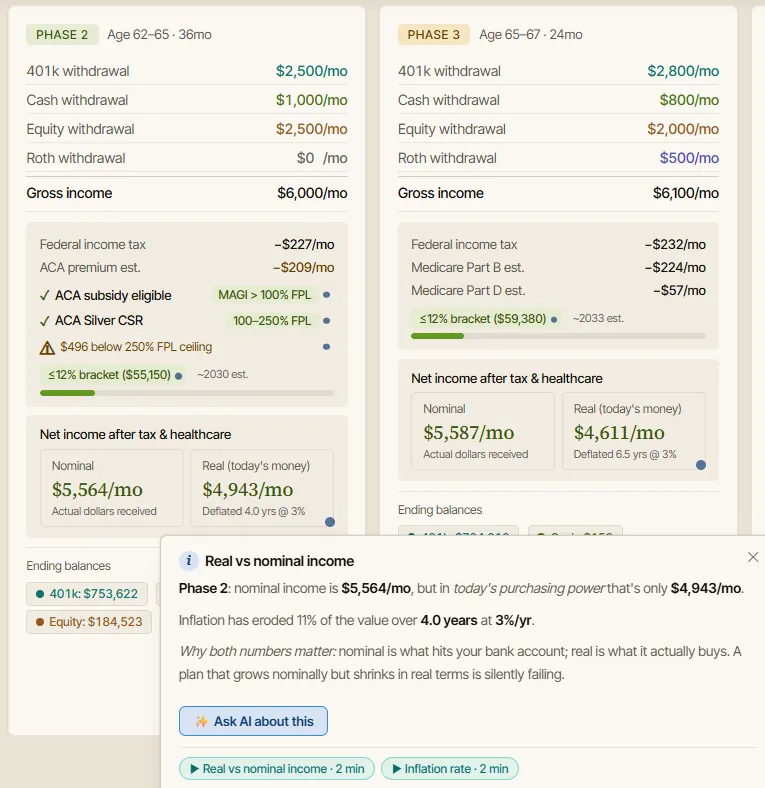
- Gross income (how much is flowing in), then
- Net income after estimated taxes and healthcare costs (what is actually spendable), then
- Real income, the net figure restated in today's dollars. Hover or tap the real figure and a small popover shows how inflation converts the future nominal amount into today's purchasing power, using your own inflation rate.
It also separates reliable income from flexible withdrawals. The planner totals your guaranteed income (Social Security plus any pensions, including UK, Canadian, and Australian pensions in those currencies) into an income floor, and tells you what percentage of your target that floor already covers, so you can see how much rides on investment returns and how much would keep arriving regardless of markets. You can set a Minimum income floor goal, and two plan-health checks test against it: Income Adequacy (an essential check, that every phase produces enough net income) and Income Floor Foundation (that enough of your income is guaranteed rather than market-dependent).
Because it is one connected model, adjusting a withdrawal moves all of these at once: a bigger withdrawal may raise gross income but cut the ending balance, lift taxes, and change healthcare costs. Seeing gross, net, real, reliable, and remaining balance together is what lets you weigh the trade-off instead of chasing a single number.
Build Your Own Income Picture
You do not need to predict every expense perfectly. For each phase, aim to identify a short list: reliable income, flexible withdrawals, which income is taxable versus tax-free, which is healthcare-sensitive, your essential income floor, your discretionary spending, and the ending balance. The goal is not a perfect forecast. It is to see whether the plan has enough income, enough flexibility, and enough remaining balance to keep working, phase after phase.
The next article in the series looks more closely at that last item: the ending balance, the number that carries the plan forward from one phase to the next.
FAQ
What is the difference between gross, net, and real income?
Gross income is the total before taxes and other costs. Net income is what remains after taxes and healthcare, which is what you can actually spend. Real income takes the net figure and restates it in today's purchasing power, so you can compare a future year against today without inflation hiding the difference.
Why does the source of the income matter if the amount is the same?
Because different sources are taxed differently and interact differently with healthcare thresholds. A traditional-account withdrawal is generally ordinary taxable income; a qualified Roth withdrawal generally is not; cash and brokerage sales fall somewhere in between. The same $2,000 can raise or leave flat your taxable income, your ACA subsidy, or your Medicare surcharge depending on which account it came from.
What is an income floor, and why build the plan around it?
The income floor is the income needed to cover essential expenses (housing, food, utilities, insurance, healthcare, basic taxes). Separating it from discretionary spending tells you how much of your lifestyle depends on stable guaranteed income versus flexible portfolio withdrawals, which is exactly what you want to know before a bad market year, not during one.
Where can I get the full framework?
This series summarizes it, but the complete step-by-step framework is in the free companion eBook, Build a Retirement Plan You Can Question. You can download it here.
Source Links
- Social Security Administration, Income Taxes and Your Social Security Benefit: https://www.ssa.gov/benefits/retirement/planner/taxes.html
- IRS, Retirement Topics, Required Minimum Distributions (RMDs): https://www.irs.gov/retirement-plans/retirement-topics-required-minimum-distributions-rmds
- Consumer Financial Protection Bureau, Planning for Retirement: https://www.consumerfinance.gov/consumer-tools/retirement/
- AI Retirement Income Planner: https://airetirementincomeplanner.com/
Educational Disclaimer
This article is for general education only. It is not financial, tax, investment, legal, healthcare, Social Security, Medicare, estate, or retirement advice. Any projections depend on assumptions that can change, and no plan can guarantee future results. Verify important numbers and rules with official sources and a qualified professional before acting.