
Short Verdict
Monte Carlo simulation and historical backtesting answer different retirement planning questions.
Monte Carlo asks:
What could happen across many randomly generated future paths?
Historical backtesting asks:
How would this plan have behaved through real past market periods?
Neither method is enough by itself.
Monte Carlo can show a wide range of possible outcomes, but it depends heavily on assumptions. Historical backtesting can show recognizable periods like recessions, market crashes, and long flat stretches, but the future will not replay the past exactly.
The better approach is to use both, then add direct stress tests for specific risks such as poor early returns, higher inflation, higher healthcare costs, delayed Social Security, and survivor outcomes.

Key Takeaways
- Monte Carlo simulation uses repeated random trials to estimate a range of possible outcomes.
- Historical backtesting runs a plan through actual past return sequences.
- Monte Carlo is useful for probability ranges, but assumptions drive the results.
- Historical backtesting is useful for real-world context, but past markets do not define the full future.
- Stress tests are still needed because specific risks can be missed by broad probability views.
- Sequence-of-returns risk should be tested with both methods.
- The AI Retirement Income Planner includes Monte Carlo, historical backtesting, stress tests, Plan Health, Confidence scoring, scenario comparison, and drawdown tools.
The Core Difference
A retirement projection is trying to answer a hard question:
Will this income plan hold up across decades of uncertain markets, inflation, taxes, healthcare costs, and personal changes?
There are several ways to test that question.
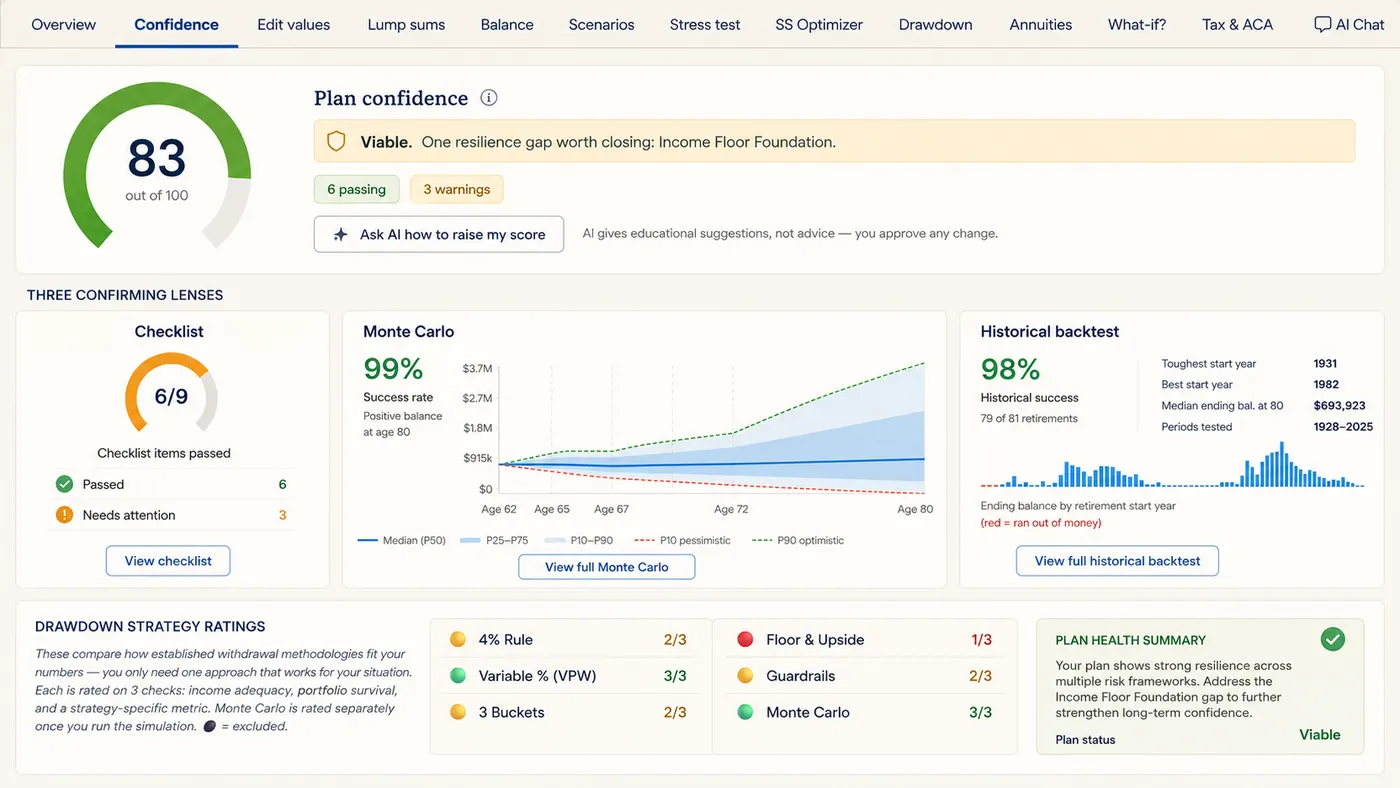
Monte Carlo simulation creates many possible future paths. Each path uses random or pseudo-random variation in returns and sometimes other assumptions. The result is usually expressed as a range of outcomes or a probability-style confidence measure.
Historical backtesting uses actual past data. Instead of inventing thousands of paths, it runs the plan through historical return sequences. It can show how the plan might have behaved through periods that really occurred.
The two tools feel similar because both are risk tools.
They are not the same tool.
What Monte Carlo Simulation Does
In retirement planning, Monte Carlo simulation usually means running the same plan through many randomized return paths.
A simple retirement Monte Carlo model may vary:
- Stock returns.
- Bond returns.
- Inflation.
- Portfolio volatility.
- Correlations between assets.
- Life expectancy.
- Spending.
- Healthcare costs.
- Taxes, in more detailed models.
The output might show:
- Probability of the portfolio lasting through a target age.
- Median ending balance.
- Low-end ending balance.
- High-end ending balance.
- Year-by-year range of balances.
- Failure years in weaker runs.
- Sensitivity to spending, returns, and inflation.
The strength of Monte Carlo is breadth.
It can create many paths that never happened in exactly that order. It can test thousands of sequences quickly. It can show that a plan may be strong in average conditions and weak in unfavorable conditions.
The weakness is assumptions.
If the return assumptions are too optimistic, the output may look too strong. If volatility is understated, the model may miss risk. If taxes, healthcare, and withdrawals are oversimplified, the final score may feel more precise than it is.
What Historical Backtesting Does
Historical backtesting runs a plan through real past market periods.
For retirement planning, a backtest might ask:
- What if this plan started before a major bear market?
- What if retirement began before high inflation?
- What if poor stock returns arrived early?
- What if bond returns were weak?
- What if the plan faced a long flat market?
Historical backtesting is useful because it gives the plan a real-world trial.
Past data includes market relationships that are hard to invent manually. It includes messy periods, recoveries, inflation shocks, rate changes, and long stretches when one asset class did better than another.
One detail changes what a backtest can tell you: whether it replays past inflation as well as past returns. A backtest that does raises withdrawals as prices rose, so a 1970s start looks hard. One that replays returns only, as the AI Retirement Income Planner's does, keeps withdrawals at the amounts in your plan, so it stresses the order of market returns but not inflation. Check which kind you are reading before drawing conclusions about a high-inflation decade.
The weakness is that history is limited.
Only one version of the past happened. The future can include return patterns, inflation paths, tax rules, healthcare costs, and policy changes that have no exact historical match.
Historical backtesting is a practical tool, not a time machine.
Comparison Table
| Question | Monte Carlo Simulation | Historical Backtesting |
|---|---|---|
| Main idea | Runs many randomized future paths | Runs the plan through past market periods |
| Best for | Seeing a range of possible outcomes | Seeing how the plan handles real past sequences |
| Output | Probability-style success or confidence ranges | Results by historical period or return sequence |
| Strength | Broad range of paths | Real-world context |
| Weakness | Depends heavily on assumptions | Limited to history that actually happened |
| Good for sequence risk | Yes, if poor early returns appear in enough runs | Yes, if tested periods include poor early returns |
| Good for inflation shocks | Yes, if inflation is modeled well | Only if it replays past inflation, not just past returns |
| Risk of false comfort | Optimistic assumptions | Believing the future must resemble the past |
| Best use | Probability lens | History lens |
| Better together? | Yes | Yes |
Why A Confidence Score Needs Context
Many retirement tools produce a confidence score.
That can be helpful.
It can also mislead if the reader treats one number as the plan.
A score may hide important details:
- Which years failed.
- Whether the first decade is fragile.
- Whether the survivor plan is weaker.
- Whether healthcare costs are too low.
- Whether taxes were simplified.
- Whether Social Security timing is carrying the plan.
- Whether the result depends on optimistic returns.
- Whether a cash reserve is being depleted.
For example, a plan may show a strong Monte Carlo score but still fail under a specific historical period of poor early returns. Another plan may look weak under conservative Monte Carlo assumptions but survive many historical periods because spending is flexible.
The score is a dashboard light.
The plan is the full engine.
Sequence Risk Is The Test Case
Sequence-of-returns risk is one of the best reasons to use both methods.
Sequence risk is the risk that poor investment returns arrive early in retirement while withdrawals are coming out of the portfolio.
Monte Carlo can test many random return sequences.
Historical backtesting can show how a plan behaved through actual poor-start periods.
But sequence risk should also be tested directly. A useful stress test may force:
- Poor returns in the first few retirement years.
- Higher inflation at the same time.
- Higher healthcare costs at the same time.
- A delayed Social Security bridge.
- Lower spending flexibility.
- A survivor event later in the plan.
The reason is simple: a broad probability score can smooth over the exact scenario the household most needs to understand.
Example: Same Plan, Different Risk Views
Assume a couple retires at 62. (Retiring early has its own bridge-year checklist: see can I retire at 62 before Medicare?.)
They have:
- $1,200,000 total portfolio.
- $90,000 annual spending before healthcare.
- Three years before Medicare.
- Social Security delayed to 67 for one spouse and 70 for the higher earner.
- $1,500 monthly pre-Medicare healthcare cost.
- A mix of cash, taxable investments, traditional retirement accounts, and Roth.
- Planned Roth conversions before RMD age.
Monte Carlo View
The Monte Carlo view may show:
- A broad range of ending balances.
- A median plan that looks comfortable.
- Some weak paths where poor returns and withdrawals line up.
- A probability-style confidence estimate.
- Sensitivity to spending and return assumptions.
This is useful. It tells the couple that uncertainty matters.
Historical Backtest View
The historical view may show:
- Which past starting periods were hardest.
- Whether early bear markets caused trouble.
- Whether cash helped during weak markets.
- Whether the larger bridge-year withdrawals, taken while Social Security is delayed, leave the plan exposed when the bad years come first.
This is useful too. It gives the couple specific episodes to study.
Stress-Test View
The Stress test grid and the other what-if tools may show:
- The plan holds at the planned returns but thins out when inflation runs at 5% or 8% alongside weaker returns.
- Changing the Roth conversion in the bridge phase changes that phase's tax and healthcare costs.
- Claiming one Social Security benefit earlier gives a smaller monthly benefit but a head start on the cumulative total.
- Lowering the first phase's withdrawals improves a Plan Health check.
Now the couple has a plan, not merely a score.
Where Monte Carlo Can Mislead
Monte Carlo is powerful, but the result depends on the model.
Watch for these issues:
Optimistic Return Assumptions
If expected returns are too high, the plan can look stronger than it is.
Low Volatility Assumptions
If volatility is too low, the model can understate sequence risk.
Thin Tail Risk
Some models may understate rare and severe market periods.
Simplified Taxes
Retirement withdrawals are taxable in different ways. A model that ignores tax details may overstate spendable income.
Flat Spending
Real spending often changes by phase. Travel, healthcare, housing, taxes, and later-life care do not always rise evenly.
Weak Healthcare Modeling
Healthcare can affect withdrawals, ACA income, Medicare premiums, IRMAA, and survivor planning.
Overconfidence In One Percentage
A 90 percent result does not mean the plan is finished. It means the assumptions produced that result.
Where Historical Backtesting Can Mislead
Historical backtesting has its own limits.
The Future Can Be Different
Past returns, inflation, interest rates, taxes, healthcare costs, and policy rules may not repeat.
History Has Limited Starting Points
There are fewer true historical retirement start dates than there are possible future paths.
Past Data May Not Match The Portfolio
A modern portfolio may include different funds, fees, tax features, international exposure, cash rates, or annuity income.
Past Tax Rules May Not Fit Current Rules
Historical returns can be tested, but today's tax rules and account types may be different.
Healthcare Costs Have Changed
Medicare, ACA coverage, prescription drug rules, and insurance markets change over time.
Good Historical Results Can Still Miss Personal Risk
Your personal risk may be a spouse's death, a delayed retirement date, a long-term care event, a move abroad, or a family support obligation. A historical market test does not automatically capture those.
Why Stress Tests Still Matter
Stress tests are direct.
Instead of asking what might happen across many paths or what happened in the past, a stress test asks:
What if this specific problem hits the plan?
Useful retirement stress tests include:
- Poor early returns.
- Higher inflation.
- Higher healthcare inflation.
- Lower Social Security timing flexibility.
- Earlier retirement.
- Longer life.
- Lower returns for a decade.
- Higher taxes.
- Roth conversion changes.
- Survivor scenario.
- Large lump-sum expense.
- Expat healthcare or currency shift.
The AI Retirement Income Planner's Stress test tab combines two of those, running the whole plan through 12 combinations of inflation (2%, your own rate, 5%, and 8%) and investment returns (3 points lower, as planned, and 3 points higher). That matters because retirement risk rarely arrives one variable at a time. Most of the others have their own tools: healthcare inflation in Edit values, Social Security timing in the SS Optimizer and What-if? tabs, the survivor scenario in What-if?, large expenses on the Lump sums tab, and poor early returns in the historical backtest.
How Taxes Affect Both Methods
Retirement risk analysis should not stop at investment returns.
Taxes can change the result.
A plan should account for:
- Traditional IRA and 401k withdrawals.
- Roth withdrawals.
- Taxable brokerage gains.
- Pension income.
- Social Security taxation.
- RMDs.
- Roth conversions.
- NIIT where relevant.
- State tax assumptions.
- ACA income before Medicare.
- Medicare IRMAA after Medicare.
IRS says RMDs are minimum amounts that must be withdrawn each year from certain retirement accounts once the rules apply. The IRS FAQ says account owners generally must start taking withdrawals from traditional IRAs, SEP IRAs, SIMPLE IRAs, and retirement plan accounts when they reach age 73.
If a model ignores RMDs, taxes, and Social Security taxation, the risk score may not represent spendable income.
In the AI Retirement Income Planner, Monte Carlo and the historical backtest test your balances against the withdrawals you set. The tax on those withdrawals is worked out in the main projection and graded by the Plan Health checks, so read the two together.
This is why a retirement risk test should be connected to the income plan and the portfolio balance.
How Social Security Timing Affects Risk Tests
Social Security timing changes portfolio withdrawals.
SSA says retirement benefits can begin as early as age 62, but benefits started before full retirement age are reduced. SSA also says benefits increase when delayed beyond full retirement age, and the increase stops at age 70. (Claiming at 62 versus waiting is worth testing under more than one market scenario.)
That creates different risk patterns:
- Claiming at 62 may reduce early withdrawals but produce lower monthly benefits.
- Delaying may raise later income but require larger bridge withdrawals.
- Couples may test one spouse claiming earlier and the higher earner delaying.
- Survivor planning may favor a different claiming strategy than a single-life break-even view.
Monte Carlo and historical backtesting should be run under more than one Social Security scenario. In the planner, both replay the withdrawals you set, so change each phase's withdrawals to match the claiming age you are testing. A new claiming age on its own does not move either result.
Otherwise, the user may be testing a benefit decision they have not fully chosen.
How Healthcare Costs Affect Risk Tests
Healthcare can change retirement risk because it can force withdrawals when markets are weak.
Before Medicare, ACA Marketplace costs can be affected by household income. HealthCare.gov says Marketplace savings are based on expected household income for the coverage year.
After Medicare, retirees may still face Part B premiums, Part D premiums, supplemental coverage, out-of-pocket costs, and IRMAA for higher-income households.
If higher healthcare costs require larger IRA withdrawals, the tax and healthcare picture can shift at the same time.
A useful risk test should include:
- Base healthcare costs.
- Higher healthcare inflation.
- Pre-Medicare ACA years.
- Medicare premium assumptions.
- IRMAA context.
- Prescription cost pressure.
- Survivor healthcare costs.
How To Use Both In The AI Retirement Income Planner
Use this workflow.
1. Build A Complete Base Plan
Enter:
- Retirement age.
- Starting balances.
- Cash.
- Taxable brokerage.
- Tax-deferred accounts.
- Roth accounts.
- Social Security.
- Pensions.
- Part-time income.
- Healthcare costs.
- Inflation.
- Tax assumptions.
- Withdrawal phases.
- Roth conversions.
- RMD assumptions.
2. Review Plan Health First
Use Plan Health to look for obvious issues before interpreting probability tools.
If the base plan has missing inputs, unrealistic healthcare costs, or an unsustainable withdrawal level, Monte Carlo and backtesting will be less useful.
3. Run Monte Carlo
Use Monte Carlo to understand:
- Range of outcomes.
- Weak lower-end paths.
- Confidence score context.
- Sensitivity to spending.
- Sensitivity to retirement age.
- Whether the plan depends on favorable returns.
4. Run Historical Backtesting
The historical backtest sits at the bottom of the Stress test tab, and its success rate also appears on the Confidence tab. Use it to see:
- Which past periods challenge the plan.
- Whether early bear markets cause trouble.
- Whether your planned withdrawals are too high to survive a decline early on.
- Whether cash reserves help.
It replays market returns against your planned withdrawals, not past inflation, so test inflation in the next step.
5. Run Stress Tests
The Stress test tab answers two direct questions at once:
- What if returns are 3 points lower, or higher, across the whole plan?
- What if inflation runs at 2%, 5%, or 8%?
Other direct questions have their own tools. A faster rise in healthcare costs is the healthcare inflation rate in Edit values. A later Social Security claim is in the SS Optimizer and What-if? tabs. One spouse dying first is the What-if? tab's survivor scenario. A market fall early in retirement is the historical backtest in step 4.
6. Compare Drawdown Strategies
Use the Drawdown tab to compare withdrawal styles:
- The 4% Rule.
- Variable Percentage Withdrawal.
- The Three-Bucket strategy.
- Floor & Upside.
- Guardrails.
- A Monte Carlo view of withdrawal sustainability.
Then use the phase withdrawal settings and What-if tools to test ideas such as a cash-first bridge, preserving Roth for later phases, or Roth conversions during lower-income years. (Which account to withdraw from first walks through those tradeoffs.)
7. Save Scenarios
The planner keeps up to three saved plans in the browser, and Compare sets your working plan against one of them. JSON export files cover anything beyond that.
Keep the base plan in one slot as a fixed reference, and save one or two changed versions at a time, such as:
- Monte Carlo weak-case adjustment.
- Historical stress case.
- Higher healthcare inflation.
- Earlier Social Security claim.
- Lower withdrawals in the first phase.
- Survivor scenario.
8. Print Or Save A Report
Use report preview to document:
- The assumptions tested.
- The weak points found.
- The changes that improved the plan.
- The items to review next year.
Practical Rule Of Thumb
Use Monte Carlo for breadth.
Use historical backtesting for context.
Use stress tests for specific fears.
Then use scenarios to decide what to change.
For example:
- Monte Carlo says the plan is sensitive to returns.
- Historical backtesting says a 1929-style start is the hard case.
- The Stress test grid says high inflation with weaker returns is the weak spot.
- Scenario comparison shows that one year of extra work, lower early spending, or a cash bridge improves the result.
That is a planning workflow.
Common Mistakes
Mistake 1: Treating Monte Carlo As A Prediction
Monte Carlo is a simulation based on assumptions. It is not a forecast.
Mistake 2: Treating Historical Backtesting As A Script
History gives useful context, but the future can be different.
Mistake 3: Looking Only At The Confidence Score
The score should lead to better questions, not replace judgment.
Mistake 4: Ignoring Taxes
Portfolio survival and after-tax retirement income are different things.
Mistake 5: Ignoring Healthcare
Healthcare costs can force withdrawals and affect tax-sensitive planning.
Mistake 6: Forgetting Survivor Outcomes
A plan that works for a couple may be weaker for one survivor.
Mistake 7: Testing One Social Security Age
Social Security timing changes early withdrawals, later income, survivor income, and taxes.
Educational Disclaimer
This article is educational only. It is not financial, tax, investment, legal, insurance, healthcare, Social Security, estate, or retirement advice. Monte Carlo results, historical backtests, stress tests, and confidence scores depend on assumptions and cannot predict future outcomes. Verify assumptions with official sources and qualified professionals before making retirement decisions. Screenshots show a sample plan with invented figures and are illustrative only.
FAQ
What is Monte Carlo simulation in retirement planning?
Monte Carlo simulation runs a retirement plan through many randomized future paths. It can estimate a range of possible outcomes and show how sensitive the plan is to market returns, inflation, withdrawals, and other assumptions.
What is historical backtesting in retirement planning?
Historical backtesting runs a retirement plan through real past market periods. It helps show how the plan might have behaved through actual return sequences.
Is Monte Carlo better than historical backtesting?
Neither is better in every case. Monte Carlo is better for broad probability-style ranges. Historical backtesting is better for seeing how a plan handles real past periods. They are strongest when used together.
Can Monte Carlo predict whether I will run out of money?
No. Monte Carlo can estimate outcomes based on assumptions, but it cannot predict future market returns, inflation, taxes, healthcare costs, or life events.
Can historical backtesting predict the future?
No. Historical backtesting shows how a plan would have behaved in past periods. The future may be different.
Why do I still need stress tests?
Stress tests let you test specific risks directly, such as poor early returns, higher inflation, higher healthcare costs, survivor planning, or delayed Social Security.
What confidence score should I aim for?
There is no universal score. A confidence score should be interpreted with the assumptions, weak cases, spending flexibility, taxes, healthcare costs, and personal preferences.
How does the AI Retirement Income Planner use these tools?
The planner includes Monte Carlo simulation, historical backtesting, stress tests, scenario comparison, drawdown strategy comparison, Plan Health checks, Confidence scoring, balance charts, income charts, Social Security tools, and report preview. It also has an optional AI assistant that can read these results and propose changes you approve; see using AI in the retirement planner.
Source Links
- SEC Investor.gov: What is Risk?: https://www.investor.gov/introduction-investing/investing-basics/what-risk
- Gupta and Tayal: Using Monte Carlo Methods for Retirement Simulations: https://arxiv.org/abs/2306.16563
- SSA: Starting retirement benefits early: https://www.ssa.gov/benefits/retirement/planner/agereduction.html
- SSA: Delayed retirement credits: https://www.ssa.gov/benefits/retirement/planner/delayret.html
- IRS: Required minimum distributions FAQs: https://www.irs.gov/retirement-plans/retirement-plan-and-ira-required-minimum-distributions-faqs
- HealthCare.gov: Saving money on health insurance: https://www.healthcare.gov/lower-costs/
- Medicare.gov: Medicare costs: https://www.medicare.gov/basics/costs/medicare-costs