
Quick Answer
A retirement plan is easiest to understand when you watch one worked from start to finish. This article follows a single 62-year-old with about $605,000 across four accounts who wants roughly $4,500 a month, and takes that rough estimate through the whole framework: dividing retirement into phases, checking taxes and healthcare in each one, watching ending balances, reviewing real income, running a Plan Health check, asking sharper questions, testing improvements, and saving scenarios to compare.

The point is not the numbers, which are simplified and hypothetical. The point is the process. By the end, a vague "can I afford it?" becomes a set of specific, answerable questions, and the plan is something you can question, test, and improve rather than a single figure you either trust or do not.
This is the capstone of our framework series drawn from the free companion eBook. It assumes the ideas from the earlier articles, especially your first planning session, and puts them together on one example.
📘 Free companion eBook: this series is drawn from Build a Retirement Plan You Can Question. Get the full framework free.
Key Takeaways
- A rough estimate is a starting point, not a plan. "$605,000, I want $54,000 a year" hides the questions that actually decide whether it works.
- Phases turn one hard question into several answerable ones. Each phase has a job: bridge to Medicare, bridge to Social Security, manage taxes, absorb RMDs, sustain real income.
- The early years are often the most delicate. Before Medicare, the account you draw from changes your healthcare cost, not just your tax bill.
- The best improvement is usually a cleaner structure, not more income. Better account order, intentional tax-bracket use, and less future RMD pressure often matter more than a bigger monthly number.
- Compare the whole plan, not one figure. A slightly lower early income can be a good trade if it protects healthcare, real income, or later balances.
- Save a baseline, an improved version, and a conservative test. Then you can see what each change did and whether the plan survives a worse world.
The Rough Estimate
Our example retiree is 62, single, and lives in the United States. They want to retire now and spend about $4,500 a month, or roughly $54,000 a year, in today's dollars. They plan through age 90, expect to claim Social Security at 67, and reach Medicare at 65. Their savings look like this:
| Account | Balance |
|---|---|
| Traditional IRA / 401(k) | $350,000 |
| Roth IRA | $130,000 |
| Cash savings | $45,000 |
| Taxable brokerage | $80,000 |
| Total | $605,000 |
Before opening any tool, they might reason: "I have $605,000, I want $54,000 a year, and Social Security starts in five years, so I just need to bridge those years." At a glance that sounds workable.
But the rough estimate assumes the hard parts away. How much of that $54,000 is taxable? How much does healthcare cost before Medicare, and will withdrawals raise it? How much Social Security will be taxable once it starts? How much will inflation erode later income? Which account should the money come from first? Will the traditional IRA grow too large before required minimum distributions? Does the Roth need protecting for later? Will the plan still hold if returns come in lower? None of those have answers yet. That is exactly what a reviewed plan is for.
This is one household followed all the way through. For several shorter examples with different shapes — earlier retirement, a pension, a survivor year — see the retirement planning case studies.
Dividing the Plan Into Phases
The first real improvement is to stop treating retirement as one long block and split it into phases, each with a distinct job.
| Phase | Ages | The job of this phase |
|---|---|---|
| Phase 1 | 62 to 65 | Early retirement before Medicare. ACA coverage applies and income affects its cost. No Social Security yet, so withdrawals and cash carry spending. |
| Phase 2 | 65 to 67 | Medicare begins; Social Security still delayed. ACA is no longer the issue, but a possible low-tax window opens before benefits and RMDs. |
| Phase 3 | 67 to 73 | Social Security begins. Portfolio pressure eases; attention shifts to how much of the benefit is taxable and whether withdrawals can fall. |
| Phase 4 | 73 to 80 | RMDs begin: at 73, or at 75 for anyone born in 1960 or later. Forced taxable withdrawals can lift income and brush against Medicare IRMAA thresholds. |
| Phase 5 | 80 to 90 | Later retirement. The questions become real income, reliable income, healthcare reserves, and the remaining balance. |
Now the retiree is no longer asking whether "retirement" works. They are asking what each phase has to accomplish, which is a far easier thing to test.
Phase 1: The Bridge Before Medicare
Phase 1 is often the most delicate part of an early retirement. From 62 to 65 the retiree needs healthcare coverage before Medicare, and if they use ACA marketplace coverage, income drives the cost. Traditional IRA withdrawals raise MAGI, and higher MAGI can shrink premium tax credits or push them past the cost-sharing reduction range.
So the question is sharper than "how do I fund three years?" It is: how does the retiree fund 62 to 65 without running up avoidable healthcare cost? Cash creates no taxable income. Traditional withdrawals usually do. Qualified Roth withdrawals keep taxable income flexible. Brokerage sales create a gain only on the profit portion. A baseline that leans on a mix, some cash to hold MAGI down, a modest traditional draw so pre-tax money is not left entirely untouched, and brokerage where gains are small, often reads better than any single source. The right mix depends on the ACA target range, the tax numbers, and the balances, which is precisely what a planner lets you test rather than guess.
Phase 2: Medicare Begins, Social Security Still Delayed
At 65 Medicare starts and the healthcare question changes. ACA MAGI management falls away; Medicare premiums, supplemental coverage, drug coverage, and possible IRMAA surcharges take its place. Social Security has still not started in the baseline, so the portfolio keeps carrying income, but this can be a valuable planning window. If taxable income is otherwise low from 65 to 67, there may be room for modest traditional withdrawals or Roth conversions at a low rate, as long as any increase is checked against Medicare thresholds. This is the bridge between two healthcare systems and two income regimes, and it often holds more flexibility than Phase 1.
Phase 3: Social Security Begins
At 67 Social Security begins, and that usually reshapes the plan. The portfolio may no longer need to produce the same income, so withdrawals can fall, assets can be preserved, or attention can move to taxes. But Social Security interacts with taxes: depending on other income, part of the benefit becomes taxable, and traditional withdrawals or capital gains can push more of it into that calculation. The question becomes how withdrawals should change now that a reliable income source has switched on. If it covers a meaningful part of spending, traditional draws may shrink, or the retiree may keep some deliberately for tax planning. This is where current income, future tax pressure, and account mix have to be balanced together.
Phase 4: The RMD Years
Later in retirement, required minimum distributions may begin from traditional accounts. If the pre-tax balance is still large, RMDs can force taxable withdrawals even when the retiree does not need the money, lifting taxable income and possibly reaching an IRMAA threshold. The real question surfaces here but is decided earlier: did the previous phases leave too much future tax pressure? Modest, manageable RMDs mean the plan is fine. RMDs that spike taxes or Medicare cost are a sign that earlier withdrawals or conversions were worth considering. That is why this phase should be reviewed long before it arrives, not when it lands.
Phase 5: Later Retirement
By 80 and beyond, the plan is about durability: reliable income, healthcare reserves, inflation-adjusted spending power, the remaining balance, and long-life risk. The portfolio may be smaller by design, which is not automatically a problem; the question is whether remaining assets and reliable income still cover the retiree's needs. Real income matters most here, because a figure that felt comfortable at 62 may not feel large at 85. A low ending balance is fine if it is intentional and the essentials are still covered, and a warning only if it is accidental.
The First Baseline Result
With the plan entered, the baseline might read like this: Phase 1 income is workable but healthcare-sensitive; Phase 2 has more tax flexibility once Medicare begins; Phase 3 improves after Social Security starts; Phase 4 shows some future RMD pressure; Phase 5 is acceptable but real income is lower than in early retirement. That is a useful baseline. It does not answer everything, but it shows where to look: ACA management from 62 to 65, tax-bracket use from 65 to 73, Roth conversion potential before RMDs, later real income, and how the plan behaves under lower returns and higher inflation.
Checking Plan Health
Next the retiree runs a Plan Health review. Suppose most checks are green and one or two are amber: later real income is lower than desired, RMD pressure may create future tax exposure, and the ACA years are sensitive to the withdrawal source. Amber does not mean the plan fails. It means there are specific, useful questions to ask, such as whether later real income can be lifted without creating an ACA problem, whether future RMD pressure can fall without triggering IRMAA, and whether the ACA years can be funded from a better account mix. Plan Health is a pointer to the next review, not a verdict.
Asking Better Questions
This is where the framework earns its keep. Rather than accept or reject the baseline, the retiree asks sharper questions, one at a time. If they use the planner's optional AI review, a good first prompt is broad on purpose:
Summarize this plan and flag the main risks.
A useful answer would name the ACA bridge years as sensitive, point to unused low tax-bracket space before RMDs, raise possible Roth conversions, note later real-income pressure, and flag future RMD or IRMAA exposure. The retiree does not apply anything yet. They follow up with narrower questions, each tied to a phase, account, threshold, or decision:
- Which phase is weakest, and why? The answer focuses the review, whether it is Phase 1 for healthcare, Phase 4 for RMDs, or Phase 5 for real income.
- Do I have unused low tax-bracket space before RMDs begin? From 65 until RMDs begin there may be room for modest traditional withdrawals or conversions, but the follow-up matters: would those affect ACA before 65 or IRMAA after? Timing decides the answer.
- How can I fund 62 to 65 while preserving ACA support where possible? More cash protects MAGI but drains reserves; Roth protects MAGI but spends future flexibility; traditional supports tax planning but raises healthcare cost. The best answer is usually a blend.
- Would small annual Roth conversions from 65 to 73 improve the plan without unreasonable tax or IRMAA cost? This is far more useful than "are Roth conversions good?" because it names the amount, the window, and the concern.
- Can I raise discretionary spending by $300 a month from 62 to 72 without weakening the later phases too much? A specific question produces a specific answer about healthcare cost, later real income, and the ending balance at 90.
Each of these points to a phase, a number, and a trade-off, which is what makes them answerable.
Testing Improvements and Saving an Improved Version
Now the retiree tests changes, one at a time, reviewing net income, real income, taxes, healthcare cost, ending balances, account mix, and Plan Health after each. An improved version might fund the ACA years from a mix of cash, limited traditional withdrawals, and brokerage sales to manage MAGI; begin modest Roth conversions after Medicare, sized to avoid an IRMAA jump; reduce portfolio withdrawals once Social Security begins; and, as a result, carry lower RMD pressure and stronger Roth flexibility later.
Notice what the improved plan does not do: it may not raise income dramatically. Its main benefit is balance, with fewer healthcare issues early, more intentional tax-bracket use, less future RMD pressure, and better later flexibility. That is often what a good retirement improvement looks like, a cleaner structure rather than a bigger number.
The improved version is saved as a separate scenario, not layered over the baseline, so the two can be compared. Comparing them means asking about the whole plan, not one figure: does net or real income improve, are taxes lower or just better distributed, are the ACA years protected, is IRMAA avoided or accepted on purpose, are ending balances stronger, does RMD pressure fall, and does the plan feel easier to manage? Sometimes the better plan pays more tax earlier, which is fine if it lowers future pressure. Sometimes it produces slightly less early income, which is fine if it protects healthcare or later balances.
The Conservative Test
Finally the retiree builds a conservative scenario: lower returns, higher inflation, higher healthcare cost, a longer life, a weaker Social Security COLA, maybe a large one-time expense. The point is not prediction. It is to measure margin. How much cushion does the plan have, which phase weakens first, does it still cover essential spending, does the final balance stay acceptable, and would discretionary spending need to flex? If the plan survives this world, confidence grows. If it does not, that is equally useful, because now the retiree can prepare a response: trim discretionary spending in weak markets, work part-time for a year or two, hold more cash, delay or reshape Social Security, or move to a more flexible withdrawal strategy. A conservative scenario is a preparation tool, not a forecast.
What the Retiree Learned
The original question was "can I retire and spend $4,500 a month?" The reviewed plan gives far better answers than yes or no. The early years are workable but healthcare-sensitive. The Medicare-but-pre-Social-Security window may offer tax planning room. Social Security eases portfolio pressure after 67. RMDs may create future tax pressure if pre-tax balances are left untouched. Roth conversions can help, but the amount and timing decide whether they are worth it. Later real income needs its own review after inflation. And the plan should be stress-tested under a worse world. That is clarity, not certainty, which is exactly what a working plan should provide.
How the Planner Runs This Case Study
The AI Retirement Income Planner is built to make this loop fast. Instead of rebuilding a spreadsheet after every change, the retiree adjusts withdrawals, Social Security timing, tax and healthcare assumptions, and strategy choices inside one file and sees the result immediately. The Overview tab shows every phase's income, taxes, healthcare, net and real income, and ending balance. The Confidence tab is the Plan Health review that points to the amber areas. The Drawdown tab compares withdrawal strategies against the plan. Saved plans holds the baseline, improved, and conservative versions in three slots so they sit side by side, and its compare view can send the two versions, along with a one-click "Ask AI about this comparison" prompt, to the optional AI review.
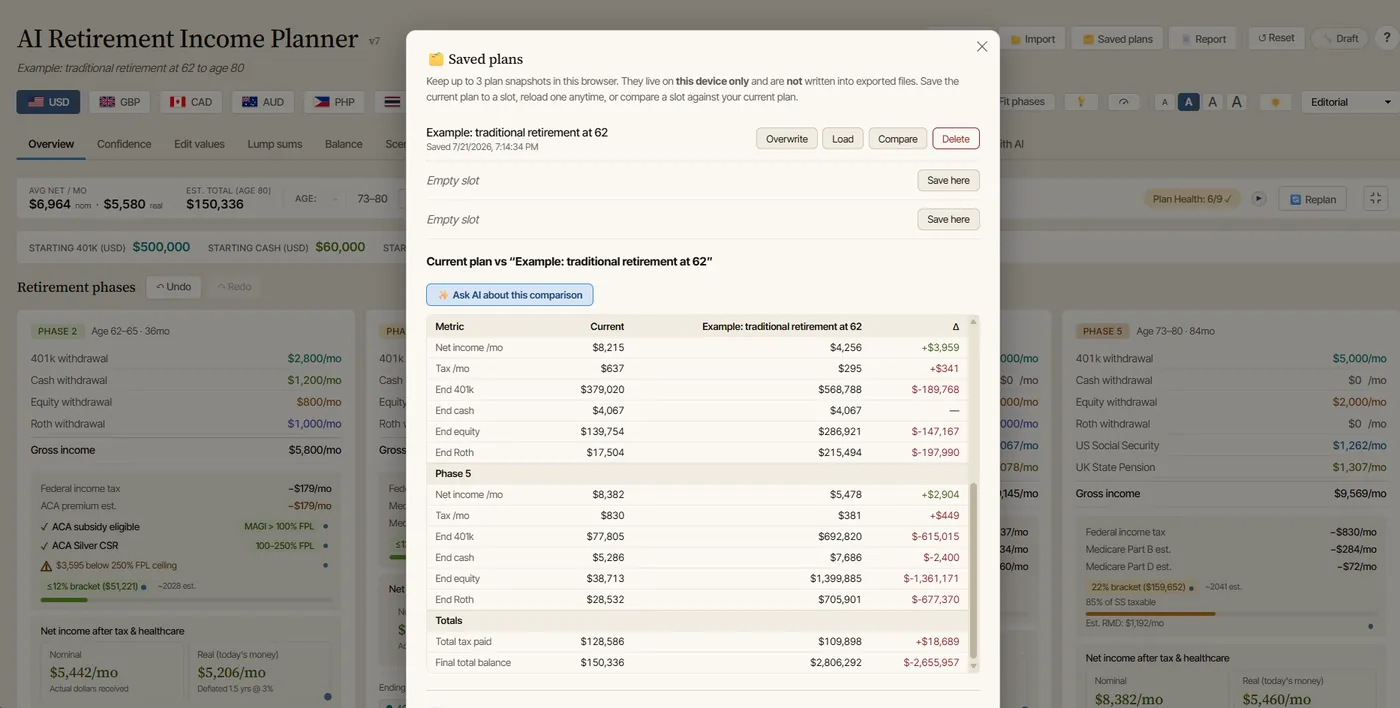
The value is not that the tool hands over one final answer. It is that it makes the review faster, clearer, and easy to repeat, which is the whole idea of a plan you can question. From here, a companion resource, our list of questions to ask your retirement plan, gives you a ready set of prompts to run against your own plan the same way this retiree ran them against theirs.
FAQ
What is the point of a retirement plan case study if the numbers are made up?
The numbers are a vehicle, not the lesson. A case study shows the process: how a vague "can I afford it?" becomes a phase-by-phase plan with specific, answerable questions about taxes, healthcare, real income, and ending balances. You replace the example figures with your own balances, income estimates, and assumptions, then run the same review. The value is the structured method, which works regardless of the particular dollar amounts.
Why start with a rough estimate at all if it is incomplete?
Because it gives you something to improve. "I have $605,000 and want $54,000 a year" is not a plan, but it is a starting point that immediately raises the right questions: how much is taxable, what does healthcare cost before Medicare, how does inflation affect later income, which account funds each phase. A rough estimate is where planning begins, not where it ends, and trying to skip straight to a perfect answer usually means never starting.
Why is the phase before Medicare treated as the most delicate?
Because before 65, the account you withdraw from changes your healthcare cost, not only your tax bill. If you use ACA marketplace coverage, higher income can reduce premium tax credits and cost-sharing reductions. A traditional IRA withdrawal raises that income; cash and qualified Roth withdrawals generally do not. So funding the early years from a careful mix, rather than defaulting to pre-tax withdrawals, can protect thousands in healthcare cost while the rest of the plan stays on track.
Does an improved plan always mean more income?
No, and that is one of the most useful lessons. An improved plan is often a cleaner structure rather than a bigger monthly number: better account order, more intentional use of low tax brackets, less future RMD pressure, and stronger later flexibility. It may even pay slightly more tax early or produce slightly less early income, and still be better, if that protects healthcare eligibility, later real income, or ending balances. You judge it on the whole plan, not one figure.
Where can I get the full framework?
This case study summarizes it, but the complete step-by-step framework, including the full input checklist and question lists, is in the free companion eBook, Build a Retirement Plan You Can Question. You can download it here.
Source Links
- Consumer Financial Protection Bureau, Planning for Retirement: https://www.consumerfinance.gov/consumer-tools/retirement/
- Investor.gov, Retirement Toolkit: https://www.investor.gov/additional-resources/retirement-toolkit
- IRS, Retirement Topics, Required Minimum Distributions (RMDs): https://www.irs.gov/retirement-plans/plan-participant-employee/retirement-topics-required-minimum-distributions-rmds
- HealthCare.gov, Marketplace and premium tax credits: https://www.healthcare.gov/lower-costs/
- AI Retirement Income Planner: https://airetirementincomeplanner.com/
Educational Disclaimer
This article is for general education only. It is not financial, tax, investment, legal, healthcare, Social Security, Medicare, or retirement advice. The figures are a simplified, hypothetical example and do not represent a recommendation for any real person. Any projection depends on assumptions that may not hold. Verify important numbers and rules with official sources and a qualified professional before acting.