
Quick Answer
The goal of your first planning session is not a perfect retirement plan. It is a clear baseline: your first working version, built from your current balances, your best estimate of future income and spending, and reasonable assumptions. It does not need to be final or solve every question. It only needs to be organized well enough that you can review it.

That matters because without a baseline every question stays abstract. With one, each question has a place to land: you can see which phase is strongest, which is weakest, test Social Security timing, adjust withdrawals, check taxes and healthcare, compare strategies, and save a revised version to compare against the original. This article walks through a practical first session, gathering your inputs, building and reading the baseline, saving it, then reviewing and improving one change at a time.
This is the twelfth article in our framework series drawn from the free companion eBook, and it brings the whole framework together into a workflow. The previous one covered keeping your plan current, the habit that a first baseline eventually feeds into, and the next one walks a single example through the whole framework in a retirement plan case study.
📘 Free companion eBook: this series is drawn from Build a Retirement Plan You Can Question. Get the full framework free.
Key Takeaways
- Aim for clarity, not certainty. A first session should end with a baseline you understand, not a plan that answers everything.
- Use reasonable estimates. Do not stall trying to make every number exact; you can refine later.
- Keep accounts separate. Enter balances by type, because a dollar in a Roth, a 401(k), cash, or a brokerage behaves very differently.
- Read the baseline before changing it. The first review is about understanding which phase is strong and which is weak.
- Save the baseline first. Then change one thing at a time so you can see what each change does.
- End with versions and a note. Keep a baseline, an improved version, and a conservative test, and write down your decisions.
The Goal Is a Baseline, Not Perfection
It is tempting to treat a first session as the moment you solve retirement. It is not. The baseline is meant to reveal problems, not hide them, so if the first version shows weak income, a low ending balance, high taxes, or a healthcare warning, that is the session working. You now know what to review. The most common first-session mistake is trying to make every number perfect before you start; reasonable estimates get you a structure you can question, and questioning is where the real planning happens. If you have never opened the planner, the getting-started guide walks through the very first screens and the step-by-step setup walkthrough covers the full setup from the wizard to a saved plan, while the overview of what preparing for retirement involves sets out what a first session is ultimately building toward.
Part 1: Gather Your Inputs
Before you build anything, collect the raw material, using estimates where you have to.
Start with the basic shape: your current age, expected retirement age, plan end age, filing status, tax residency, and expected location. Current and retirement age set where the plan begins; the end age sets how long the money must last; filing status and location drive taxes and healthcare.
Then gather account balances by type, not as one lump: traditional 401(k) and IRA, Roth, cash, taxable brokerage, and any pension or annuity value. This separation is not busywork, because each behaves differently for tax and withdrawal planning, which is the whole reason the framework treats retirement as a timeline of phases funded from different sources.
Next, set reasonable growth assumptions tied to each account (a lower rate for cash, a higher long-term rate for a diversified portfolio), and resist the urge to use optimistic returns to force the plan to work. If it only works at high returns, that is useful information. Then enter your income sources (Social Security, pensions, annuities, rental, part-time) with amounts and start ages, picking one Social Security claiming age for the baseline. Add your spending in today's dollars, split into essential and discretionary if you can, since the two carry different risk. Finally enter your healthcare expectations by phase (ACA before Medicare, then Part B and D after) and your tax parameters, using current values, and verifying them whenever a decision sits near a threshold.
Part 2: Build and Read the Baseline
With inputs in place, set a baseline withdrawal pattern: for each phase, a first estimate of how much comes from traditional accounts, Roth, cash, brokerage, and guaranteed income. Do not worry if it is imperfect. Then, and this is the important part, read the plan before you touch it. On the Overview tab, look at each phase's gross income, tax estimate, healthcare cost, net and real income, withdrawals, ending balance, and any warnings, and simply notice which phase looks strongest, which looks weakest, whether net income covers the target, whether real income holds up, and which number surprises you. The first review is about understanding, not fixing.
Then save the baseline under a clear name (Baseline Plan, 2026 Baseline, Retire at 62 Baseline) before you change anything. This one habit prevents the most frustrating first-session outcome: adjusting withdrawals, claiming ages, and conversions until you have lost track of where you started and can no longer tell what helped.
Part 3: Review and Improve
Now the plan can be questioned. Start with the Plan Health review to see which checks are strong, which are borderline, and which need attention, remembering that a warning is a prompt to weigh a trade-off, not an automatic failure. Then find the weakest phase, often the pre-Medicare years, the bridge before Social Security, or the first RMD phase, and focus there first, because solving the weakest phase usually lifts the whole plan more than small tweaks everywhere.
From there, change one thing at a time and review the effect on income, taxes, healthcare, ending balances, and Plan Health after each. A few changes are almost always worth testing early: different Social Security claiming ages (judged on later real income and portfolio pressure, not just the monthly benefit), your tax bracket position across phases, your healthcare-sensitive years (ACA MAGI before Medicare, IRMAA after), and a comparison of withdrawal strategies by fit rather than by highest income. If you use the optional AI review, do it once the baseline is saved: ask for a summary and the main risks, then follow up specifically, and review each proposed change before applying only the ones you understand and agree with.
Part 4: Save Versions and Write It Down
Once you have adjustments that look useful, save an improved scenario as a separate version rather than overwriting the baseline, so you can compare where you started against what changed. Then build a conservative test: lower returns, higher inflation, higher healthcare costs, a longer plan end age, and see whether the plan still holds. That version does not have to become your main plan; it is a stress test, and a plan that survives it earns confidence while one that fails still tells you where you need a response plan.
Finally, write a short planning note: the date, your baseline assumptions, the main risk you found, the best improvement you tested, the scenarios you saved, the open questions, the values that need verifying, and your next review date. A few lines are enough. Retirement planning is many small decisions, and a note stops you from wondering months later why you made them.
How the Planner Gets You Started
The AI Retirement Income Planner is built to make this first session concrete rather than intimidating. It opens pre-filled with a full example plan, so you are never staring at a blank form; you see a working timeline of phase cards immediately and can replace the example numbers with your own. A first-run welcome offers a short path to learn the tool, a Concepts Primer, a feature tour, and a Setup Wizard that walks you through the key inputs (ages, balances by account, income sources, spending, healthcare, and tax settings) in order, which is exactly the Part 1 gathering above turned into a guided flow.
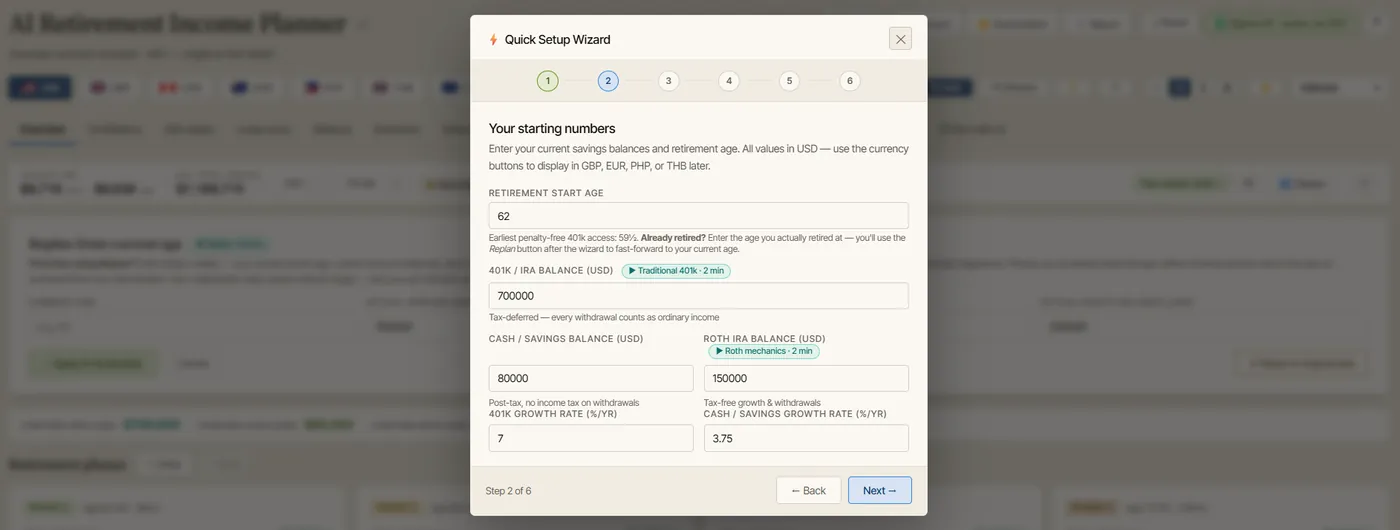
From there the rest of the session maps straight onto the tabs. The Overview tab is where you read the baseline phase by phase. The Confidence tab is the Plan Health review. Saved plans holds your baseline, improved, and conservative versions side by side (three slots) so you can compare them. The Drawdown tab compares withdrawal strategies against your plan, and the optional AI Chat and Plan-with-AI features review the plan you have built and propose changes you approve. Because the whole model recalculates on every edit, testing one change at a time shows its full effect immediately, which is what makes the read-save-review-improve rhythm practical. A good first session does not end with certainty. It ends with clarity: you know which phase is strongest, which needs review, whether income and real income hold up, whether taxes and healthcare need attention, and which questions to follow up. That is a strong start, and you can improve the plan from there.
FAQ
What should my first retirement planning session actually produce?
A clear baseline, not a finished plan. The baseline is your first working version, built from current balances, estimated future income and spending, and reasonable assumptions. It should be organized well enough to review, so you can see which phase is strongest and weakest, whether income and real income hold up, and where taxes or healthcare need attention. A good first session ends with clarity about what to review next, not certainty that everything is solved.
Do I need exact numbers to start?
No. Use reasonable estimates and refine later. Trying to make every number perfect before you begin is the most common first-session mistake, because it stops you from getting a structure you can actually question. Rough balances, a reasonable growth assumption, and a best-guess spending figure are enough to build a baseline that reveals the real issues, which you can then improve with better inputs over time.
Why should I keep my accounts separate instead of using one total?
Because account type changes the tax and withdrawal picture completely. A dollar in a traditional 401(k) or IRA is taxable on withdrawal and drives future RMDs; a Roth dollar is generally tax-free and invisible to healthcare income measures; cash adds no taxable income; a brokerage dollar is taxed only on its gain. Entering balances by type lets the plan model the order you draw from them, which is one of the most important retirement decisions.
What is the single most important habit in a first session?
Save the baseline before you change anything. If you start adjusting withdrawals, Social Security timing, and conversions without a saved starting point, you quickly lose track of what actually helped. With a saved baseline, you can test one change at a time, keep an improved version and a conservative stress test as separate scenarios, and always compare back to where you began.
Where can I get the full framework?
This series summarizes it, but the complete step-by-step framework is in the free companion eBook, Build a Retirement Plan You Can Question. You can download it here.
Source Links
- Consumer Financial Protection Bureau, Planning for Retirement: https://www.consumerfinance.gov/consumer-tools/retirement/
- Investor.gov, Retirement Toolkit: https://www.investor.gov/additional-resources/retirement-toolkit
- Social Security Administration, Retirement Benefits: https://www.ssa.gov/benefits/retirement/
- AI Retirement Income Planner: https://airetirementincomeplanner.com/
Educational Disclaimer
This article is for general education only. It is not financial, tax, investment, legal, healthcare, Social Security, Medicare, or retirement advice. Any projection depends on assumptions that may not hold, and a baseline plan is a starting point for review, not a recommendation. Verify important numbers and rules with official sources and a qualified professional before acting.