
Quick Answer
Retirement is easier to plan when you stop treating it as one long, uniform period and start treating it as a timeline with turning points. Some of those turning points are set by age (penalty-free account access, Social Security, Medicare, required minimum distributions), some by your own choices (when you retire, when you claim), and each one changes the planning question.

A phase is simply a stretch of retirement where the same conditions apply: the same income sources, the same healthcare rules, the same tax situation. Break retirement into phases and you can ask a much better question than "how much can I withdraw?" You can ask, phase by phase, what does this period need to accomplish, and does today's decision weaken a later phase?
This is the second article in our framework series drawn from the free companion eBook. If you have not read it yet, start with why a retirement plan should be a working model, not one number.
📘 Free companion eBook: this series is drawn from Build a Retirement Plan You Can Question. Get the full framework free.
Key Takeaways
- Retirement income is best planned as a timeline, not a single average year.
- Common age milestones (59½, 62, 65, 67, 70, 73) mark points where the plan may change. They do not tell you what to do; they tell you when the question changes.
- Each phase has its own job: bridge to Social Security, keep income under an ACA threshold, use a low-tax window before required minimum distributions, protect a reliable income floor.
- The ending balance of one phase is the starting balance of the next, so the phases form a chain of trade-offs.
- The planner builds this timeline for you: the Overview tab shows retirement as phase cards with editable age boundaries, and it recalculates the later phases whenever you change something. If you are new to it, the step-by-step setup guide walks through building this from scratch.
Why One Number Cannot Tell You How to Produce the Income
Most plans start with a spending target: "I need about $4,000 a month." That is a useful figure to know, but it does not tell you how to produce that income safely, because the same $4,000 can come from very different places:
- Social Security plus small portfolio withdrawals.
- 401(k) withdrawals in the years before Social Security starts.
- Cash and taxable brokerage sales.
- Pension income plus Roth withdrawals.
- A blend of accounts, cash, rental income, and part-time work.
Each mix has a different tax result, affects the remaining portfolio differently, and interacts differently with healthcare costs. And crucially, the same target behaves differently at different points in retirement. A $4,000 target before Medicare is not the same as $4,000 after Medicare begins. A $4,000 target before Social Security is not the same as after it starts. A $4,000 target before required minimum distributions is not the same as after they kick in.
The number can stay flat while the plan behind it changes completely. That is exactly why a timeline matters, and it is a big part of how much you can actually spend in retirement.
The Age Milestones That Create Phases
Retirement has a handful of common milestones. Not everyone uses all of them, but together they give you a starting structure:
- 59½: most retirement accounts become accessible without the early-withdrawal penalty. This matters a lot if you retire before Social Security or Medicare.
- 62: the earliest age Social Security retirement benefits can usually begin. Claiming early starts income sooner but generally at a lower monthly benefit than waiting.
- 65: Medicare eligibility usually begins. For anyone who has been on ACA marketplace insurance, retiree coverage, or self-pay, this is often a major cost change.
- 67: a common planning reference for full retirement age (the exact age depends on birth year), the point at which Social Security is no longer reduced for claiming early.
- 70: delayed-claiming credits stop growing, so this is usually the latest practical age to start Social Security.
- 73 or 75: the age required minimum distributions (RMDs) begin for retirees with traditional pre-tax accounts: 73 if you were born from 1951 to 1959, 75 if you were born in 1960 or later. RMDs can force taxable withdrawals even if you do not need the cash.
None of these milestones tell you what to do. They mark the points where the plan may change: before 65 you may care intensely about ACA income thresholds; after 65 the focus shifts to Medicare premiums and IRMAA; before Social Security your portfolio carries more of the load; after RMDs begin you have less control over taxable income.
The Planner's Default Five-Phase Timeline
The planner turns those milestones into a working structure. By default it splits retirement into five phases, with sensible starting boundaries you can change to match your own situation:
| Phase | Default ages | What tends to change |
|---|---|---|
| Phase 1 | Retirement to 62 | The years before Social Security. Cash, 401(k)/IRA, brokerage, or part-time work carry the income. If you are under 65, ACA and MAGI matter. |
| Phase 2 | 62 to 65 | Social Security can begin here. Still before Medicare, so ACA thresholds may still apply. |
| Phase 3 | 65 to 67 | Medicare has begun. ACA concerns give way to Medicare premiums and possible IRMAA surcharges. |
| Phase 4 | 67 to 73 | Full retirement age reached. The low-tax window that runs right up to RMDs, so often the best stretch for testing Roth conversions. |
| Phase 5 | 73 to plan end | The RMD years, which begin at 73, or at 75 for anyone born in 1960 or later. Taxable income may rise whether or not you need the cash. |
Two things make this more than a fixed template:
- You edit the boundaries. Those ages (62, 65, 67, 73) are inputs, not hard-coded rules. If your Medicare, claiming, or retirement dates differ, change them and the phases redraw.
- The timeline adapts to you automatically. If you retire before 59½, the planner adds a separate "Pre 59½" phase, because most retirement accounts carry a 10% early-withdrawal penalty until then — the phase is where you decide whether to leave them alone, pay that penalty, or claim an exception such as the Rule of 55. And it splits a phase at your Social Security start age, showing a "before Social Security" and "after Social Security" half so the change is visible right where it happens.
Each Phase Has Its Own Job
The reason phases are useful is that each one groups together a set of conditions, which gives it a job to do. In one phase the job is to bridge the gap until Social Security begins. In another it is to keep income low enough to manage ACA costs. In another it is to use low tax brackets before RMDs begin. In another it is to protect a reliable income floor while allowing more flexible spending from investments.
That changes how you evaluate the plan. Instead of asking whether the entire retirement is good or bad, you ask what each phase needs to accomplish:
- Does Phase 1 produce enough income before Social Security?
- Does Phase 2 avoid unnecessary healthcare costs?
- Does Phase 3 preserve enough for later years?
- Does Phase 4 make good use of lower-tax years?
- Does Phase 5 stay workable once RMDs begin?
Five smaller, clearer questions are far easier to review than one giant retirement calculation.
The Ending Balance Links the Phases Together
The most important connection between phases is the ending balance. Whatever remains at the end of one phase becomes the starting point for the next. Draw down too aggressively early and the next phase starts weaker. Keep withdrawals too low and the portfolio grows, but you may live more tightly than you needed to.
A low ending balance is not automatically wrong. Some retirees deliberately spend down assets, especially with strong guaranteed income; others want to preserve a cushion for healthcare, a long life, or legacy. The point is not whether the balance falls. The point is whether the decline is understood, intentional, and still leaves the later phases workable. Because the planner shows each phase's ending balance and carries it into the next, that trade-off is visible instead of hidden. (The ending balance gets a closer look later in this series.)
The Same Withdrawal Can Land Differently in Different Phases
Here is the idea that makes the timeline click. A $10,000 withdrawal does not have the same effect everywhere:
- In one phase it fills an unused low tax bracket and reduces future RMD pressure.
- In another it pushes income above an ACA subsidy threshold.
- In another it triggers or raises an IRMAA surcharge.
- In another it simply covers needed spending with little downside.
The same dollar amount can be smart in one phase and costly in the next. That is why a withdrawal decision is never only about how much. It is about when the money comes out, which account it comes from, what it does to taxable income and healthcare costs, and what balance remains afterward. Deciding which account to draw from first, and when to claim Social Security, are phase-by-phase questions, not one-time ones.
How the Planner Builds the Timeline
The AI Retirement Income Planner is built around exactly this idea. The Overview tab shows retirement as a set of phase cards, one per period of the plan.
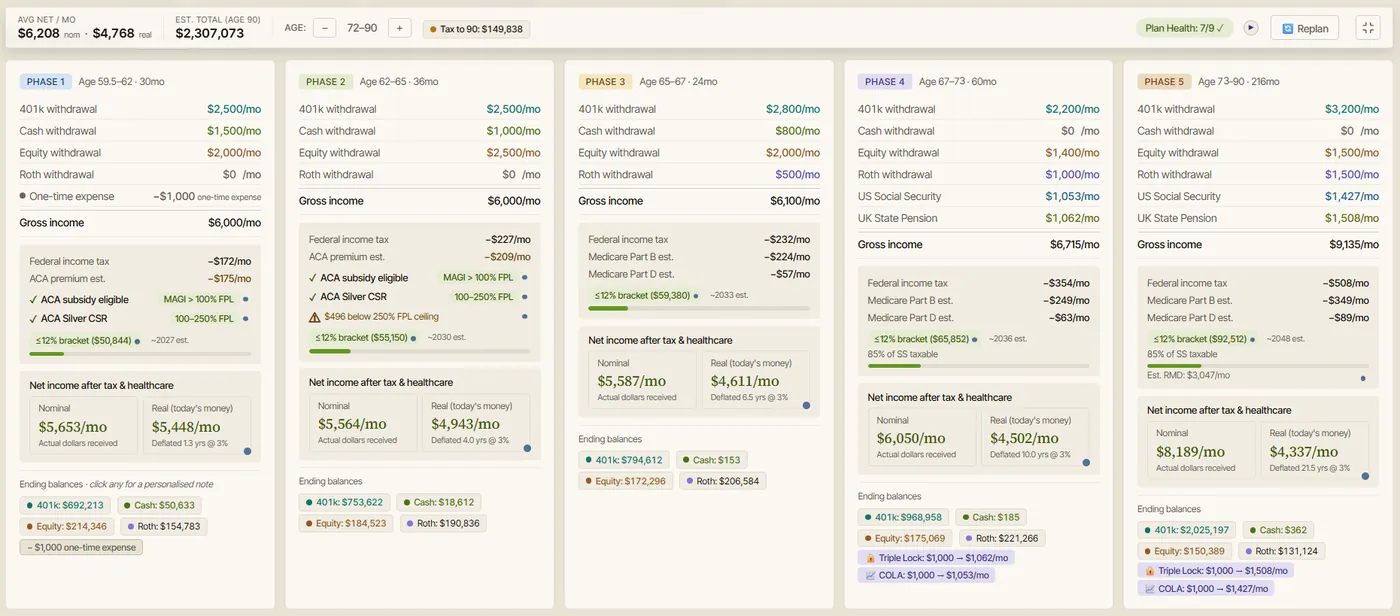
Each card lays out that phase's income sources, withdrawals, estimated taxes, healthcare costs, net income, real income, and ending balance. Because the whole thing is a connected model, you can test a change without rebuilding anything:
- Increase a withdrawal in one phase and the plan recalculates.
- Change your Social Security timing and the later phases update.
- Adjust a tax or healthcare assumption and only the affected phases move.
This matters because retirement planning is an adjustment process. You rarely get the right answer by entering one set of assumptions and accepting the first result. You build a baseline, review it, make a change, review the effect, and decide whether the trade-off is worth it. A phase-based view makes that loop fast because you can see exactly where each change lands. If you are retiring around 62 and bridging to Medicare, the planner's phase view is what makes questions like can I retire at 62 before Medicare answerable rather than guessed.
Build Your Own Timeline First
Before you calculate anything, sketch a rough timeline. Start with your expected retirement age, then add any age where something important changes:
- Retirement account access and the end of employment income.
- Start of part-time or pension income.
- Your Social Security claiming age (and a spouse's, if relevant).
- Medicare eligibility and the end of ACA coverage.
- Start of RMDs.
- Any planned relocation, currency or residency change, mortgage payoff, or expected change in spending or healthcare costs.
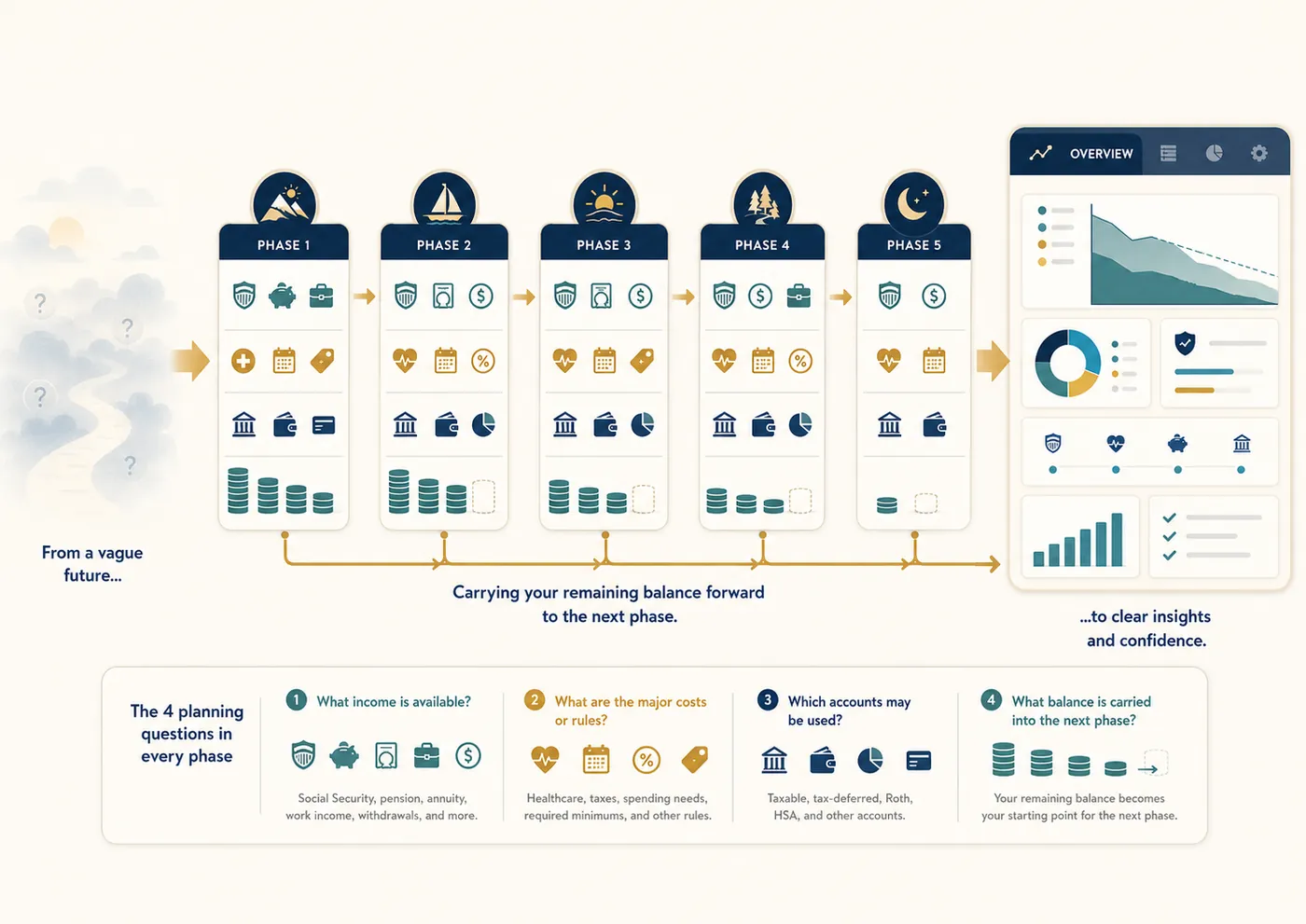
You do not need a perfect list. You just need enough structure to separate one phase from another. Then, for each phase, jot down four things: which income sources are available, which major costs or rules apply, which accounts may need to be used, and what balance should remain for the next phase. That simple exercise turns retirement from a vague future into a sequence you can actually analyze, which is precisely what the planner's Overview tab then does with real numbers.
The next article in the series looks at what fills that timeline: why your monthly income number is only the start, and how gross, net, and real income tell you very different things.
FAQ
How many phases should a retirement plan have?
Enough to separate the periods where the rules change, and no more. The planner defaults to five phases (plus an automatic pre-59½ phase and a Social Security split when they apply), which covers the usual milestones: before Social Security, before and after Medicare, the pre-RMD window, and the RMD years. If your situation is simpler or more complex, you move the boundary ages to fit.
What if I retire much earlier or later than the defaults?
Change the boundaries. Retire at 55 and you will want a longer early phase before penalty-free account access and Social Security; the planner also adds a dedicated pre-59½ phase. Retire at 70 and you may begin with Social Security, Medicare, and portfolio withdrawals all active at once. The defaults are a starting point, not a rule.
Why does the ending balance matter so much between phases?
Because each phase hands its ending balance to the next as a starting balance. A phase can hit its income target and still weaken the following phase by drawing down too fast. Seeing the balance carried forward, phase by phase, is what tells you whether the current period is supporting the future or consuming it.
Where can I get the full framework?
This series summarizes it, but the complete step-by-step framework is in the free companion eBook, Build a Retirement Plan You Can Question. You can download it here.
Source Links
- Social Security Administration, Retirement Benefits: https://www.ssa.gov/benefits/retirement/
- Medicare.gov, When does Medicare coverage start: https://www.medicare.gov/basics/get-started-with-medicare
- IRS, Retirement Topics, Required Minimum Distributions (RMDs): https://www.irs.gov/retirement-plans/retirement-topics-required-minimum-distributions-rmds
- AI Retirement Income Planner: https://airetirementincomeplanner.com/
Educational Disclaimer
This article is for general education only. It is not financial, tax, investment, legal, healthcare, Social Security, Medicare, estate, or retirement advice. Any projections depend on assumptions that can change, and no plan can guarantee future results. Verify important numbers and rules with official sources and a qualified professional before acting.