
Quick Answer
Most retirement plans treat healthcare as a fixed monthly bill. For a large stretch of retirement it is anything but fixed, because before age 65 your health insurance costs can rise and fall with your income, and after 65 a high enough income can add a surcharge to your Medicare premiums. The same withdrawal that looks affordable on a tax spreadsheet can cost noticeably more once its effect on healthcare is counted.

That is the heart of this article: healthcare belongs inside the income plan, not in a separate column added at the end. A withdrawal is not only taxable income. It may reduce ACA premium assistance, forfeit cost-sharing help, or lift the income figure Medicare uses for surcharges. The goal is not to hold income as low as possible forever. It is to see the trade-off clearly and decide on purpose.
This is the sixth article in our framework series drawn from the free companion eBook. The previous one covered how taxes change the shape of retirement income, and it ended by pointing here, because a tax decision is very often a healthcare decision too.
📘 Free companion eBook: this series is drawn from Build a Retirement Plan You Can Question. Get the full framework free.
Key Takeaways
- Healthcare is phase-specific. The years before Medicare, the Medicare years, and later retirement each need their own review, because the cost structure changes at 65.
- Before Medicare, income drives cost. ACA premium tax credits and cost-sharing reductions are tied to income, so your withdrawal strategy can raise or lower your healthcare bill.
- MAGI is the hinge. The same spending funded from cash, Roth, brokerage, or a traditional account produces very different MAGI, and MAGI is what healthcare programs watch.
- After 65, watch IRMAA. Higher income can trigger Medicare surcharges on Part B and Part D, often on a two-year lookback, so a move today can raise a premium later.
- There is a real tension. Keeping income low protects ACA help but can leave a traditional account to grow into a bigger future RMD, so the right answer depends on your numbers.
- Put healthcare in net income. A plan that shows income before healthcare overstates comfort.
Healthcare Is Phase-Specific
Healthcare planning is not one decision made once. It changes across the retirement timeline. Before Medicare, a retiree might rely on employer retiree coverage, a spouse's plan, ACA marketplace insurance, private cover, a health-sharing arrangement, or coverage in another country. At 65 the structure shifts to Medicare Part B, Part D, supplemental cover or Medicare Advantage, and the possibility of IRMAA surcharges. Later retirement may need a larger reserve for higher care needs.
Because the rules and the costs change at these boundaries, a phase-based plan is the natural way to review them. It lets you look at healthcare in the years each version actually applies, rather than assuming one flat premium for all of retirement. The period from retirement to Medicare may call for one strategy, and the Medicare years quite another.
Before Medicare: The Early-Retirement Gap
For many US retirees the years before Medicare are the most income-sensitive of all. Retire at 62 and there are roughly three years to bridge before Medicare at 65. Retire at 60 and it is about five. During that gap, if there is no spouse's plan or retiree medical coverage, health insurance before Medicare usually means the ACA marketplace, and that is exactly where income planning starts to matter.
ACA premium tax credits and cost-sharing reductions are linked to income, so a retiree who funds spending with large traditional IRA or 401(k) withdrawals raises taxable income, raises MAGI, and can reduce their own subsidy. The important insight is that the same spending need can produce very different healthcare outcomes depending on where the money comes from:
- Spending from cash usually does not raise taxable income.
- A qualified Roth withdrawal usually does not raise it either.
- A traditional IRA/401(k) withdrawal usually raises it in full.
- A brokerage sale raises income only by the gain portion.
- Part-time work or rental income can raise MAGI.
So the ACA-years question is not just "can I afford the premium." It is "how does my income plan change the premium."
MAGI: The Number Healthcare Watches
MAGI, modified adjusted gross income, is the hinge that connects income choices to healthcare cost. For ACA purposes it helps set your premium tax credits and cost-sharing reductions. For Medicare, income from a prior year feeds the IRMAA surcharge calculation. The precise formula differs by program, but the planning idea is simple: some income choices push that number up and some do not.
Picture a retiree who needs an extra $10,000 of spending before Medicare. Drawn from a traditional IRA, it may lift MAGI by the full $10,000. From cash, it may not move MAGI at all. From a Roth, a qualified withdrawal may leave MAGI untouched. From a brokerage account, only the gain portion may count. Same spending, very different healthcare consequence, which is why the source of income deserves as much thought as the amount. This is also why the order you draw from your accounts is a healthcare decision, not only a tax one.
ACA Premium Credits and the Income Range
ACA premium tax credits lower the monthly cost of marketplace coverage for eligible households, and the amount depends on household income, size, location, and the benchmark plan. For early retirees the practical effect is that income planning has a healthcare price attached. If income rises, your expected share of the premium can rise. If income falls, assistance can grow.
That leads to a question many retirees never think to ask: what income range am I trying to stay within during the ACA years? It may not be the same as the ideal tax range. A retiree can have plenty of room left in a low federal bracket and still choose not to use all of it, because filling it would cost more in lost healthcare assistance than it saves in tax. This is the clearest reason taxes and healthcare have to be reviewed together rather than in separate rooms.
Cost-Sharing Reductions: More Than the Premium
Premiums are only half the ACA story. Cost-sharing reductions, or CSR, lower deductibles, copays, coinsurance, and out-of-pocket maximums for eligible people who choose a qualifying Silver plan. For some early retirees CSR is worth as much as the premium subsidy itself, because a cheap-looking plan with a huge deductible can still make care expensive.
The trap is planning around the monthly premium alone. If your income qualifies you for strong CSR, a Silver plan can offer far better real-world protection than a cheaper Bronze plan that forfeits it. So the questions become: am I only chasing a low premium, or also preserving cost-sharing help; would a larger withdrawal push me past the CSR range; and would using cash or Roth keep income in a better band. We cover this in depth in our guide to the ACA Silver-plan CSR advantage.
The ACA-vs-RMD Tension
Managing income down for ACA reasons has a cost of its own, and a good plan makes it visible. Keeping income low before Medicare protects healthcare assistance, but it can also leave traditional accounts untouched, growing toward a larger required distribution later. That creates a genuine tension: hold income low now for healthcare, or use some low-bracket space now to defuse a future RMD problem.
There is no automatic answer. A retiree with a very large traditional IRA may decide some extra taxable income is worth it. One with high healthcare sensitivity may decide preserving ACA help matters more. Many split the difference, taking modest traditional withdrawals and funding the rest from cash or Roth. The point of a plan is to let those options be compared rather than guessed.
Medicare Changes the Question: IRMAA
At 65, Medicare eligibility usually simplifies one thing and introduces another. The ACA marketplace may fall away, replaced by Part B premiums, Part D, supplemental cover or Medicare Advantage, and the possibility of IRMAA. IRMAA, the Income-Related Monthly Adjustment Amount, is an extra premium that higher-income beneficiaries pay on Part B and Part D.
Its importance is that it turns an income decision into a healthcare-cost decision. A retiree weighing a large Roth conversion might find the tax acceptable, then discover the conversion lifts income enough to trigger IRMAA, so the true cost is tax plus higher Medicare premiums. Crossing an IRMAA threshold can still be worth it, because the conversion, sale, or withdrawal may bring benefits that justify the surcharge. The point is to know the surcharge is there before deciding, not after the premium notice arrives.
Timing and the Two-Year Lookback
IRMAA has a timing twist that catches people out: the surcharge is generally based on income from a tax return two years earlier. That means a decision now can raise a Medicare premium later. A Roth conversion at 63 can affect premiums at 65. A capital gain at 66 can show up afterward. A large withdrawal can create a surcharge in a future Medicare year.
The exact rules should be checked against current guidance, but the planning principle is steady: a healthcare cost can follow a tax decision by a couple of years. That is why income spikes deserve careful review near Medicare age and during the Medicare years, and why one-time events matter more than their single-year tax bill suggests.
One-Time Income Events
Not all income is recurring. Selling a house, selling investments, a Roth conversion, deferred compensation, a large IRA withdrawal, or capital gains from rebalancing can all spike income in a single year and ripple into both taxes and healthcare calculations, including the IRMAA lookback. Such an event may be perfectly reasonable, but it should be reviewed in the year it happens and in any later year its income touches.
The useful question is whether the event can be timed, split, offset, or funded differently. Sometimes it cannot. Often there is flexibility: a conversion can be sized, a brokerage sale spread across years, a gain offset by a loss, or a large discretionary expense moved to a lower-income year. Healthcare thresholds are what make that timing worth the effort.
Put Healthcare in Net Income
Healthcare shapes real lifestyle, so it belongs in net income rather than as a footnote. A retiree may have strong gross income and a tighter life than expected once premiums, deductibles, prescriptions, and out-of-pocket costs are paid. If gross income is $5,000 a month but healthcare runs $900 before Medicare, the spendable figure is very different, and if a higher withdrawal raises that healthcare cost, the net gain from the withdrawal shrinks. Treating healthcare as a core expense, not a side note, is what keeps a plan honest. And because those costs tend to rise faster than general prices, the next article in this series looks at inflation and real income.
Living Abroad
For retirees living outside the United States, healthcare planning can look completely different. Some countries have lower direct costs or national systems; some require private cover for a visa; some retirees keep US Medicare as a fallback while using local or international insurance. The planning questions shift to which country, whether the local system is accessible, whether private cover is needed, whether Medicare is retained, and how currency moves affect costs paid locally while income arrives in dollars or pounds. Healthcare may be cheaper abroad, but it still belongs in the plan, coordinated with residency, tax, and currency assumptions.
How the Planner Shows Healthcare
The AI Retirement Income Planner keeps healthcare inside the income view, because healthcare and income decisions are connected. On each Overview phase card, a pre-Medicare US phase shows an ACA premium estimate and an ACA Silver CSR band that reads your MAGI against the thresholds ("MAGI at or below 100% FPL", "100 to 250% FPL", or "above 250% FPL"). When a phase sits just under a hard line, the card adds a MAGI headroom badge such as "$3,595 below the 250% FPL Silver-CSR ceiling", and it flags the 400% subsidy cliff and the 150% and 200% CSR steps the same way, so you can see a threshold coming before you cross it. Once a phase reaches Medicare age, those lines switch to Medicare Part B and Part D estimates, and the card flags IRMAA risk when MAGI runs high.
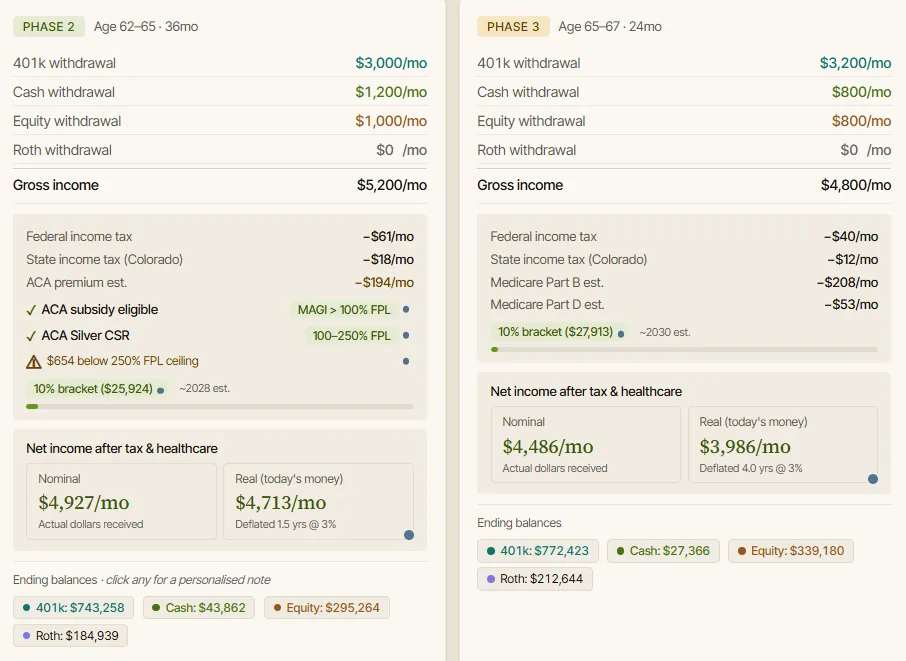
The Tax & ACA tab documents the mechanics: how MAGI is built, how the FPL thresholds (100% floor, 250% CSR ceiling, 400% subsidy cliff) are applied and inflated forward, and how IRMAA is checked against a configurable threshold. Healthcare premiums can inflate at their own healthcare-inflation rate, separate from general CPI, and the Medicare Part B and Part D estimates are yours to set in the Edit values tab. On the Confidence tab, the Plan Health Score runs three healthcare-linked checks: ACA Subsidy Protected (MAGI stays between the 100% and 400% FPL lines across pre-Medicare phases), CSR / Subsidy Headroom (warns when a phase is near the 250% Silver-CSR ceiling or a subsidy cliff), and IRMAA Not Triggered (MAGI stays below the surcharge threshold in Medicare phases), with plain suggestions like using Roth or cash to hold MAGI in range. And for retirees living abroad, selecting a foreign-residence currency marks ACA, Medicare, and IRMAA as not applicable, so the model reflects the actual coverage situation. Because it is one connected model, a larger traditional withdrawal shows the extra tax, any ACA or IRMAA knock-on, and the change in net income together.
Questions to Ask
During the ACA years, before Medicare:
- What is my expected MAGI, and what income range am I trying to stay within?
- Am I trying to preserve premium credits, cost-sharing reductions, or both?
- Which income sources raise MAGI, and which spending sources do not?
- Would a Roth conversion help future tax pressure more than it costs in current healthcare?
Once Medicare begins:
- What are my expected premiums, and am I near an IRMAA threshold?
- Could a withdrawal, capital gain, Roth conversion, or RMD trigger a surcharge two years out?
- Would spreading income across years, or using Roth or cash, keep me under the line?
FAQ
Does my income really change my health insurance cost before Medicare?
Yes. ACA premium tax credits and cost-sharing reductions are tied to income, so higher MAGI can shrink both. Because different funding sources move MAGI differently, the same spending can produce different premiums and out-of-pocket costs depending on whether you draw from cash, Roth, a brokerage account, or a traditional IRA or 401(k). That is why the years before Medicare are the most income-sensitive healthcare years for many retirees.
What is IRMAA and when does it apply?
IRMAA is the Income-Related Monthly Adjustment Amount, an extra premium that higher-income Medicare beneficiaries pay on Part B and Part D. It generally uses income from a tax return two years earlier, so a high-income event today, such as a Roth conversion or a large capital gain, can raise your Medicare premiums a couple of years later. Crossing a threshold can still be worthwhile, but it should be a known cost, not a surprise.
Should I always keep my income low for healthcare reasons?
Not necessarily. Holding income low protects ACA assistance before 65 and avoids IRMAA after, but it can leave a traditional account growing toward a larger required distribution later, which creates its own future tax pressure. The stronger approach is to compare the options, sometimes taking modest traditional withdrawals or Roth conversions in low-income years while funding the rest from cash or Roth, rather than defaulting to the lowest possible income every year.
How is MAGI different from the money I spend?
MAGI is an income measure that healthcare programs use, while your spending is cash flow. They are not the same, because after-tax cash and qualified Roth withdrawals can fund spending without raising MAGI, whereas traditional-account withdrawals usually raise it in full and brokerage sales raise it by the gain. Two retirees with identical monthly spending can therefore face very different ACA and Medicare costs.
Where can I get the full framework?
This series summarizes it, but the complete step-by-step framework is in the free companion eBook, Build a Retirement Plan You Can Question. You can download it here.
Source Links
- HealthCare.gov, Marketplace and income (premium tax credits): https://www.healthcare.gov/lower-costs/
- HealthCare.gov, Cost-sharing reductions (Silver plans): https://www.healthcare.gov/glossary/cost-sharing-reduction/
- Medicare.gov, Part B costs and IRMAA: https://www.medicare.gov/basics/costs/medicare-costs
- IRS, Roth IRAs: https://www.irs.gov/retirement-plans/roth-iras
- Consumer Financial Protection Bureau, Planning for Retirement: https://www.consumerfinance.gov/consumer-tools/retirement/
- AI Retirement Income Planner: https://airetirementincomeplanner.com/
Educational Disclaimer
This article is for general education only. It is not financial, tax, investment, legal, healthcare, Social Security, Medicare, or insurance advice. ACA rules, FPL thresholds, Medicare costs, and IRMAA brackets change, and any projection depends on assumptions that may not hold. Verify important numbers and rules with official sources such as HealthCare.gov and Medicare.gov and a qualified professional before acting.