
Short Answer
Yes, some people can retire at 62 before Medicare starts. The hard part is the gap between Social Security and Medicare.
Age 62 is the earliest age most people can claim Social Security retirement benefits. Medicare usually starts at 65. That leaves about three years where your plan may need to cover private health insurance, taxes, withdrawals, and day-to-day income without the full Medicare safety net. Leaving work earlier only stretches that gap, so retiring at 55 can mean roughly ten years to bridge before Medicare.
The better question is:
Can your income plan cover ages 62 to 65 without creating tax, healthcare, or withdrawal problems later?

Key Takeaways
- Social Security retirement benefits can start as early as 62, but claiming before full retirement age reduces the monthly benefit.
- Medicare is usually first available at 65, so retiring at 62 often creates a health insurance bridge.
- Marketplace coverage may be an option before Medicare. Premium tax credits depend on income and household size.
- Withdrawals from a 401k or IRA can affect taxable income and may affect healthcare subsidy planning.
- A serious age-62 retirement plan should test Social Security timing, healthcare costs, taxes, withdrawals, inflation, and market risk together.
Why 62 Is Tempting
Age 62 feels like the first real retirement doorway.
The Social Security Administration says retirement benefits can begin as early as age 62. It also says full benefits are available only at full retirement age. If you start early, the benefit is reduced for each month before full retirement age.
Source: SSA, Starting Your Retirement Benefits Early
That creates a trade-off:
| Claiming choice | What it can do |
|---|---|
| Claim at 62 | Starts income earlier, but locks in a lower monthly benefit |
| Wait until full retirement age | Gives a higher monthly benefit than claiming early |
| Delay after full retirement age | Can increase the benefit up to age 70 |
For someone born in 1960 or later, SSA lists full retirement age as 67. The same SSA page shows that claiming at 62 produces a reduced benefit compared with the full-retirement-age amount.
That does not mean claiming at 62 is wrong. It means the decision needs context. For a deeper look at that choice, see should you claim Social Security at 62 or wait?
If claiming early lets you avoid selling investments in a bad market, it may help. If delaying gives you a stronger income floor for the rest of your life, it may also help. Couples also need to think about survivor income.
The Medicare Gap
Medicare.gov says most people get Medicare Part A and Part B when first eligible, usually when turning 65.
Source: Medicare.gov, Prepare to sign up
If you retire at 62, you may need health coverage for roughly three years before Medicare begins, and retiring at 60 stretches that bridge to about five years. Health insurance before Medicare is its own planning problem.
Possible sources include:
- A spouse's employer plan.
- Retiree health benefits.
- COBRA for a limited period.
- A Health Insurance Marketplace plan.
- Private insurance.
- Medicaid, if eligible in your state.
HealthCare.gov says that if you retire before 65 and lose job-based coverage, you can use the Marketplace to buy a plan. Losing job-based coverage may also qualify you for a Special Enrollment Period.
Source: HealthCare.gov, Health coverage for retirees
That same HealthCare.gov page says Marketplace applications determine whether you qualify for premium tax credits and lower out-of-pocket costs based on income and household size.
This is why the bridge years need their own plan. Healthcare has its own rules. Income can affect the cost.
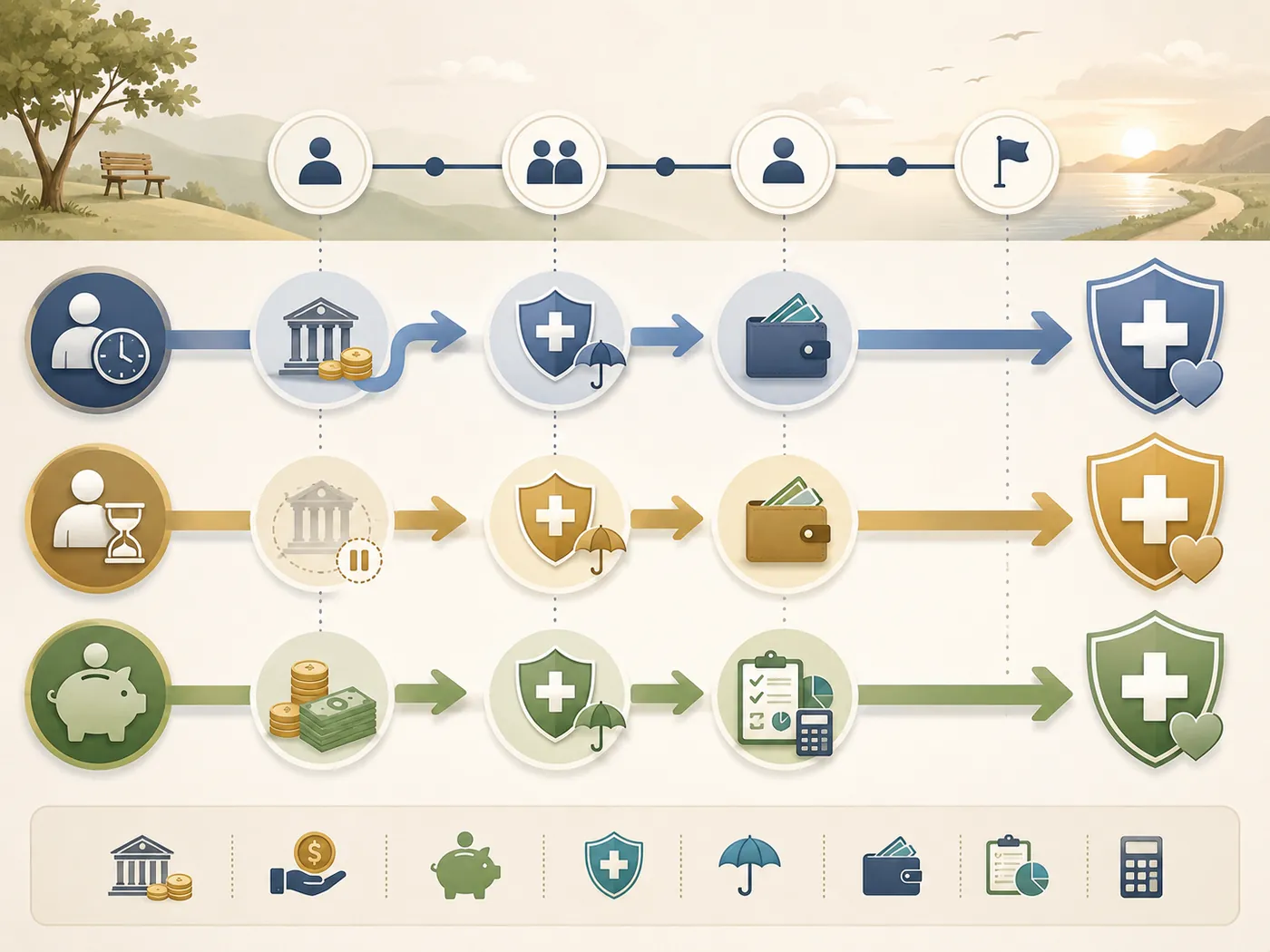
What You Need To Model Before Retiring at 62
Start with these questions:
- What will health insurance cost from 62 to 65?
- What happens if you claim Social Security at 62?
- What happens if you delay Social Security to 67 or 70?
- Which account pays the bills during the bridge years?
- How much taxable income will those withdrawals create?
- Will Roth conversions help or hurt?
- What if markets fall early in retirement?
- What if inflation is higher than expected?
A Simple Example
Assume a 62-year-old wants to retire this year.
| Item | Example |
|---|---|
| Age | 62 |
| Medicare age | 65 |
| 401k balance | $650,000 |
| Cash | $90,000 |
| Taxable brokerage | $220,000 |
| Roth IRA | $130,000 |
| Desired spending | $5,500/month after tax and healthcare |
| Social Security choice | Claim at 62 or delay |
| Healthcare | Marketplace plan until Medicare |
This person does not need a one-word answer. They need to compare a few versions of the plan.
Version 1: Claim Social Security at 62
This may reduce the amount pulled from savings in the first few years.
The trade-off is a lower monthly benefit for life. For couples, it may also reduce the survivor benefit if the higher earner claims early.
Version 2: Delay Social Security
This may create a stronger future income floor.
The trade-off is more pressure on savings between 62 and the claiming age. If the market falls early, those extra withdrawals can hurt.
Version 3: Use Cash as a Bridge
Cash can help fund the bridge years without creating the same taxable income as larger 401k withdrawals.
The trade-off is simple: cash can run down fast. Once it is spent, the plan has less room for surprises.
What Most Simple Calculators Miss
Healthcare and income interact
Marketplace costs may depend on household income and household size. HealthCare.gov says premium tax credits and lower out-of-pocket costs are based on those factors.
That means a 401k withdrawal, IRA withdrawal, pension, capital gain, or Roth conversion can change the healthcare picture. This is why a retirement calculator with taxes and healthcare is more useful than a savings-only estimate.
A dollar is not always a dollar
Spending $1,000 from cash is not the same as withdrawing $1,000 from a traditional 401k.
| Source | Why it matters |
|---|---|
| Cash | Flexible, but limited |
| 401k or traditional IRA | Usually taxable when withdrawn |
| Taxable brokerage | May create dividends, interest, or capital gains |
| Roth | Often useful for tax flexibility |
The order of withdrawals can affect taxes, healthcare subsidy planning, future RMDs, and later retirement income.
Early market losses can do more damage
Retiring at 62 usually means a longer withdrawal period. If markets fall early, withdrawals can lock in losses and make recovery harder. This is sequence-of-returns risk.
The fix is not always "work longer." Sometimes the fix is a better bridge strategy, lower early withdrawals, part-time income, or a different Social Security plan.
How to Model This in the AI Retirement Income Planner
This is the kind of question that belongs in a phase-based retirement model.
Step 1: Set retirement age to 62
Use the Edit values tab to set the start age. The first phase can represent the bridge years before Medicare.
Step 2: Enter the account balances
Add balances for:
- 401k or tax-deferred accounts.
- Cash.
- Taxable equity or brokerage.
- Roth.
The total matters, but the bucket matters too. Each bucket behaves differently.
Step 3: Add healthcare assumptions
Use the Tax & ACA areas to model pre-Medicare coverage. If Marketplace coverage is involved, watch income-sensitive ACA planning.
Step 4: Compare Social Security ages
Use the SS Optimizer or What-if tools to compare claiming at 62, full retirement age, and 70.
Look at:
- Monthly income.
- Portfolio withdrawals.
- Taxes.
- Survivor income if married.
- Ending balances.
- Plan Health.
Step 5: Test a cash bridge
Create one version that uses more cash from 62 to 65. Create another that uses more 401k withdrawals.
Compare:
- Net monthly income.
- Taxable income.
- Healthcare subsidy sensitivity.
- Ending balances.
- Plan Health warnings.
Step 6: Run the stress tests
Use Stress test, Monte Carlo, and historical backtest tools to see how the plan behaves if returns are weak or inflation is higher than expected. Monte Carlo and historical backtesting look at that risk from different angles.
Step 7: Ask the AI co-pilot a specific question
Useful prompts:
- "Can I retire at 62 and delay Social Security to 67 without running out of cash?"
- "Optimize my bridge years before Medicare while keeping healthcare costs manageable."
- "Compare claiming Social Security at 62 versus 67 and explain the trade-offs."
- "Use more cash in Phase 1 so my 401k can keep growing. Show me the trade-offs."
Signs Retiring at 62 May Be Realistic
Retiring at 62 may be more realistic if:
- You have a clear health insurance plan until Medicare.
- You have enough cash or taxable assets for the bridge years.
- You can delay Social Security without over-stressing the portfolio.
- The plan survives weak market and inflation assumptions.
- Taxes and healthcare have been modeled together.
- You have a fallback, such as lower spending, part-time work, or delaying retirement.
Signs You May Need to Adjust
Look more closely if:
- Healthcare costs make the first three years tight.
- The plan depends on strong investment returns.
- Cash runs out before Medicare.
- 401k withdrawals create too much taxable income.
- A spouse would be exposed if one person dies.
- The plan fails under high inflation or poor early returns.
Age-62 Retirement Checklist
Before retiring at 62, model:
- Monthly spending need.
- Health insurance until 65.
- Social Security at 62, full retirement age, and 70.
- Cash bridge strategy.
- 401k withdrawal strategy.
- Roth conversion opportunities.
- ACA income sensitivity.
- Tax brackets.
- Inflation.
- Sequence-of-returns risk.
- Survivor income if married.
- Emergency reserve.
- Part-time work fallback.
FAQ
Can I get Medicare at 62?
Usually, no. Medicare.gov says most people first get Medicare Part A and Part B when first eligible, usually when turning 65. Some people qualify earlier because of disability or certain conditions, but ordinary retirement at 62 does not by itself create Medicare eligibility.
Source: Medicare.gov, Prepare to sign up
Can I claim Social Security at 62?
Yes. SSA says Social Security retirement benefits can start as early as age 62. Claiming before full retirement age reduces the monthly benefit.
Source: SSA, Starting Your Retirement Benefits Early
What health insurance can I use if I retire before 65?
Options may include a spouse's employer plan, retiree coverage, COBRA, Marketplace coverage, Medicaid if eligible, or private insurance. HealthCare.gov says retirees who need coverage can use the Marketplace to buy a plan, and losing job-based coverage may qualify for a Special Enrollment Period.
Source: HealthCare.gov, Health coverage for retirees
Do 401k withdrawals count as income for Marketplace coverage?
HealthCare.gov's retiree coverage page says IRA or 401k withdrawals generally count as income and links to IRS guidance for reporting retirement savings income. This is one reason early retirees should model withdrawals and healthcare together.
Source: HealthCare.gov, Health coverage for retirees
Is retiring at 62 a bad idea?
Not automatically. Retiring at 62 can work for some households. The risk is making the decision with an incomplete model. A good plan should test healthcare costs, Social Security timing, taxes, withdrawals, inflation, and market risk.
Should I claim Social Security at 62 if I retire at 62?
Maybe. Claiming at 62 may reduce portfolio withdrawals early, but it also reduces the monthly benefit compared with waiting. Couples should also consider survivor income. Test the whole plan before deciding.
How the Planner Helps
The AI Retirement Income Planner helps turn the age-62 question into a model you can inspect:
- Use five retirement phases to isolate the bridge years.
- Model cash, 401k, equity, and Roth withdrawals separately.
- Compare Social Security claiming ages.
- Estimate taxes and healthcare costs.
- Watch ACA, IRMAA, RMD, and tax bracket issues.
- Run scenarios, stress tests, Monte Carlo, and historical backtests.
- Use Plan Health to see what needs attention.
- Ask the AI co-pilot to explain trade-offs in plain English.
Try the live demo with a sample plan, then model your own bridge-year question in the AI Retirement Income Planner.
Sources
- Social Security Administration: Starting Your Retirement Benefits Early
- Medicare.gov: Prepare to sign up
- HealthCare.gov: Health coverage for retirees
- HealthCare.gov: Lower costs on Marketplace coverage
Educational Disclaimer
This article is for educational purposes only and is not financial, tax, investment, healthcare, or legal advice. Retirement outcomes depend on personal circumstances, assumptions, tax law, healthcare costs, market performance, inflation, and life events. Consider consulting qualified professionals before making retirement, tax, Social Security, or health insurance decisions.