
Short Answer
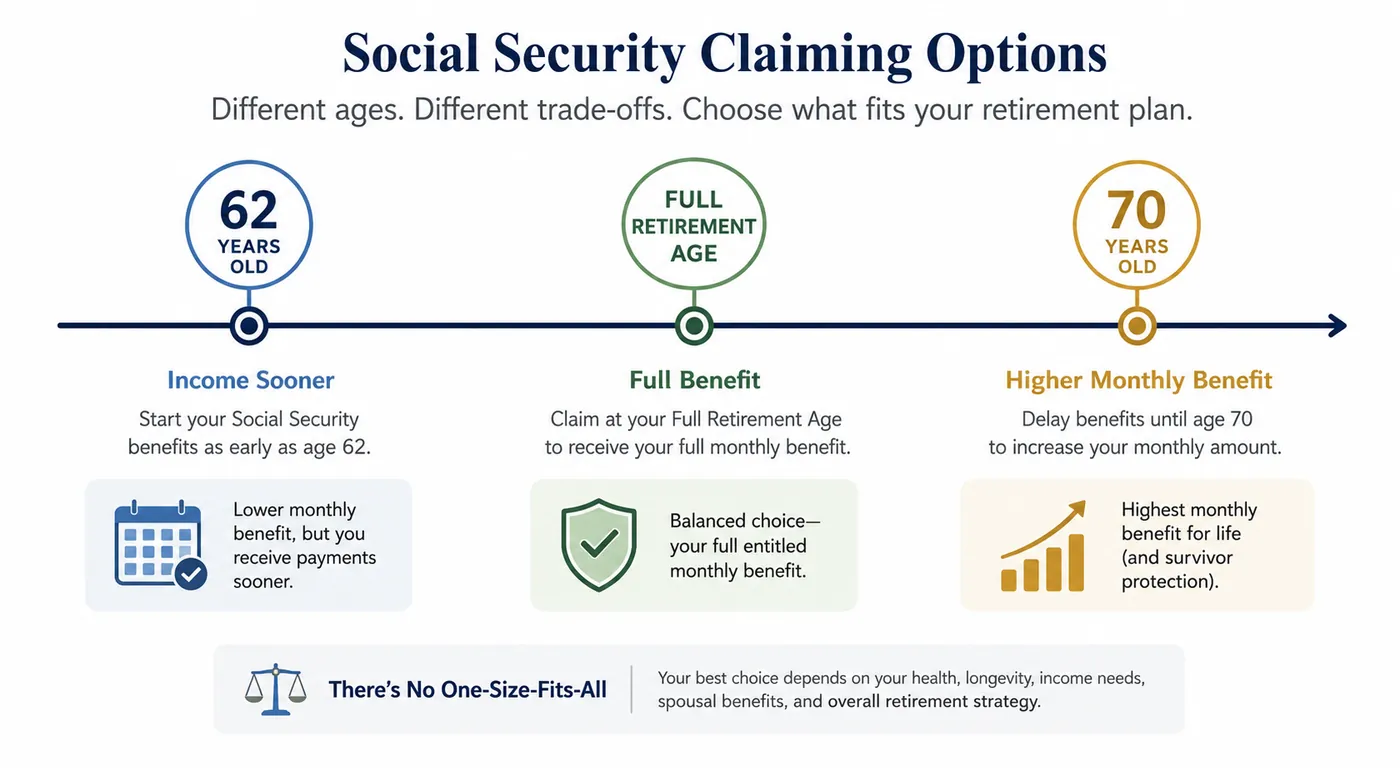
Claiming Social Security at 62 gives you income sooner. Waiting can give you a higher monthly benefit.
The Social Security Administration says you can start retirement benefits as early as age 62, but you receive full benefits only at full retirement age. SSA also says that if you delay benefits from full retirement age up to age 70, your benefit amount increases.
That does not mean everyone should wait. It also does not mean everyone should claim early.
The better question is:
Which claiming age gives your household the strongest retirement income plan after taxes, withdrawals, healthcare costs, life expectancy, and survivor planning are included?
Why This Decision Is Hard
Social Security timing is hard because the first monthly check is only one part of the decision.
Claiming at 62 may help if you need income, want to reduce portfolio withdrawals, have health concerns, or cannot keep working. Waiting may help if you expect a long retirement, want a larger inflation-adjusted income base, or need to protect a surviving spouse.
The right answer depends on the whole household:
- Retirement age
- Other income sources
- Account balances
- Taxable withdrawals
- Healthcare costs before and after Medicare
- Spouse or survivor benefits
- Life expectancy
- Inflation
- Market risk
- Whether you plan to work before full retirement age
That is why this decision should be modeled inside the retirement income plan, not judged from a monthly benefit estimate alone.
What Happens If You Claim At 62?
Age 62 is the earliest age most people can claim Social Security retirement benefits.
SSA says that if you start benefits early, your benefit is reduced by a small percentage for each month before full retirement age. For people born in 1960 or later, SSA's example table shows full retirement age as 67, and a $1,000 full-retirement-age benefit would be reduced to about $700 if claimed at 62.
The main advantage is cash flow sooner.
The main tradeoff is a lower monthly benefit for life, before future cost-of-living adjustments are applied.
Claiming at 62 may be worth modeling if:
- You need income now.
- You are retiring before Medicare and need to bridge cash flow.
- You have health concerns or a shorter life expectancy.
- You want to reduce withdrawals from savings in early retirement.
- You are coordinating with a spouse's higher benefit.
- You are no longer working and have limited other income.
It deserves extra caution if you are still working before full retirement age, because the earnings test may affect benefit payments.
What Happens If You Wait?
Waiting can raise the monthly benefit.
SSA says retirement benefits increase by a certain percentage for each month you delay starting benefits beyond full retirement age, and the increase stops at age 70. For people born in 1943 or later, SSA lists delayed retirement credits of 8 percent per year.
Waiting may be worth modeling if:
- You have enough savings or income to cover the delay years.
- You expect a long retirement.
- Your spouse may depend on your benefit as a survivor.
- You want a larger guaranteed monthly income base.
- You are trying to reduce longevity risk.
- You can use the delay years for Roth conversions or tax planning.
Waiting is not free. You need income during the delay years. That may come from work, taxable savings, IRA withdrawals, a pension, a spouse's income, or another source. Which account to draw from first is its own decision: see which retirement account should you withdraw from first?
Working While Claiming Early
Working before full retirement age can change the decision.
SSA says you can work while receiving Social Security retirement benefits, but if you are younger than full retirement age and earn more than the yearly earnings limit, SSA may reduce your benefit amount.
For 2026, SSA says:
- If you are under full retirement age for the entire year, the earnings limit is $24,480, and SSA deducts $1 from benefits for every $2 earned above the limit.
- In the year you reach full retirement age, the limit is $65,160 for earnings before the month you reach full retirement age, and SSA deducts $1 for every $3 earned above the limit.
- Starting with the month you reach full retirement age, there is no limit on how much you can earn and still receive benefits.
SSA also says it recalculates benefits at full retirement age to give credit for months when benefits were reduced or withheld due to excess earnings.
This is one reason early claiming is not only an age decision. It is also a work and cash-flow decision.
Medicare Timing Still Matters
Social Security and Medicare are linked in people's minds, but they are not the same decision.
SSA says Medicare usually starts at age 65. SSA also warns that if you delay retirement benefits past age 65, you should still file for Medicare when needed. Waiting too long to sign up for Medicare Part B or Part D can lead to delayed coverage or higher costs in some situations.
So a person might:
- Claim Social Security at 62 and enroll in Medicare at 65.
- Wait until full retirement age for Social Security and enroll in Medicare at 65.
- Wait until 70 for Social Security and still enroll in Medicare at 65.
The claiming age and Medicare enrollment plan should be coordinated, but they are not the same lever.
If you are leaving work before 65, the bridge to Medicare is its own planning problem: see can I retire at 62 before Medicare?
The Survivor Planning Issue
For married couples, Social Security claiming is often a household decision.
The higher earner's claiming age can affect the benefit available to a surviving spouse. That makes the delay decision more important for couples where one spouse has a much larger benefit, because of the widow's tax cliff.
A simple breakeven calculation may miss this.
The right test is not only, "How long do I need to live for waiting to pay off?"
It is also:
- What happens if both spouses live a long time?
- What happens if the higher earner dies first?
- What happens if the lower earner dies first?
- How does the survivor's income compare with survivor spending?
- Do taxes and Medicare costs change after one spouse dies?
Taxes Can Change The Answer
Social Security benefits may be taxable depending on other income.
Roth conversions, IRA withdrawals, pension income, taxable interest, capital gains, and RMDs can all interact with Social Security taxation.
For example:
- Claiming early may add Social Security income while you are also drawing from investments.
- Waiting may create lower-income years that can be used for Roth conversions.
- Delaying until 70 may increase future guaranteed income, which can affect later taxable income.
- RMDs beginning later may overlap with Social Security and pensions.
This is why the Social Security decision belongs beside Roth conversion, RMD, IRMAA, and withdrawal planning. A retirement calculator with taxes and healthcare can show those interactions in one place.
A Simple Example
Suppose a single retiree leaves work at 62 with savings, a traditional IRA, and no pension.
Option 1: Claim Social Security at 62. The retiree gets income sooner and takes less from savings early, but the monthly Social Security benefit is reduced for life.
Option 2: Wait until full retirement age. The retiree needs more portfolio withdrawals between 62 and full retirement age, but gets a larger monthly benefit later.
Option 3: Wait until 70. The retiree needs the most savings support during the delay years, but gets the highest monthly benefit.
None of these is automatically best.
The result depends on portfolio size, taxes, spending, health, market returns, longevity, and whether the retiree can emotionally tolerate higher early withdrawals.
How To Model Social Security In The Planner
Use this workflow in the AI Retirement Income Planner:
- Enter ages, retirement dates, account balances, pension income, healthcare assumptions, and spending goals.
- Use the SS Optimizer to compare claiming ages.
- Build a baseline with claiming at 62.
- Build a second scenario with claiming at full retirement age.
- Build a third scenario with claiming at 70.
- Review the Balance tab to see how delay years affect withdrawals.
- Review Tax & ACA to see how taxable income changes.
- Check Confidence to see whether the strategy improves or weakens the plan.
- Use Stress test to see what happens under weak markets, inflation, healthcare shocks, and longevity. Monte Carlo and historical backtesting add two more views of that risk.
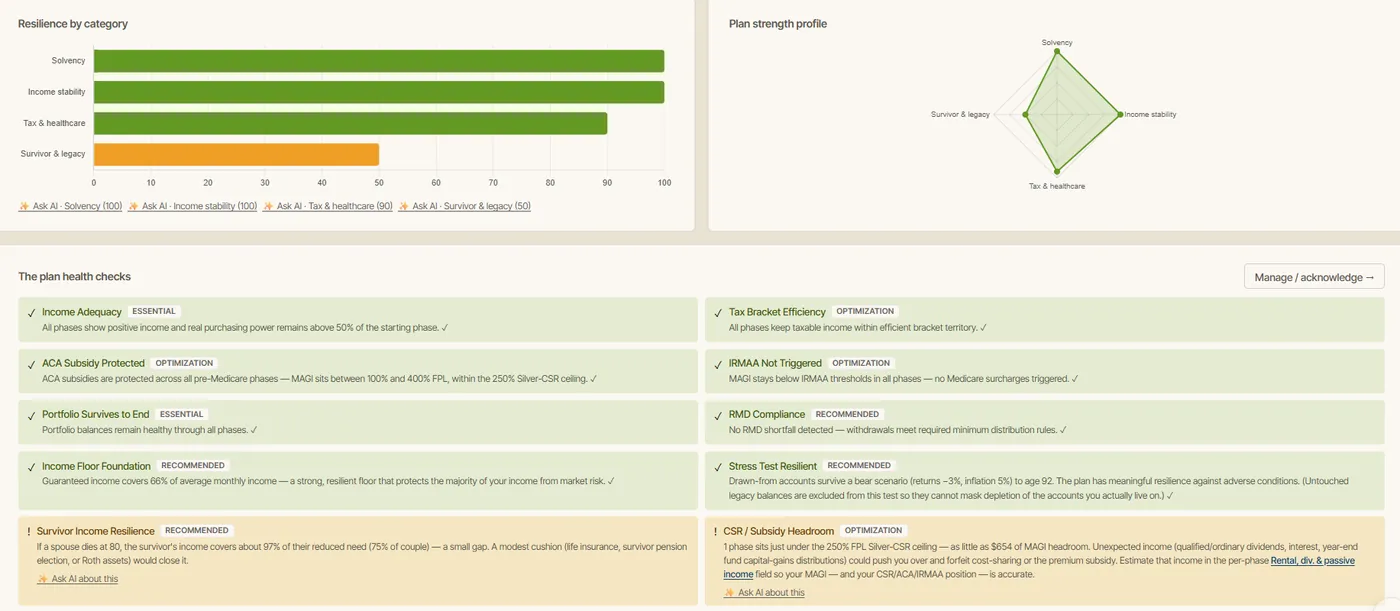
- Open Plan Health to see whether the strategy creates warnings or improves weak spots.
The best claiming age is the one that works inside the full plan, not the one that wins a single isolated calculation.
Questions To Answer Before Claiming
Before you claim, ask:
- What is my full retirement age?
- What is my estimated benefit at 62, full retirement age, and 70?
- Am I still working?
- Will the earnings test apply?
- Do I have health insurance before Medicare?
- Am I coordinating with a spouse?
- What happens to survivor income?
- How long can my portfolio support delayed claiming?
- Will delaying create tax-planning room?
- How does the decision affect RMD years?
- How does the plan look in a bad market?
- What happens if I live longer than expected?
When Claiming At 62 May Make Sense
Claiming at 62 may be reasonable if:
- You need income.
- You have a shorter life expectancy.
- You are not working above the earnings limit.
- You want to reduce portfolio withdrawals.
- Your spouse has a stronger benefit record.
- Waiting would cause too much stress or force poor investment decisions.
The key is to model the long-term cost of the lower benefit.
When Waiting May Make Sense
Waiting may be reasonable if:
- You can cover expenses without claiming.
- You expect a long retirement.
- You want more guaranteed income later.
- Your spouse may depend on your survivor benefit.
- You want to reduce longevity risk.
- You can use delay years for Roth conversion or withdrawal planning.
The key is to model the cost of supporting the delay years.
FAQ
What is the earliest age to claim Social Security retirement benefits?
SSA says you can start receiving Social Security retirement benefits as early as age 62.
What happens if I claim before full retirement age?
SSA says your benefit is reduced by a small percentage for each month before full retirement age. The reduction depends on your birth year and the number of months before full retirement age.
What happens if I delay Social Security after full retirement age?
SSA says your benefit increases for each month you delay beyond full retirement age, and the increase stops at age 70.
Do delayed retirement credits continue after age 70?
No. SSA says the benefit increase stops when you reach age 70.
Can I work and receive Social Security?
Yes, but SSA says if you are younger than full retirement age and earn more than the yearly earnings limit, your benefit amount may be reduced. Starting with the month you reach full retirement age, there is no limit on earnings for benefit payment purposes.
Should I delay Medicare if I delay Social Security?
Not automatically. SSA says Medicare usually starts at age 65 and warns that if you delay starting Social Security past 65, you should still apply for Medicare when needed.
Is claiming at 62 always a mistake?
No. Claiming at 62 can make sense for some households. It depends on income needs, health, work status, spouse and survivor planning, taxes, and savings.
Is waiting until 70 always best?
No. Waiting can raise the monthly benefit, but it requires other income during the delay years. The best answer depends on the full retirement plan.
Sources
- SSA, Starting Your Retirement Benefits Early: https://www.ssa.gov/benefits/retirement/planner/agereduction.html
- SSA, Delayed Retirement Credits: https://www.ssa.gov/benefits/retirement/planner/delayret.html
- SSA, Receiving Benefits While Working: https://www.ssa.gov/benefits/retirement/planner/whileworking.html
- SSA, What Important Things To Consider When Planning For Retirement: https://www.ssa.gov/benefits/retirement/planner/otherthings.html
Educational Disclaimer
This article is for education only. Social Security claiming decisions can affect lifetime income, survivor benefits, taxes, healthcare planning, and portfolio withdrawals. Check SSA.gov and consider speaking with a qualified financial or tax professional before making a claiming decision.