
Short Answer
An annual retirement plan review should update current balances, spending, income, withdrawals, taxes, healthcare, Medicare, Social Security, RMDs, cash reserves, debt, survivor planning, and stress-test scenarios. The point is to replace stale assumptions with current facts before small changes become large problems.
The best annual review is practical. It should tell you what changed, what still works, what needs attention, and which questions should go to a qualified professional. If you want the wider principle behind the habit rather than the checklist itself, the companion article on keeping your retirement plan current covers why a plan is a working model rather than a document you file away.
Key Takeaways
- Review the plan from current age and current balances.
- Compare actual spending with last year's plan.
- Update Social Security, pension, annuity, and work income.
- Review tax withholding, estimated taxes, RMDs, and Medicare IRMAA exposure.
- Update healthcare premiums, prescriptions, and long-term care assumptions.
- Run stress tests for inflation, markets, healthcare, survivor income, and large expenses.
- Save the annual review plan, compare it with last year's version, and keep notes for professional review.

1. Update Current Balances
Start with the account values you have now.
Review:
- Cash.
- Checking and savings.
- Taxable brokerage.
- Traditional IRA.
- 401k or similar employer plan.
- Roth IRA.
- HSA.
- Pension or annuity income records.
- Home equity, if it is part of the plan.
- Debt balances.
The annual review should not rely on last year's portfolio value. Retirement projections are highly sensitive to current balances, especially once withdrawals have started, which is why a sustainability check works from current balances and current spending rather than from the retirement date you originally planned around.
2. Compare Actual Spending With Planned Spending
Look at what actually left the household.
Separate:
- Essential spending.
- Flexible spending.
- Healthcare spending.
- Taxes.
- Insurance.
- Home repairs.
- Vehicle costs.
- Family support.
- Travel.
- One-time purchases.
Then compare actual spending with last year's plan. If the difference was temporary, note it. If the difference is ongoing, update the forward projection, since a new recurring spending level is one of the usual reasons balances come in lower than expected while a single heavy year is not.
3. Review Reliable Income
Update every recurring income source.
Review:
- Social Security.
- Spouse Social Security.
- Pension income.
- Annuity income.
- Rental income after expenses.
- Part-time work.
- Disability income, if relevant.
- Other recurring income.
If work income is part of the plan and the retiree is younger than full retirement age, SSA's working-while-receiving-benefits rules should be checked before assuming the same benefit amount continues.
4. Review Withdrawals By Account
Look at withdrawals by source, not merely the total.
Review:
- Cash withdrawals.
- Taxable brokerage sales.
- Traditional IRA withdrawals.
- 401k withdrawals.
- Roth withdrawals.
- HSA withdrawals.
- One-time lump sums.
Ask:
- Which account funded normal spending?
- Which account funded one-time expenses?
- Were taxes withheld?
- Did withdrawals create capital gains?
- Did cash reserves shrink too much?
- Are Roth accounts being preserved or used intentionally?
The withdrawal source affects future flexibility, taxes, RMDs, and survivor planning. If last year's withdrawals did not follow the order you intended, it is worth revisiting which retirement account to withdraw from first before setting this year's pattern.
5. Review Taxes
A retirement plan review should include tax cash flow.
Review:
- Federal tax.
- State tax.
- Pension withholding.
- IRA or 401k withholding.
- Social Security taxation.
- Taxable-account gains.
- Estimated tax payments.
- Roth conversion activity.
- Capital gains or losses.
- Medicare IRMAA exposure.
If the tax bill surprised you, the plan needs an updated tax assumption. A tax surprise can turn into a withdrawal surprise if it is ignored.
6. Review RMDs
The IRS says retirees generally have to start taking withdrawals from IRAs, SIMPLE IRAs, SEP IRAs, or retirement plan accounts at age 73. RMDs are minimum annual withdrawals, and withdrawals are generally included in taxable income except for amounts that were already taxed or can be received tax-free.
During the annual review, check:
- Current age.
- RMD start age.
- Current tax-deferred balances.
- Projected RMD amount.
- Tax effect.
- Medicare IRMAA effect.
- Survivor tax effect.
- Qualified charitable distribution questions for professional review.
RMDs should be reviewed before the first RMD year, not after the tax bill arrives.
7. Review Medicare And Healthcare
Medicare.gov provides current Medicare cost information, including premiums, deductibles, coinsurance, and copayments.
Update:
- Part B premium.
- Part D premium.
- Medigap premium.
- Medicare Advantage costs, if relevant.
- Prescription costs.
- Dental, vision, and hearing costs.
- Out-of-pocket medical spending.
- Long-term care assumptions.
- Healthcare inflation.
Healthcare costs are a major reason an old plan can go stale. Update them separately from general spending.

8. Review Cash Reserves And Debt
Cash reserves and debt can change the retirement plan quickly, and whether the plan still works while those payments continue is worth re-testing each year rather than treating last year's answer as settled.
Review:
- Emergency cash.
- One year of expected withdrawals.
- Home repair reserve.
- Healthcare reserve.
- Mortgage.
- HELOC.
- Vehicle loans.
- Credit cards.
- Medical bills.
- Tax debt.
If cash is too low, the plan may be forced to sell investments during a bad market. If cash is too high, the plan may have less long-term growth. The right balance depends on the household.
9. Review Survivor Planning
For couples, every annual review should include a survivor check.
Review:
- Social Security after the first death.
- Pension survivor election.
- Annuity survivor benefit.
- Filing status change.
- RMD changes.
- Housing plan.
- Healthcare costs.
- Estate documents.
- Beneficiary designations.
A plan that works for two people may be weaker for one. Annual review is the time to catch that, including the move from joint to single tax brackets that can raise the survivor's tax bill on a smaller income.
10. Run Stress Tests
Test the plan against pressure.
Include:
- Market decline.
- Higher inflation.
- Higher healthcare costs.
- Long life.
- Lower returns.
- Higher withdrawals.
- Major home repair.
- Vehicle replacement.
- Widowhood.
- Long-term care.
Stress testing is not about predicting the future. It is about seeing which parts of the plan bend first. Reading the same plan through several separate lenses, rather than one headline number, is covered in checking a retirement plan from several angles.
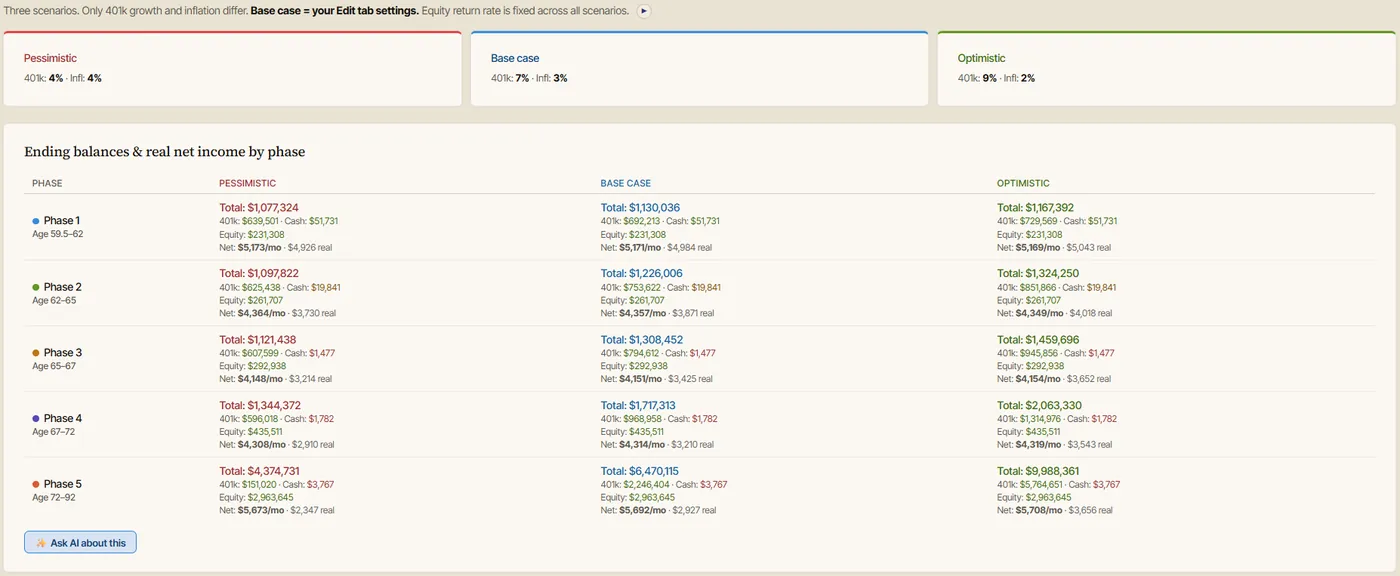
How To Use The AI Retirement Income Planner For The Annual Review
Use this workflow:
- Open last year's saved plan or recreate it from the report.
- Update current age and balances.
- Update spending.
- Update income sources.
- Update withdrawals by account type.
- Update tax, Medicare, healthcare, and RMD assumptions.
- Save the annual-review version.
- Compare it with prior saved versions if available.
- Run Stress Test.
- Use What-if tools for inflation, Social Security, Roth conversion size, survivor scenario, and maximum sustainable spending.
- Review Plan Health checks and Plan Confidence.
- Use report preview with notes for a professional review conversation.
- Move the plan through Draft, Under review, or Signed off status as appropriate.
- Set the 12-month review reminder after sign-off.
Signing off is the step that closes the loop. It captures a snapshot of the inputs and key numbers, sets the review date twelve months out, and makes today the reference point, so next year's review starts from a recorded position rather than from memory.
Annual Review Questions
Use these questions as a final pass:
- Did spending rise faster than expected?
- Did withdrawals come from the intended accounts?
- Did taxes match the plan?
- Did healthcare costs change?
- Did Social Security, pension, or work income change?
- Did RMD projections change?
- Is cash reserve too low or too high?
- Is debt higher or lower?
- Does the survivor plan still work?
- Did the stress test expose a new weak point?
- What needs professional review before year-end?
FAQ
How often should I review my retirement plan?
Many retirees review the plan once a year and after major changes such as a market decline, death of a spouse, large withdrawal, healthcare change, home sale, tax surprise, or Social Security decision.
What should I update first in an annual retirement review?
Start with current balances, current spending, current income, current withdrawals, current healthcare costs, and current tax assumptions.
Should RMDs be part of an annual review before age 73?
Yes. Future RMDs can affect taxable income, Medicare IRMAA, Social Security taxation, withdrawal order, and survivor planning.
What should I do with the annual review results?
Use the results to identify what still works, what needs attention, and which questions should go to a qualified professional.
Can the planner help with annual reviews?
Yes. The planner supports current-age replanning, saved-plan comparison, Stress Test, What-if tools, Plan Health checks, Plan Confidence, report preview, plan status workflow, and a 12-month review reminder after sign-off.
Source Links
- IRS required minimum distributions: https://www.irs.gov/retirement-plans/plan-participant-employee/retirement-topics-required-minimum-distributions-rmds
- SSA receiving benefits while working: https://www.ssa.gov/benefits/retirement/planner/whileworking.html
- Medicare costs: https://www.medicare.gov/basics/costs/medicare-costs
- Investor.gov retirement planning glossary: https://www.investor.gov/introduction-investing/investing-basics/glossary/retirement-planning
- AI Retirement Income Planner: https://airetirementincomeplanner.com/
Educational Disclaimer
This article is for general education only. It is not financial, tax, investment, legal, healthcare, insurance, Social Security, Medicare, estate, AI safety, software, or retirement advice. Confirm tax, Medicare, Social Security, RMD, withdrawal, investment, insurance, healthcare, debt, housing, and estate details with official sources and qualified professionals.