
Quick Answer
Most retirement income falls into one of three buckets, and the planner keeps them apart on purpose: Social Security (including SSDI), pensions and disability benefits that are not Social Security, and everything else — work, rentals, one-offs.
The reason is not tidiness. Which box you choose decides three things: how the income is taxed, whether it rises each year, and when it starts and stops. Get the box wrong and every one of those is wrong too.
Key Takeaways
- SSDI is Social Security. It goes in the Social Security field, not the disability field — it carries the same annual increase, it is taxed under Social Security rules, and at full retirement age it quietly becomes your retirement benefit at the same amount.
- Employer, private and VA disability are not Social Security. They belong in the pension and disability streams, where each gets its own annual increase, its own tax treatment, and its own end age.
- Most private disability stops at 65. If yours does, say so — otherwise a plan will keep paying it for life on top of your Social Security and show you money you will never see.
- A benefit that never rises is normal. Set its annual increase to zero rather than leaving it to track inflation.
- If something does not apply to you, enter 0. That is how you remove it, and it is the only place you need to do it.
The Short Version
| What you receive | Where it goes | Why |
|---|---|---|
| Social Security retirement | Social Security | Taxed under Social Security rules |
| Social Security spousal | Spouse Social Security | Starts when your spouse reaches their claim age |
| Social Security survivor (from a late spouse) | Social Security | You keep the larger benefit; it is still Social Security |
| SSDI (Social Security Disability) | Social Security | Same annual increase, same tax rules, converts at full retirement age |
| Employer or private long-term disability | Pension / disability stream | Different tax treatment; usually stops at 65 |
| VA disability | Pension / disability stream, marked tax-free | Adds to your income without affecting tax at all |
| Employer pension | Pension / disability stream | Its own annual increase, or none |
| Survivor pension from a late spouse | Pension / disability stream | Already in payment — set the start age at or below your age now |
| UK State Pension | UK State Pension | Grows by the Triple Lock, and under the treaty it is taxed differently |
| Part-time or consulting work | Part-time work, on the phase | Ordinary earned income, only in the years you expect it |
| Rental, annuity or dividend income | Rental / passive income | Can be taxable or a return of your own capital |
| An inheritance or a house sale | Lump sums | A one-off event in a single year, not an income stream |
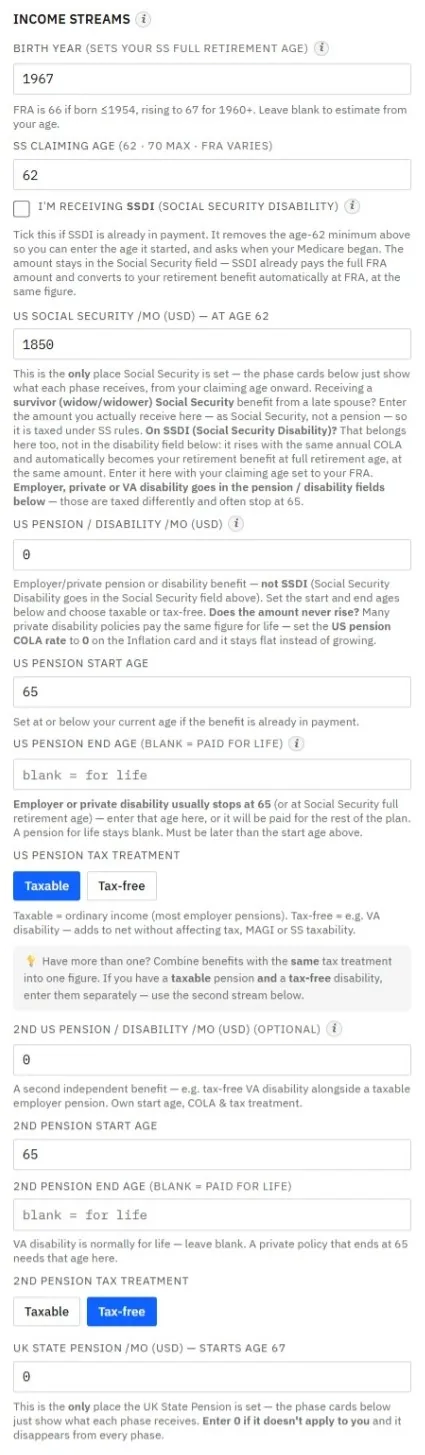
Social Security, and the Part That Catches People Out
Your own retirement benefit is the straightforward case: one figure, one claiming age.
A survivor benefit from a late spouse is still Social Security, so it goes in the same place. Enter what you actually receive, not what your spouse used to receive — when one person dies the household keeps the larger of the two benefits, not both.
SSDI is where people most often go wrong, understandably, because it has the word "disability" in it. But it is a Social Security benefit and behaves like one in three ways that matter:
- It pays your full amount. There is no reduction for starting early. SSDI pays the same figure you would have received by waiting until full retirement age — which is why it can start at 55 or 58 and still be the "full" number.
- It converts automatically. At full retirement age your SSDI simply becomes your retirement benefit, at the same monthly figure. Nothing arrives in the post; nothing changes in your bank account. One amount covers both sides of that birthday.
- It is taxed as Social Security. Only part of it is taxable, and how much depends on your other income. A private disability benefit entered in the same box would be taxed quite differently, so the box genuinely changes your tax bill.
There is a fourth consequence that costs real money: SSDI brings Medicare 24 months after your benefit starts, whatever your age. Someone on SSDI at 55 usually has Medicare at 57 — not 65. That means marketplace subsidies stop and Medicare premiums start years earlier than the standard timeline. A plan that assumes 65 for everybody will show you subsidies you are not entitled to and leave out premiums you are paying.
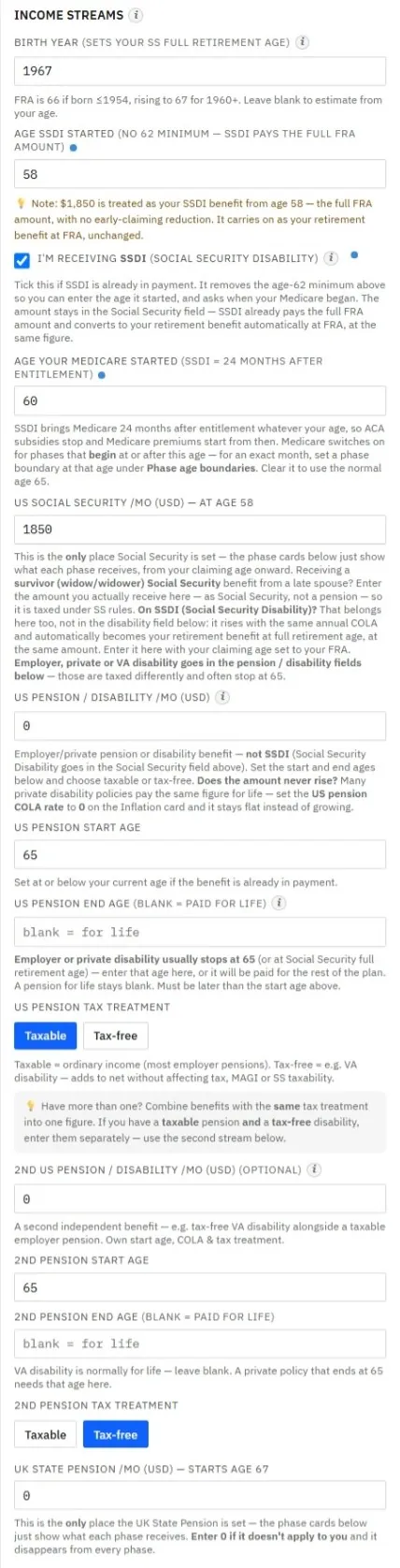
Disability That Is Not SSDI
Employer schemes, private policies you bought yourself, and VA disability are all handled together — and separately from Social Security — because they vary so much from one another. Three questions decide how each behaves:
Is it taxed? An employer-paid policy is usually taxable. A policy you paid for with your own after-tax money usually is not. VA disability is tax-free. Tax-free income is worth noticeably more than the same figure taxed, and it does not push up the taxable share of your Social Security either.
Does it rise each year? Many private policies pay the same figure for life. That is not an oversight to correct — it is the policy. Set the annual increase to zero and it stays flat, which over a thirty-year retirement is a very different picture from one that quietly grows with inflation.
When does it stop? This is the one worth checking your paperwork for. Most employer and private long-term disability terminates at 65, or at Social Security full retirement age — the point the cover is designed to hand over to your retirement income. If you do not say so, a plan will keep paying it for the rest of your life, stacked on top of your Social Security. On a $3,000 a month benefit that is roughly $900,000 of income that will never arrive, and the error always flatters the plan.
If the benefit ends before your Social Security starts, you will see a gap. That gap is real. Far better to find it now, while you can still do something about it, than at 65.
Pensions
An employer pension goes in the same place as disability, for the same reason: it is a fixed monthly amount with its own rules. Set the age it starts — at or below your current age if it is already in payment — and its annual increase, which for many private pensions is zero.
If you receive a survivor or joint-and-survivor pension from a late spouse, that goes here too, already in payment. And if you have both a taxable pension and a tax-free disability benefit, use both streams rather than adding them together — otherwise one of them gets taxed wrongly.
The UK State Pension
If you have worked in the UK you may be entitled to a UK State Pension alongside your US benefits, and the tax treaty between the two countries treats it differently from Social Security. It has its own field, it starts at 67, and it grows by the Triple Lock rather than the US annual increase.
If it does not apply to you, enter 0. That is the whole answer, and it removes it from every phase of your plan at once. There is no second place to switch it off.
Everything Else
Part-time or consulting work is ordinary earned income, entered on the phases where you actually expect it rather than as a lifelong stream — most people taper off rather than stopping dead, and modeling it year by year is more honest.
Rental, annuity and dividend income has its own field because it can be taxable or partly a return of your own capital, and that distinction changes both your tax and the income figure the ACA and Medicare look at. For a rental, what belongs in the box is the net figure after vacancy, repairs and management, since the planner does not model those costs separately.
An inheritance, a house sale or a large one-off expense is not an income stream at all — it is a single event in a single year, and it belongs in lump sums. Spreading a windfall across a phase as though it were monthly income would understate what it does to your tax in the year it lands.
Why the Box Matters More Than It Looks
It is tempting to think that income is income, and that a hundred dollars is a hundred dollars wherever you put it. In a retirement plan it genuinely is not, for three reasons:
- Tax. Social Security is taxed under its own rules, and only partly. A pension is ordinary income. VA disability is not taxed at all. The same figure in three different boxes produces three different tax bills, which is the subject of how taxes change retirement income.
- The income that decides your healthcare costs. Marketplace subsidies before 65 and Medicare surcharges after it are both driven by an income figure that counts some kinds of income and not others. That figure is MAGI, and there is more than one definition of it. Misfiling a benefit can push you over a threshold you would never really have crossed — or hide one you would.
- Time. Some income is for life, some stops at a set age, some has not started yet. A plan is mostly a story about when, and the boxes are how you tell it.
FAQ
Is SSDI the same as Social Security for planning purposes? Yes, in every way that matters here. It carries the same annual cost-of-living increase, it is taxed under Social Security rules, and it becomes your retirement benefit automatically at full retirement age at the same amount. Enter it as Social Security, with the age it actually started.
Can SSDI start before 62? Yes. The age-62 minimum applies to a retirement benefit you choose to claim. Disability has no earliest age and no reduction for starting early — it pays your full amount whenever it begins.
Should I combine my pension and my disability benefit into one figure? Only if they are taxed the same way. If one is taxable and the other is not, keep them separate so each is taxed correctly.
My disability benefit never increases. Is that wrong? No, it is common — particularly for private policies. Set its annual increase to zero so the plan shows it staying flat instead of quietly growing.
What if I am not entitled to the UK State Pension? Enter 0 in the UK State Pension field and it disappears from every phase of your plan.
Where does a survivor benefit go? A Social Security survivor benefit goes in the Social Security field. A survivor pension or annuity from a late spouse goes in a pension stream, with the start age set at or below your age now, since it is already being paid.