
Quick Answer
One of the largest and least-discussed risks in a married couple's retirement plan is what happens to the survivor. When the first spouse dies, two things happen at once: the household keeps only the larger of the two Social Security checks (the smaller one stops), and the survivor usually moves from married-filing-jointly to single tax brackets, which are roughly half as wide.
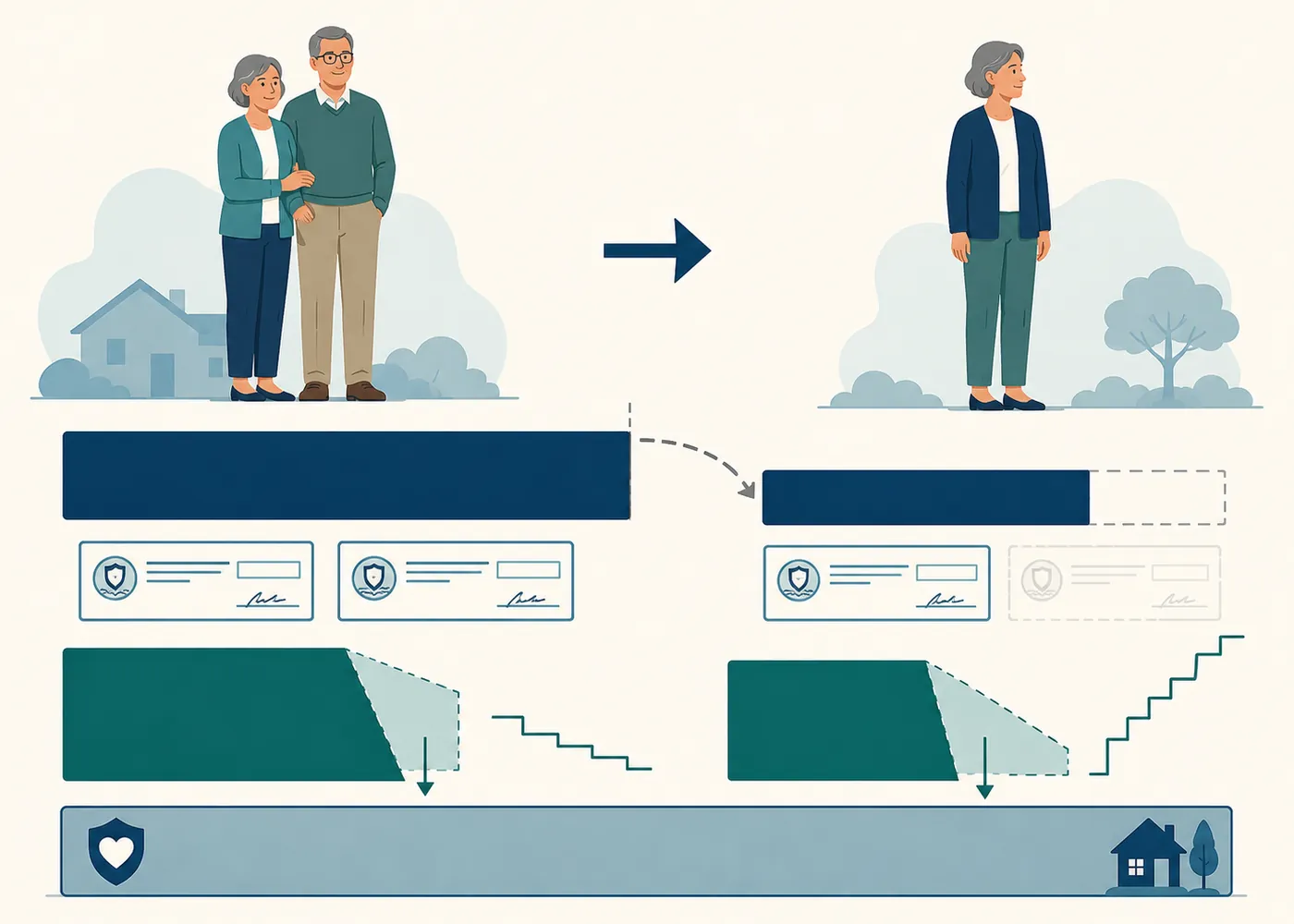
Income falls, tax rates often rise on what remains, and yet one person's living costs are typically 70 to 80 percent of a couple's, not half. That combination is what planners call the widow's tax cliff, and it can turn a comfortable joint plan into a tight solo one overnight. The good news is that it is highly foreseeable, which means it is one of the most plannable risks there is.
Key Takeaways
- On the first death, the household keeps the larger Social Security benefit; the smaller one ends.
- The survivor usually files as single, where brackets and the standard deduction are about half of joint, so the same or even lower income can be taxed at a higher rate.
- Spending does not halve. One person costs roughly 70 to 80 percent of a couple, so the income gap bites.
- The biggest lever is often delaying the higher earner's Social Security, because that larger benefit is what the survivor keeps for life.
- If you are already a surviving spouse, survivor income still fits a normal plan: survivor Social Security goes in the Social Security field, a survivor pension goes in a pension slot, and you file single.
What the Widow's Tax Cliff Actually Is
The name is grim but the mechanics are simple, and they apply to any surviving spouse regardless of gender.
One Social Security check stops. A married couple receives two Social Security benefits. When one spouse dies, the survivor keeps the higher of the two and the lower one ends. If both benefits were similar, the household loses a bit less than half its Social Security. If one spouse earned far more, the survivor keeps the big check but still loses the second income entirely.
Taxes get less friendly. A surviving spouse generally files as single starting the year after the death (a qualifying-surviving-spouse status can apply for up to two years if there is a dependent child, but many retirees do not qualify). Single brackets and the single standard deduction are roughly half the joint amounts. So even though income went down, a larger share of what remains can be taxed, and more of the survivor's Social Security can become taxable. The same dynamic can push the survivor into higher Medicare IRMAA surcharges on a lower income.
Spending barely moves. Housing, utilities, insurance, property taxes, and most fixed costs do not fall by half when a household goes from two people to one. Research and rules of thumb put a survivor's needs around 70 to 80 percent of the couple's spending. Lower income, higher effective tax rate, only slightly lower costs: that is the cliff.
Two Different Situations
This topic shows up in two ways, and they call for different actions.
1. You are planning ahead as a couple. The death is a future event you want the plan to survive. Here the goal is to look at the survivor's position now and shape the plan so it holds up, while both spouses are alive to make the choices.
2. You are already a surviving spouse. The death has happened and you now receive income derived from your late spouse. Here the goal is simply to represent your real income correctly and plan forward as a single filer.
Where a Survivor's Income Goes in a Plan
If you are already receiving benefits from a deceased spouse, they fit an ordinary plan cleanly, but the placement matters for getting the tax right:
- Survivor Social Security (you receive the higher of your own or your late spouse's benefit) goes in the Social Security field. Enter the amount you actually receive. It belongs there, not in a pension field, because Social Security is taxed under its own rules (the provisional-income formula, at most 85 percent taxable) and affects MAGI differently.
- A survivor or beneficiary pension (your late spouse's employer pension or annuity continuing to you) goes in a pension slot, with its start age set at or below your current age since it is already in payment, and its own taxable or tax-free treatment.
- Filing status becomes single (unless a qualifying-surviving-spouse status applies).
Getting these in the right place is the difference between a plan that reflects your real after-tax income and one that misstates it. (The planner now spells this out right on the input fields.)
How the Planner Models the Survivor Transition
The AI Retirement Income Planner has a dedicated survivor scenario built for exactly this question, so a couple can see the survivor's position before it ever happens.
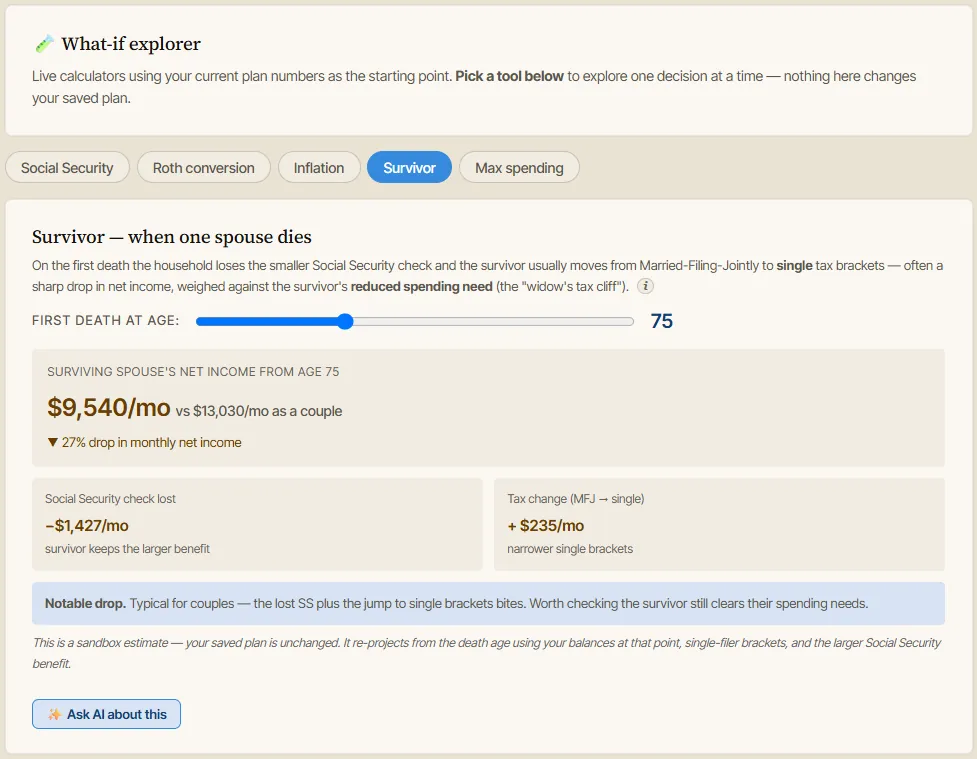
It runs for any married-filing-jointly plan, including one where only one of you has Social Security of your own. In Edit values, switch on Married filing jointly, enter your Social Security plus your spouse's (amount, claim age, and the spouse's current age if there is an age gap), then tick Model survivor scenario and choose a first-death age. From there the model does what actually happens:
- The survivor keeps the larger of the two Social Security benefits, and the smaller one stops.
- Filing switches to single, so the narrower brackets and smaller standard deduction apply to every later phase.
- Each pension continues at the survivor percentage you set, matching your real election: 100 percent for a full joint-and-survivor pension, around 50 percent for a typical joint-and-survivor election, or 0 for a single-life pension or disability that ends at death.
- You set the survivor spending need as a percentage of the couple's spending (it defaults to 100 percent, the most conservative view; lowering it to about 70 to 75 percent benchmarks the survivor against realistically reduced costs).
The before-and-after appears in the What-if explorer (with a slider for the first-death age), and a Survivor Income Resilience check joins your Plan Health panel, so the survivor's position becomes part of your regular plan review rather than an afterthought. If you want it explained in plain English, and you have added your own AI key, you can ask the optional assistant:
Model the survivor scenario for my plan. How much does household income drop when the first spouse dies, how much of that is the lost Social Security check versus the switch to single-filer taxes, and what would most improve the survivor's position?
What You Can Actually Do About It
The widow's tax cliff is foreseeable, so there are real levers, and a plan lets you weigh them:
- Delay the higher earner's Social Security. This is often the single most effective move. The larger benefit is exactly what the survivor keeps for life, so delaying it (up to age 70) raises the floor the survivor lands on. This is a core reason when to claim Social Security is a household decision, not an individual one.
- Do Roth conversions while still filing jointly. The wider joint brackets are a limited-time resource. Converting traditional balances to Roth while both spouses are alive can shrink the pre-tax accounts (and future RMDs) that would otherwise be taxed at harsher single rates later. This connects directly to which accounts you draw from and convert.
- Choose the pension survivor election deliberately. A single-life pension pays more now but stops at death; a joint-and-survivor election pays less now but continues to the survivor. Model both.
- Build a reliable income floor. The more of the survivor's essential spending covered by guaranteed income (the surviving Social Security benefit plus any continuing pension or annuity), the less the cliff hurts.
- Consider life insurance to bridge. Especially earlier in retirement, coverage on the higher earner can offset the lost income for the survivor.
A Simple Way to Use This
You do not need to dwell on a hard subject to plan for it well:
- In a joint plan, turn on the survivor scenario and pick a realistic first-death age.
- Look at the survivor's net income and the Survivor Income Resilience check.
- If the survivor looks tight, test the levers: delay the higher earner's claim, add Roth conversions in the joint years, revisit the pension election.
- Set the survivor spending need to something realistic (often 70 to 80 percent) rather than assuming costs halve.
- If you are already a survivor, enter your survivor Social Security and any survivor pension in the right fields, file single, and plan forward from there.
Fifteen minutes spent here can be worth more than years of investment tinkering, because it protects the person least able to course-correct later.
FAQ
What happens to Social Security when a spouse dies?
The surviving spouse keeps the larger of the two benefits, and the smaller benefit stops. If the survivor was receiving their own smaller benefit, it is generally stepped up to the deceased's higher amount (subject to the survivor's own age and claiming rules). The household never keeps both checks.
Why do taxes go up if income went down?
Because filing status usually changes from married-filing-jointly to single, and single brackets and the standard deduction are roughly half the joint amounts. A lower income spread across much narrower brackets can be taxed at a higher effective rate, and more of the survivor's Social Security can become taxable. That is the heart of the widow's tax cliff.
I am already widowed. Where does my survivor income go in a retirement plan?
Enter a survivor Social Security benefit in the Social Security field (the amount you actually receive), so it is taxed under Social Security rules. Enter a survivor or beneficiary pension in a pension slot with its start age at or below your current age. File as single. From there you plan as a single-filer household.
What is the most effective way to protect a survivor?
For most couples, delaying the higher earner's Social Security claim does the most, because that larger benefit is what the survivor keeps for life. Roth conversions during the joint-filing years, a joint-and-survivor pension election, a strong guaranteed-income floor, and life insurance are the other main levers.
Source Links
- Social Security Administration, Survivors Benefits: https://www.ssa.gov/benefits/survivors/
- Social Security Administration, If You Are the Survivor (benefit amounts): https://www.ssa.gov/benefits/survivors/ifyou.html
- IRS, What Is My Filing Status: https://www.irs.gov/help/ita/what-is-my-filing-status
- AI Retirement Income Planner: https://airetirementincomeplanner.com/
Educational Disclaimer
This article is for general education only. It is not financial, tax, investment, legal, Social Security, Medicare, estate, or retirement advice. Survivor benefit rules, tax brackets, filing-status rules, and personal circumstances change. Verify current rules with SSA.gov and IRS.gov and consult a qualified professional before making decisions.