
Quick Answer
Municipal bond interest is exempt from federal income tax. It is not exempt from the calculation that decides how much of your Social Security gets taxed.
That calculation — the IRS calls it provisional income — explicitly adds tax-exempt interest back in. So buying munis can leave your bond interest untaxed while quietly pushing a much larger amount of Social Security into the taxable column. The bond does what it promised. Your tax bill still goes up.
Key Takeaways
- Tax-free is not the same as invisible. Municipal interest is excluded from taxable income but included in provisional income, in ACA subsidy income, and in the income Medicare uses to set your IRMAA surcharge.
- The leverage runs the wrong way. Every dollar of tax-exempt interest can drag up to 85 cents of Social Security into tax, so a modest amount of muni income can cost far more in tax than it saves.
- It is worst in the band you are probably in. If your provisional income sits between the thresholds, you are on the steep part of the curve. Below or well above it, munis behave the way you expected.
- This is invisible unless you model it. Your broker shows the interest as tax-free. Nothing on that statement mentions your Social Security.
- Leaving it out of a plan understates your tax and overstates your subsidies. That is why the planner now has its own field for it.
The Worked Example
Take a straightforward plan: retirement at 59½, a 401(k), some cash and equities, and $2,000 a month of Social Security. No municipal bonds. In the first years of Medicare, the federal tax bill is zero — the standard deduction covers the modest withdrawals, and at that income level none of the Social Security is taxable at all.
Now add $30,000 a year of municipal bond interest. Genuinely tax-exempt. Nothing else changes.
| Without munis | With $30,000 of muni interest | |
|---|---|---|
| Tax on the bond interest | — | $0 |
| Share of Social Security that is taxable | 8% | 85% |
| Federal tax bill | $0 | $1,645 |
The bond interest itself is never taxed. Not one dollar of it. The entire $1,645 comes from Social Security that was not taxable before and is now — because the $30,000 pushed provisional income past the point where 85% of the benefit counts.
Why It Happens
The taxable share of your Social Security is not a flat percentage. It is decided by a separate income figure built specifically for this test:
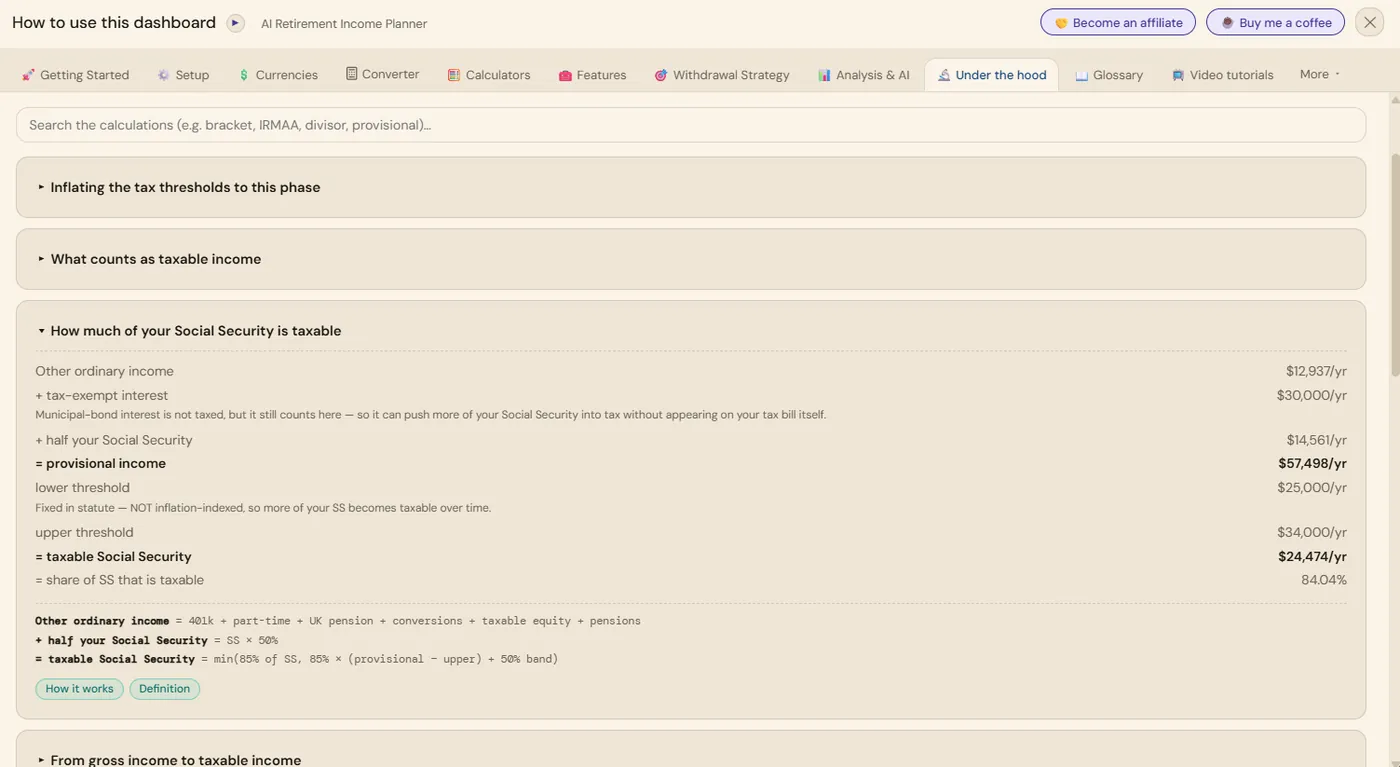
Provisional income = your other income + tax-exempt interest + half your Social Security
That middle term is the whole story. Congress wrote it in deliberately, precisely so that municipal bonds could not be used to keep Social Security out of tax.
Once provisional income crosses the thresholds, the taxable share climbs toward 85%. And here is the part that makes it bite: the thresholds are fixed in statute and have never been indexed to inflation. They were set at $25,000 and $34,000 for a single filer in 1984 and they are the same today. Every year, ordinary inflation pushes more retirees across a line that has not moved in forty years.
When Munis Still Make Sense
None of this makes municipal bonds a bad investment. It makes them a bad assumption. They work well when:
- Your provisional income is already well above the top threshold. If 85% of your Social Security is taxable no matter what you do, there is nothing left to drag in, and the exemption is pure gain.
- Your provisional income is comfortably below the bottom threshold, with enough headroom that the interest does not push you across.
- You are not yet claiming Social Security. With no benefit to tax, the provisional-income test has nothing to work on.
The expensive case is the middle: enough Social Security for the leverage to matter, and provisional income near the thresholds. That describes a great many retirees in their late sixties.
The Other Two Places It Counts
Social Security tax is the trap people miss, but it is not the only one.
ACA subsidies. If you retire before 65, tax-exempt interest counts toward the income figure behind your marketplace subsidy. It can move you over the 250% cost-sharing ceiling, or off the 400% subsidy cliff entirely — and that cliff is worth thousands, not hundreds.
Medicare IRMAA. The IRMAA definition of income is, in so many words, adjusted gross income plus tax-exempt interest. It is named in the rule. Muni interest can put you into a higher Medicare bracket two years later, which is a surcharge on both Part B and Part D, for both spouses if you are married.
So the same interest can be working against you in three places at once while your brokerage statement calls it tax-free. Each of those three uses a different definition of income, which is worth understanding on its own: see what MAGI is.
How to Check Your Own Position
The planner has a Tax-exempt interest field for each phase, next to rental income, added in the August 2026 update. Enter what you actually expect to receive.
It is deliberately kept out of your taxable income — because it genuinely is not taxable — while being counted in the three places above. Open Under the hood and look at the Social Security group: you will see tax-exempt interest on its own line in the provisional-income working, and you can watch the taxable share of your benefit move as you change it.
The useful experiment is to enter your muni interest, note the tax figure, then set it to zero and look again. The difference is what those bonds are really costing you. If it is larger than the tax you are avoiding, that is worth knowing before you buy more of them.
A Note on What This Is Not
This is a description of how the arithmetic works, not advice on whether to hold municipal bonds. The right answer depends on your bracket, your state, your other income and what you are comparing them against — and it is genuinely different for different people. What is not different is the mechanism: if you receive Social Security, tax-exempt interest raises your provisional income, and provisional income decides how much of your benefit is taxed.
Model it before you decide, rather than after.