
Quick Answer
If you retire before 65, one of the highest-value moves in your whole plan can be hiding in a single choice on the health insurance marketplace: picking a Silver plan when your income qualifies you for cost-sharing reductions.

Cost-sharing reductions (CSR) are extra savings the ACA adds on top of premium subsidies, but they only attach to Silver-tier plans, and only if your income lands in the right band. When they apply, they can dramatically lower your deductible, your copays, and your annual out-of-pocket maximum, often worth several thousand dollars a year. Miss the band, or buy the wrong metal tier, and you leave that money on the table. The catch is that it is your income you control in early retirement that decides whether you qualify, which is exactly the kind of lever a retirement plan is built to test.
📘 This is part of our healthcare series. For the pre-Medicare coverage decision more broadly, start with health insurance before Medicare.
Key Takeaways
- Cost-sharing reductions only apply to Silver plans. Qualify for CSR but buy Bronze or Gold, and you forfeit the benefit entirely.
- CSR is available when household income is roughly 100% to 250% of the federal poverty level (FPL). The lower your income in that band, the stronger the help.
- CSR raises a Silver plan's value from about 70% to 73%, 87%, or 94% actuarial value, cutting deductibles, copays, and the out-of-pocket maximum.
- It is a cliff, not a slope. One dollar of income over 250% FPL removes CSR completely, which can cost thousands.
- Early retirees have unusual control over the income figure (MAGI) that decides eligibility, because withdrawals from Roth accounts and cash do not raise it the way traditional-account withdrawals do.
What a Silver Plan Actually Unlocks
Marketplace plans come in metal tiers (Bronze, Silver, Gold, Platinum) that describe roughly how much of your care the plan pays on average, known as the actuarial value. A standard Silver plan pays about 70% and you pay the rest through deductibles, copays, and coinsurance up to an annual out-of-pocket maximum.
Here is the part many people miss. If your income qualifies, the ACA automatically upgrades your Silver plan through cost-sharing reductions, without changing the premium. Your Silver plan keeps its name but behaves like a much richer plan: a lower deductible, smaller copays, and a lower out-of-pocket maximum. The planner's own glossary sums it up plainly, noting that in the qualifying band a Silver plan gets "dramatically lower deductibles and out-of-pocket maxes," often "$4 to 8k a year on top of premium subsidies."
Two different kinds of help are in play, and it is worth keeping them straight:
- Premium subsidies lower your monthly premium and can be applied to any metal tier.
- Cost-sharing reductions lower what you pay when you actually use care, and they only exist on Silver plans.
The CSR Tiers: 94, 87, and 73
Cost-sharing reductions are not one flat discount. They come in tiers keyed to income, and the lower your income within the band, the more valuable the boosted Silver plan becomes:
| Household income (approx. FPL) | Silver plan becomes | What it means |
|---|---|---|
| 100% to 150% | Silver 94 | About 94% actuarial value: very low deductible and out-of-pocket max |
| 150% to 200% | Silver 87 | About 87% actuarial value: strong reductions |
| 200% to 250% | Silver 73 | About 73% actuarial value: modest but real reductions |
| Above 250% | Standard Silver (~70%) | No cost-sharing reductions |
A note on the low end: in states that expanded Medicaid, adults below about 138% of FPL are generally covered by Medicaid rather than a marketplace plan, so the practical CSR band for marketplace shoppers often starts around 138%. Your state and household size decide the exact dollar figures, and the marketplace uses the prior year's published FPL numbers to determine eligibility.
The Mistake That Costs Thousands
The single most common CSR mistake is simple: qualifying for cost-sharing reductions and then buying a non-Silver plan.
It is an easy trap. A Bronze plan often has the lowest premium, so it looks like the cheapest option at a glance. But if your income is in the CSR band, a Silver plan you were entitled to would have come with a far lower deductible and out-of-pocket maximum, savings that can dwarf the premium difference the first time you have a real medical event. Choosing Bronze in that situation can mean paying a small amount less each month to give up thousands in protection you had already earned. The tiers only exist on Silver, so the metal choice is not a detail. It is the whole benefit.
(The reverse is also true and worth knowing: if your income is above 250% FPL so CSR does not apply, a Gold plan can sometimes be a better value than Silver. The right tier depends on whether you qualify for CSR, which is why the income question comes first.)
It Is a Cliff, Not a Slope
Cost-sharing reductions have a hard edge at 250% of FPL. Unlike premium help, which phases down gradually, CSR does not taper at the top. Cross 250% FPL by a single dollar and the cost-sharing reductions vanish entirely.
That is why an unplanned bit of income late in the year, a larger-than-expected withdrawal, a mutual fund capital gains distribution, some freelance work, can knock you off the cliff and cost thousands. The lesson is not to obsess over every dollar, but to know where the edge is and leave yourself a margin, especially in December when the year's income is nearly settled.
The Lever Early Retirees Actually Have: MAGI
Eligibility is based on your modified adjusted gross income (MAGI), and this is where early retirees have an advantage most workers do not: in your 60s, before Social Security and required minimum distributions force your hand, you often have real control over your taxable income. Worth knowing before you rely on that control: MAGI is not one number, and the Marketplace version differs from the one Medicare uses later.
The key is that different income sources hit MAGI differently:
- Traditional 401(k) and IRA withdrawals raise MAGI.
- Capital gains from selling in a taxable brokerage account raise MAGI.
- Roth withdrawals do not raise MAGI.
- Cash savings you spend down do not raise MAGI.
So a retiree who needs, say, $60,000 to live on can often assemble it in ways that keep MAGI inside the CSR band, by leaning on Roth and cash for part of the spending rather than pulling everything from a traditional 401(k). The planner's glossary describes exactly this pattern: "many people deliberately keep MAGI in this band by living off cash and Roth in their 60s."
The Trade-Off Worth Naming: CSR vs Roth Conversions
Staying under 250% FPL for CSR is powerful, but it is not free, and a good plan should show both sides. The same low-income years that protect CSR are also the classic window for Roth conversions at low tax rates, and conversions raise MAGI. You often cannot maximize both in the same year.
There is no universal right answer. For some retirees, locking in years of strong CSR and low healthcare costs before Medicare is the better deal. For others, converting more to Roth now, accepting the loss of CSR in those years, reduces a much larger tax and IRMAA problem later. The point is that this is a real, quantifiable trade-off, not a slogan, and it is precisely the kind of question you want to test with numbers rather than guess. This is closely tied to which accounts you draw from first and to how much you can actually spend once healthcare is in the picture.
How the Planner Helps You See It
The AI Retirement Income Planner treats the CSR band as a first-class part of every pre-Medicare year, so this benefit stops being invisible.
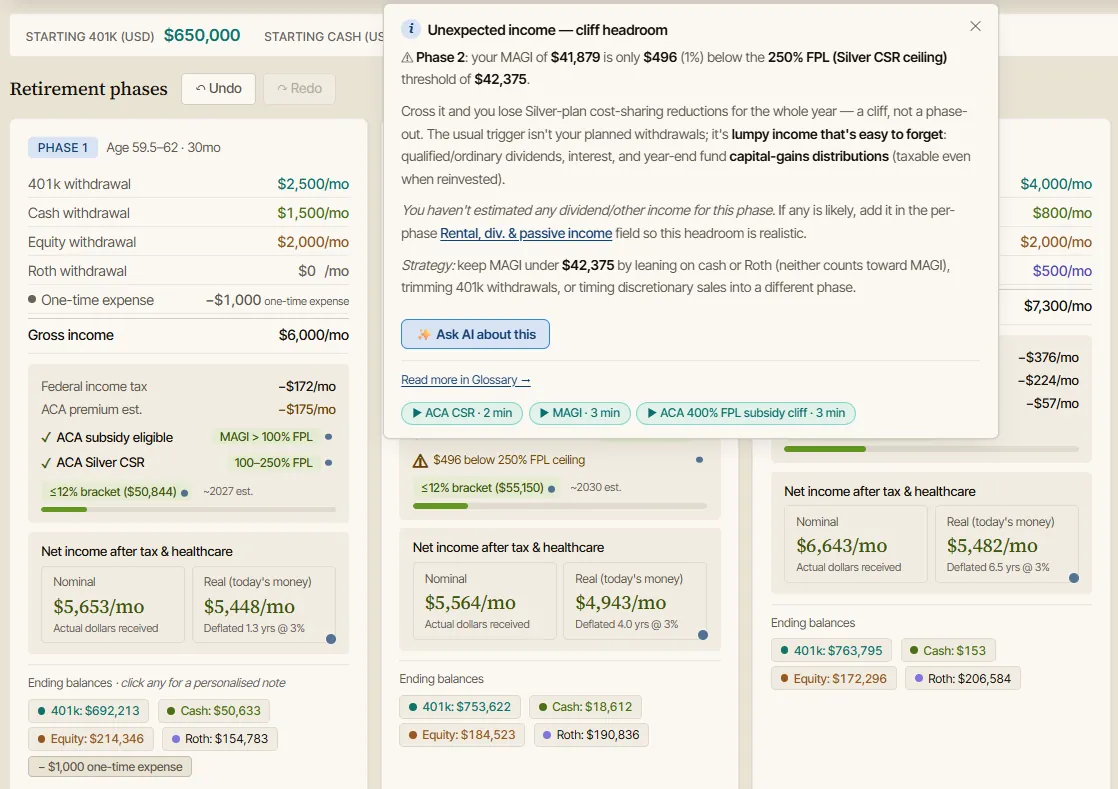
- On each phase card, an ACA Silver CSR row shows where that phase's MAGI sits: at or below 100% FPL, inside the 100 to 250% band (CSR eligible), or above 250% FPL. Click it for a plain-language explanation using your own numbers.
- The Tax & ACA tab shows an ACA CSR (≤250% FPL) line with your calculated ceiling and either how much room you have left or how far above it you are.
- A cliff-proximity warning flags when a phase's MAGI is sitting just under the 250% ceiling (or the 150% and 200% tier steps), where a small surprise could drop you a tier or off the cliff.
- When you are close but not there, a suggestion can appear: "You could qualify for ACA Silver CSR," noting that pulling MAGI below 250% FPL would unlock cost-sharing reductions.
- The Confidence tab runs two related Plan Health checks, ACA Subsidy Protected and CSR / Subsidy Headroom, so the benefit shows up in your overall plan review rather than only on a single screen. If you want a walkthrough of those checks, see how to use Plan Health.
Because it is one connected model, you can watch the effect directly: change a phase's withdrawal mix, and the ACA Silver CSR status and MAGI headroom update alongside your taxes, net income, and ending balance. If you have added your own AI key, you can also ask the optional assistant to reason about it in plain English:
In each pre-Medicare phase, is my MAGI below the 250% FPL Silver CSR ceiling? If any phase is above it, suggest specific withdrawal changes that would bring it under, and tell me what that would cost me in Roth conversion room.
A Simple Way to Use This
You do not need to master ACA rules to benefit. A practical routine:
- Build your pre-Medicare phases with realistic spending.
- Look at the ACA Silver CSR status on each phase before 65.
- Where a phase is above 250% FPL, test whether shifting some spending to Roth or cash brings it under, and note the trade-off with Roth conversions.
- If you decide to target the CSR band, remember at enrollment to actually choose a Silver plan, so the reductions attach.
- Leave yourself a margin below the 250% cliff for year-end surprises.
That short loop can be worth more than almost any investment tweak, because it is a near-guaranteed reduction in healthcare costs during some of the most expensive insurance years of your life.
FAQ
What is Silver CSR?
Silver CSR is shorthand for the cost-sharing reductions built into Silver marketplace plans. "Silver" is the metal tier; "CSR" is the discount on what you pay when you actually use care. Put together, Silver CSR means a Silver plan whose deductible, copays, and out-of-pocket maximum have been cut because your income qualifies. The same Silver plan bought by someone with a higher income has none of that built in, which is why two people can hold what looks like the same policy and face very different bills.
What does CSR eligible mean?
It means your projected modified adjusted gross income for the year falls under 250% of the federal poverty level for your household size, so the marketplace will apply cost-sharing reductions if — and only if — you enroll in a Silver plan. Eligible is not the same as enrolled: the eligibility is yours, but the discount only attaches to a Silver policy. Choose Bronze or Gold while CSR eligible and the benefit is simply not applied, with nothing on the checkout page to tell you what you gave up.
How do MAGI and ACA subsidies fit together?
MAGI is the input; the subsidies are the output. The marketplace looks at your modified adjusted gross income against the federal poverty level, and that one number decides both halves of the help: the premium tax credit that lowers your monthly bill, and the cost-sharing reductions that lower what you pay at the doctor. For an early retiree, MAGI is largely a choice rather than a fact, because it is built from which accounts you draw on — traditional withdrawals, conversions, interest, and capital gains raise it, while Roth withdrawals and spending down cash do not. That is what makes ACA planning a withdrawal-order problem rather than an insurance problem.
What is the difference between a premium subsidy and a cost-sharing reduction?
A premium subsidy (the advance premium tax credit) lowers your monthly premium and can be used on any metal tier. A cost-sharing reduction lowers what you pay when you use care, by cutting your deductible, copays, and out-of-pocket maximum, and it is only available on Silver plans. Many people qualify for both, but only capture the CSR half if they choose Silver.
Do I have to buy a Silver plan to get cost-sharing reductions?
Yes. Cost-sharing reductions are built into Silver plans only. If you qualify based on income but enroll in a Bronze, Gold, or Platinum plan, you receive no CSR. That is the most common and most expensive CSR mistake.
What income counts, and how do I stay under 250% of FPL?
Eligibility uses modified adjusted gross income (MAGI), which includes traditional 401(k) and IRA withdrawals, capital gains, interest, and the taxable and non-taxable parts of Social Security, but not Roth withdrawals or spending down cash. Early retirees can often manage MAGI by choosing which accounts to draw from. Because it is a hard cliff at 250% FPL, plan for a margin so an unexpected gain does not push you over.
Is targeting CSR always the right move?
No. The low-income years that protect CSR are also good years for Roth conversions, and conversions raise MAGI, so the two can conflict. For some retirees, years of strong CSR win; for others, converting to Roth to reduce future taxes, RMDs, and IRMAA is worth giving up CSR. It is a trade-off to model with your own numbers, not a one-size rule.
Source Links
- HealthCare.gov, Cost-sharing reduction (glossary): https://www.healthcare.gov/glossary/cost-sharing-reduction/
- HealthCare.gov, Save on out-of-pocket costs with a Silver plan: https://www.healthcare.gov/lower-costs/save-on-out-of-pocket-costs/
- HealthCare.gov, Health plan categories (metal tiers): https://www.healthcare.gov/choose-a-plan/plans-categories/
- KFF, Explaining Health Care Reform: Questions About Health Insurance Subsidies: https://www.kff.org/affordable-care-act/issue-brief/explaining-health-care-reform-questions-about-health-insurance-subsidies/
- AI Retirement Income Planner: https://airetirementincomeplanner.com/
Educational Disclaimer
This article is for general education only. It is not financial, tax, investment, legal, healthcare, Social Security, Medicare, insurance, or retirement advice. ACA subsidy and cost-sharing rules, income thresholds, and federal poverty levels change and depend on your state, household size, and specific circumstances. Verify current rules and your own eligibility on HealthCare.gov or your state marketplace, and consult a licensed professional before making coverage or retirement decisions.