
Quick Answer
Most retirement calculators assume a standard path: work until your mid-60s, claim Social Security, retire in the country you already live in. Real lives are more varied, and a plan has to bend to fit them. Someone retiring at 56 cannot touch a 401(k) yet. A US citizen living in Thailand has a very different tax and healthcare picture. A digital nomad living on freelance income needs a plan that holds together across decades of moving around.

The AI Retirement Income Planner runs the same engine for all of them; only the inputs change. This article walks through three worked case studies, an early retiree, an expat, and a digital nomad, to show how each situation is modeled and what the planner reveals about it. If you have not built a plan yet, the step-by-step setup guide covers the basics first.
Key Takeaways
- Retiring before 59.5 adds a bridge phase. The planner locks the 401(k) and funds those early years from cash, brokerage, and part-time work.
- Expats get a foreign-residence model. Selecting a non-US currency excludes US ACA and Medicare costs and lets you view the plan in the local currency.
- Low income can mean low or zero federal tax. With modest income and favorable capital-gains treatment, an expat's federal tax can be small, though US filing still applies.
- Nomads must plan for inflation. A stable-feeling income today requires much larger withdrawals decades later, which the nominal-versus-real figures make visible.
- Success is net income, not low tax. Sometimes paying more tax to earn far more income is the better plan; the right measure is what you actually get to spend.
Case Study 1: The Early Retiree Before 59.5
Meet someone who retires at 56. The problem is immediate: you cannot withdraw from a 401(k) without penalty until 59.5, so those first years have to be funded another way.
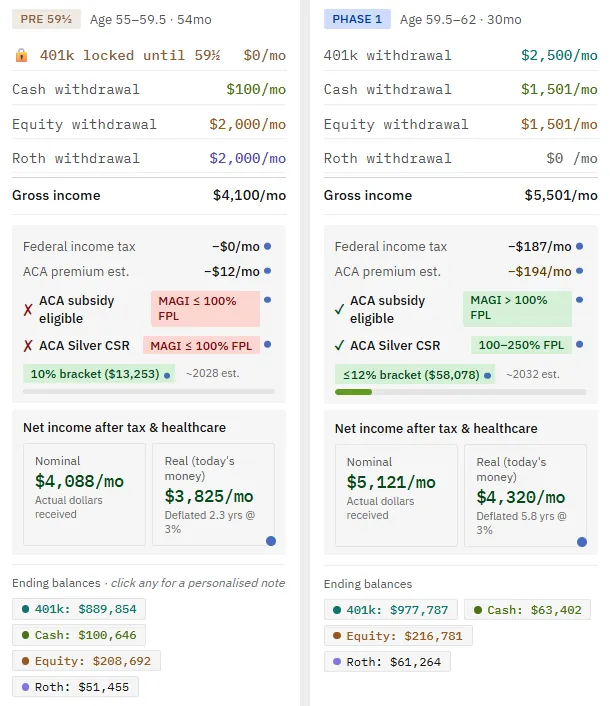
When you set a retirement age below 59.5, the planner automatically adds an extra pre-59.5 phase to the front of the plan, with a note that the 401(k) is inaccessible. In that phase your income comes from your cash savings, a taxable brokerage account, and any part-time work, exactly the accounts you can reach without penalty. Everything else works as usual: at 59.5 the 401(k) unlocks and the normal phases resume. Switch the retirement age back to 59.5 or later and the extra phase disappears.
This is the same challenge faced by anyone asking whether they can retire at 55: the plan lives or dies on whether the bridge accounts can carry the gap. Modeling it explicitly, rather than pretending the 401(k) is available early, is what makes an early-retirement plan honest.
Case Study 2: The US Expat in Southeast Asia
Now consider a US citizen who sells up and moves to the Philippines or Thailand. Say they are 58, have proceeds from a house sale in cash and a brokerage account, no 401(k), and plan to claim Social Security later.
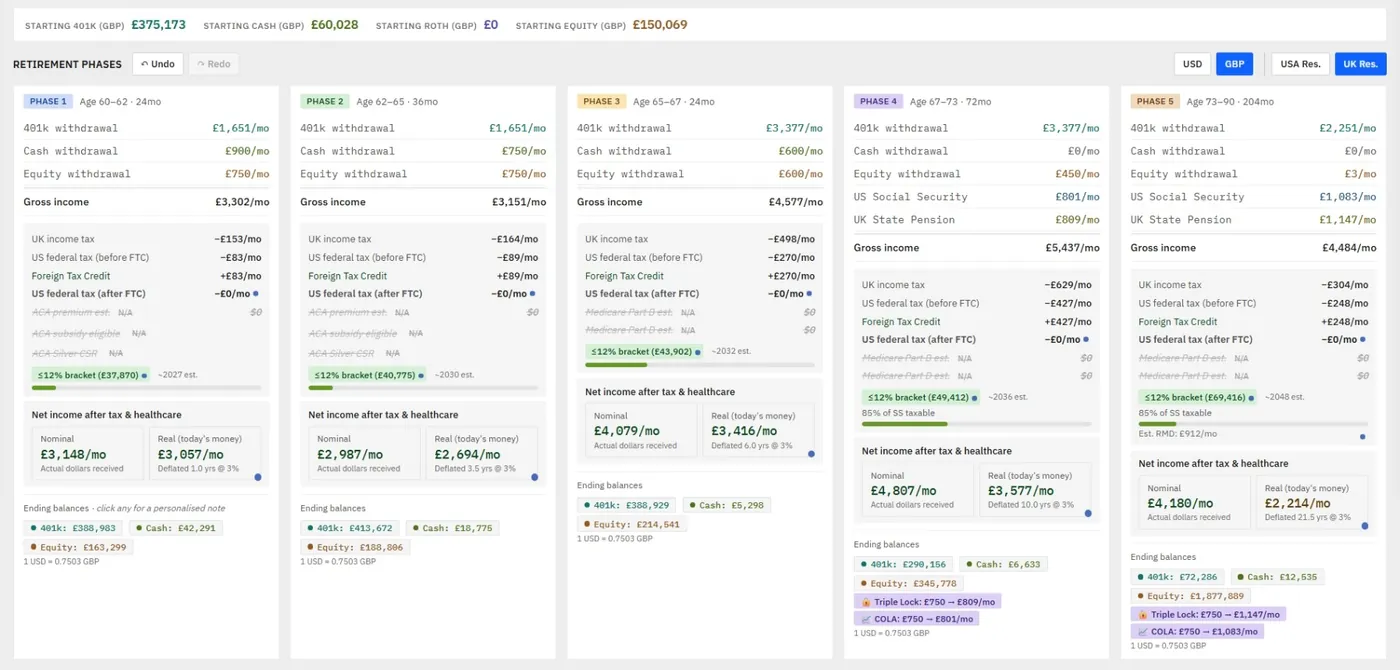
Two things change in the model. First, selecting a non-US currency (Philippine pesos or Thai baht) puts the plan into foreign-residence mode, which excludes US ACA and Medicare costs, reflecting a retiree living outside the United States, and lets you view the whole plan in the local currency at live exchange rates or at rates you set yourself. Second, the tax picture often looks very different: with modest income and favorable long-term capital-gains treatment, federal tax can be low or even zero in some years, though as a US citizen you still file a US return on your worldwide income.
There is real strategy here. In one version, taking more from a brokerage account early, while gains fall in a low or zero capital-gains band, and banking the surplus as cash for later phases can smooth income and cut lifetime tax meaningfully. The planner makes that visible so you can compare approaches. Two cautions the planner is careful about: it models expat scenarios as foreign-residence assumptions rather than the full local tax law of every country, and how your specific destination taxes US pension or investment income is something to confirm with a professional. For a deeper look at the choice itself, see comparing retiring in the US versus abroad, and for the underlying mechanics, taxes, ACA, and healthcare.
Case Study 3: The Digital Nomad
The third case is a freelancer who sold a house at 55, put the proceeds in a brokerage account, and plans to keep working as a digital nomad until 67, when Social Security begins.
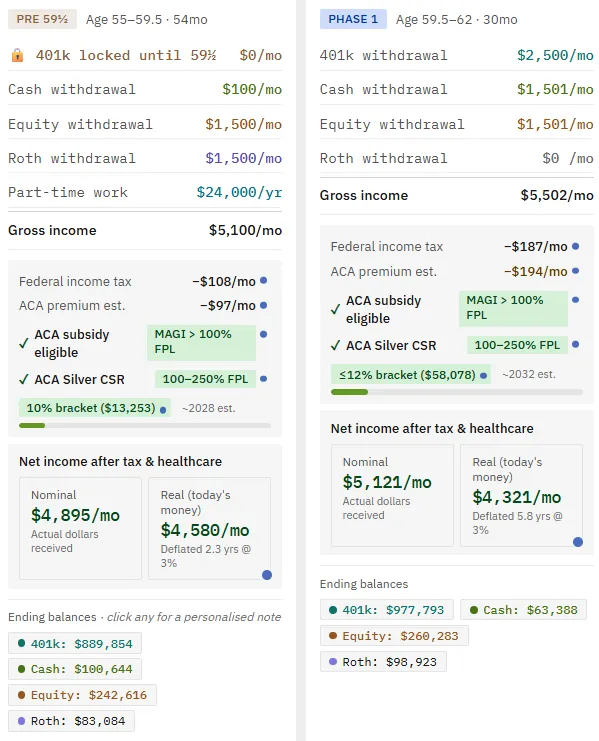
The interesting part is not the accounts; it is the inflation trap. This nomad wants a steady lifestyle, say the equivalent of $3,800 a month, from 55 all the way to 80 or 90. It is tempting to think "I only need $3,800," and plan around that flat figure. But to actually have $3,800 of spending power in a later phase, you may need to withdraw well over $5,000 in nominal dollars, because inflation has eroded what each dollar buys.
The planner shows both figures, nominal and inflation-adjusted real income, for every phase, so this gap is visible rather than a nasty surprise. Planning around the real figure, and blending part-time income with modest withdrawals early so investments keep growing, is what lets the lifestyle hold up across the whole plan. This is exactly why understanding real versus nominal income matters, and how part-time work reshapes a plan rather than just adding to it.
The Common Thread: One Engine, Different Inputs
Across all three cases, one point stands out about measuring success. In the expat example, a version with more money in equities produced a much higher lifetime tax bill, and also a much higher monthly income. Paying more tax looked "worse" but living on more money was clearly better.
That is the real lesson of running your own scenario. The goal is not the lowest tax figure or the largest ending balance in isolation; it is the net income you actually get to spend, tested against your real situation. Whether you are retiring early, moving abroad, or working from a laptop in a different country each year, the same month-by-month engine models it, and the value is seeing your own numbers rather than a generic assumption. Building a couple of versions and comparing them side by side is usually where the useful discoveries come from.
FAQ
Can the planner handle retiring before 59.5?
Yes. Set a retirement age below 59.5 and the planner adds an extra pre-59.5 phase, where you choose how the 401(k) is handled: leave it untouched and fund those years from cash, a taxable brokerage account and any part-time work, or draw on it and have the 10% early-withdrawal penalty priced in. If you left work at 55 or later, the Rule of 55 removes that penalty. The normal phases resume once the 401(k) becomes accessible without penalty at 59.5.
How does the planner model retiring abroad?
Selecting a non-US currency such as Philippine pesos or Thai baht puts the plan into foreign-residence mode, which excludes US ACA and Medicare costs and displays the plan in the local currency. US federal tax still applies because the US taxes worldwide income. The planner models foreign-residence assumptions rather than the full local tax law of each country, so confirm local rules with a professional.
Will I really owe no US tax as a low-income expat?
Sometimes federal tax can be low or zero, particularly when income is modest and long-term capital gains fall in a low or zero-rate band. That is situation-specific and not guaranteed, and you still file a US return on worldwide income as a citizen. Treat the planner's figure as an estimate to discuss with a tax professional.
Why does a digital nomad need to worry about inflation so much?
Because a long plan on freelance income spans decades, and a fixed monthly target loses purchasing power over time. To keep the same real lifestyle, later withdrawals must be much larger in nominal dollars. The planner shows nominal and real income for each phase so you plan around what your money will actually buy, not just today's figure.
Is paying more tax ever the better plan?
It can be. If a strategy produces a higher lifetime tax bill but also a substantially higher net monthly income, the higher-income plan may be preferable. The right measure of success is the income you get to spend across the whole plan, not the tax figure or ending balance viewed on its own.
Source Links
- IRS, US Citizens and Resident Aliens Abroad: https://www.irs.gov/individuals/international-taxpayers/us-citizens-and-resident-aliens-abroad
- IRS, Topic No. 409 Capital Gains and Losses: https://www.irs.gov/taxtopics/tc409
- Medicare.gov, Living Outside the US: https://www.medicare.gov/basics/get-started-with-medicare/medicare-basics/medicare-and-living-abroad
- Social Security Administration, Payments Abroad: https://www.ssa.gov/international/payments.html
- AI Retirement Income Planner: https://airetirementincomeplanner.com/
Educational Disclaimer
This article is for general education only. It is not financial, tax, investment, legal, healthcare, Social Security, Medicare, estate, or retirement advice. The case studies are simplified illustrations, not recommendations, and figures are examples. Cross-border and expatriate tax is complex and specific to each person's situation and destination. Projections are estimates based on the assumptions entered. Consult qualified tax and financial professionals before making significant decisions.