
Short Answer
The best way to compare retiring in the US versus abroad is to build both plans side by side. Use the same ages, account balances, Social Security assumptions, pensions, spending goals, and risk settings. Then change the variables that actually differ: taxes, healthcare, housing, currency, insurance, travel, bank accounts, inflation, and whether you might return to the United States later.
The cheaper-looking plan is not always the stronger plan. The stronger plan is the one that still works after healthcare, taxes, exchange rates, and relocation risks are modeled.
Want the short version first? Our free Retire Abroad comparison takes one set of savings and withdrawals and shows what your net monthly income becomes as a resident of the US, UK, Canada or Australia — income tax, healthcare and the US–UK treaty Foreign Tax Credit included. No sign-up. It runs the same calculations as the planner, so the numbers agree. The rest of this article covers the parts a single comparison cannot settle: currency risk, housing, family travel, and the return-home case.
Key Takeaways
- Start with a US baseline before building the abroad scenario.
- Compare after-tax income, not headline cost of living.
- Medicare coverage outside the United States is limited.
- Currency risk can change the real cost of living abroad.
- Social Security abroad should be checked with SSA rules and tools.
- A return-to-US scenario should be included even if the move feels permanent.
- The planner's saved-plan Compare sets two versions side by side, and each version has its own Stress test, Plan Health checks, and Plan Confidence.

Why A Simple Cost-Of-Living Comparison Is Weak
Many retiring-abroad comparisons start with rent, groceries, restaurants, and transportation. Those numbers matter, but they are only part of the decision.
A complete comparison should include:
- Taxes on retirement income.
- Healthcare premiums and out-of-pocket care.
- Medicare limits outside the United States.
- Social Security payment rules abroad.
- Exchange-rate changes.
- Housing deposits, leases, sale costs, and relocation costs.
- Travel back to see family.
- Emergency travel.
- Local banking and account reporting.
- Estate documents and beneficiary planning.
- Long-term care.
- The cost of moving back.
A lower rent bill can be overwhelmed by higher healthcare costs, a weaker dollar, lost access to a familiar care network, or a costly return-home move.
Step 1: Build The US Baseline
Start with the plan you already understand: retiring in the United States.
Model:
- Current or expected retirement state.
- Federal tax.
- State tax, if relevant.
- Social Security timing.
- Pension income.
- IRA and 401k withdrawals.
- Roth withdrawals.
- Taxable brokerage income.
- Medicare costs after 65.
- Pre-Medicare healthcare, if retiring early.
- Housing.
- Transportation.
- Travel.
- Long-term care assumptions.
This baseline is the control case. The abroad plan should beat or improve on this plan after taxes, healthcare, risk, and lifestyle tradeoffs are included.
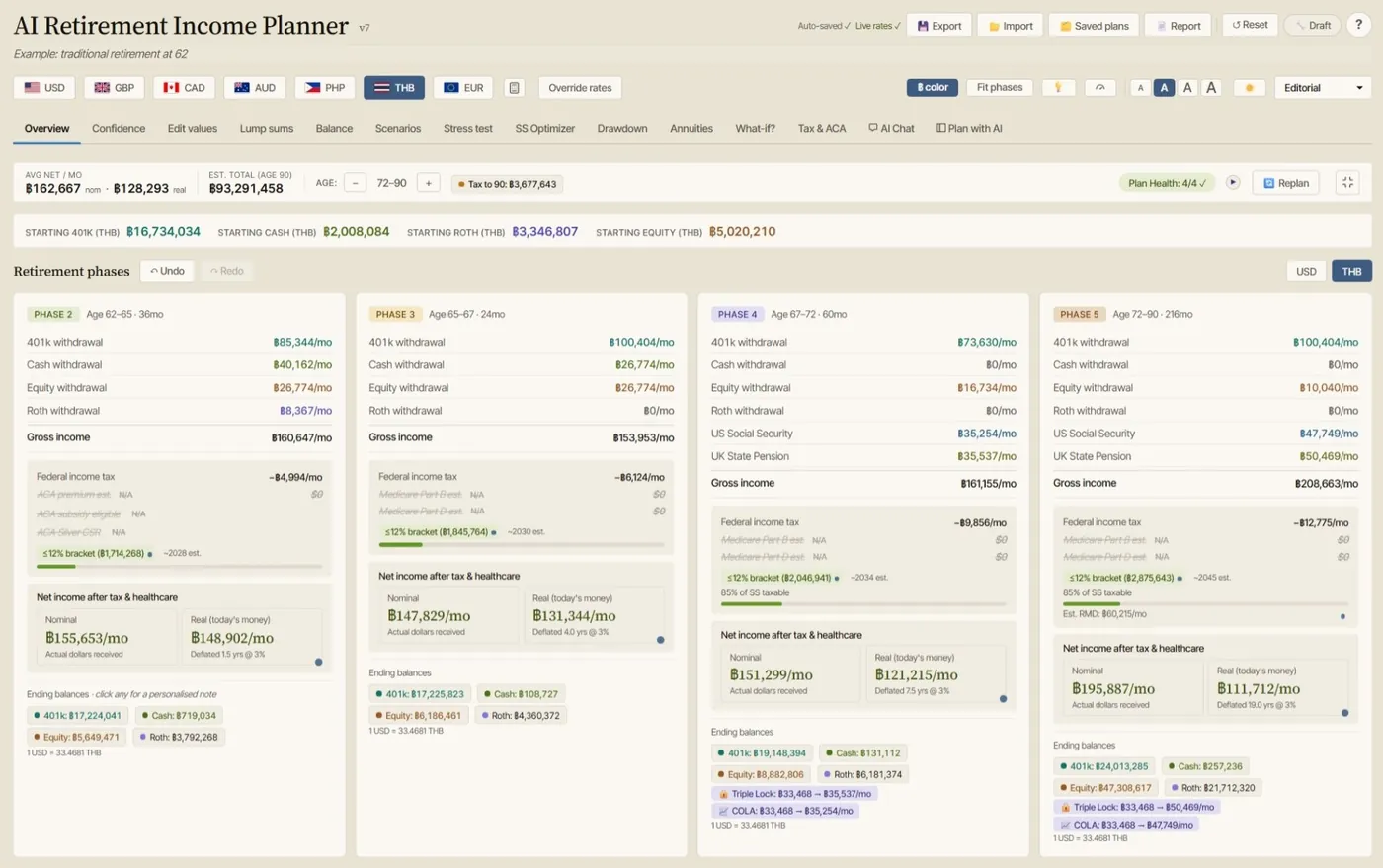
Step 2: Build The Abroad Scenario
Next, save the US baseline to a saved-plan slot, then change only the assumptions that would differ abroad.
Change:
- Planning currency.
- Housing cost.
- Local spending.
- Foreign-residence healthcare assumptions.
- Private insurance.
- Medical evacuation.
- Currency exchange rate.
- Local tax assumptions.
- Travel back to the United States.
- Foreign bank account assumptions.
- Return-home cost.
Keep the same starting balances, ages, and Social Security decisions at first. This makes the difference between scenarios easier to understand.
Step 3: Compare Taxes
Taxes can change the answer quickly.
For many US retirees, the starting point is that US citizens and resident aliens abroad are generally subject to US tax on worldwide income. That means the abroad scenario should not simply erase US tax. The tax side has enough moving parts to deserve its own treatment, which is in expat retirement taxes: what to model before moving.
Compare:
- US federal tax.
- State tax exposure.
- Foreign tax on pension income.
- Foreign tax on IRA or 401k withdrawals.
- Foreign tax on Social Security.
- Foreign Tax Credit assumptions.
- Tax treaty questions.
- Reporting tasks for foreign accounts.
- Currency conversion for tax reporting.
Some foreign tax systems may be favorable to retirees. Others may tax income differently than expected. Do not assume the local cost-of-living article has answered the tax question, and use a retirement calculator that models taxes and healthcare together rather than a single spending estimate.
The Foreign Tax Credit line above is the one most people carry the wrong mental model into. It is not a discount, and the two tax bills do not add together. The credit is capped at your US liability, so once the arithmetic settles you end up paying the higher of the two countries' bills, not the sum. That has a consequence worth planning around: if the foreign bill is the larger one, your US tax effectively disappears into the credit, and if it is smaller, you top up to the US figure and the move stops being a tax decision at all. We set out the exact formula, and the point where it flips, on the cross-border methodology page.
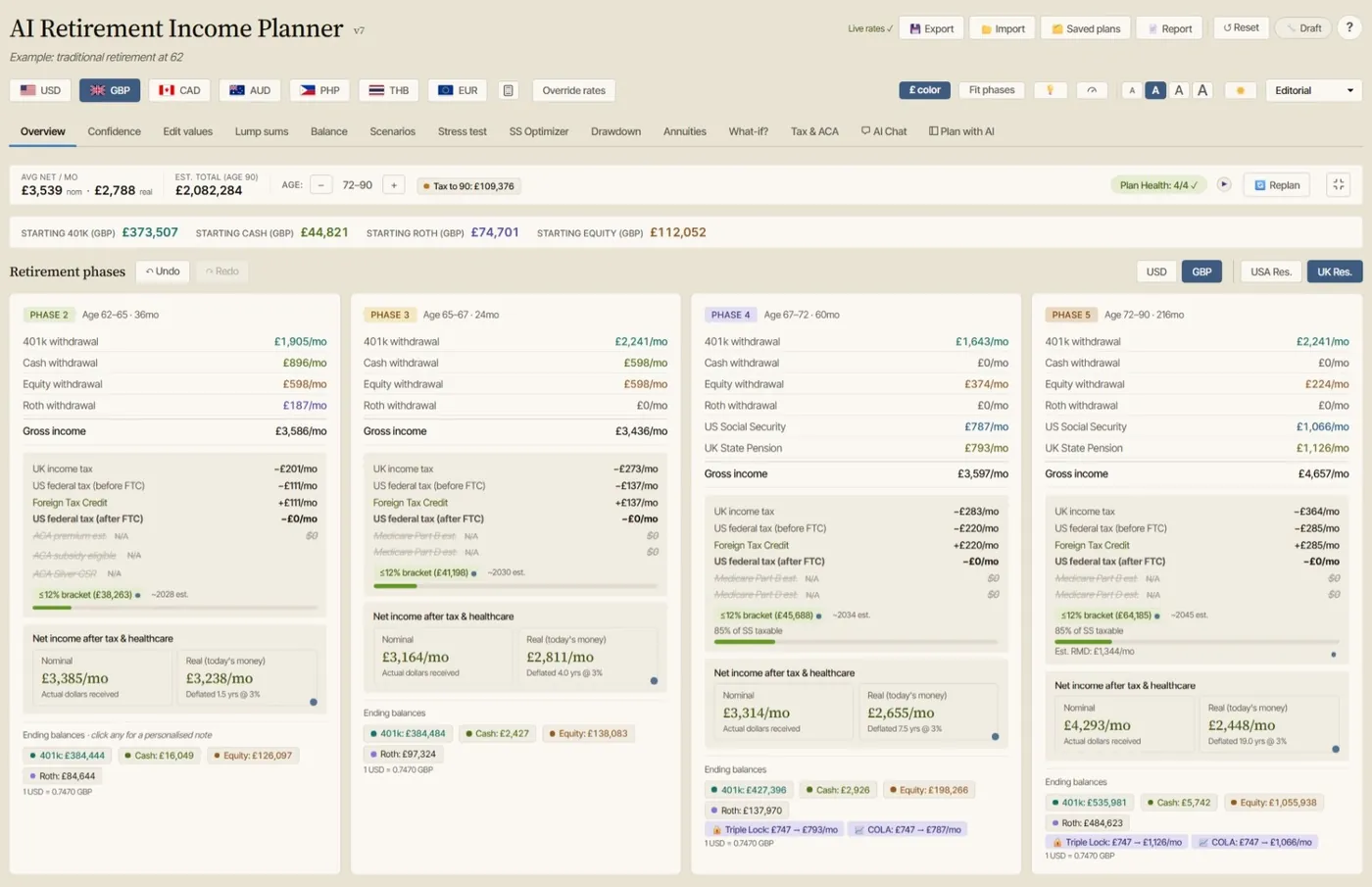
This is not theoretical. In our cross-border data study, a US citizen living in the UK pays more income tax than they would at home from the first year, and the gap more than doubles at 67, when US Social Security moves into the UK tax base under the treaty. Before 67 free UK healthcare more than makes up for it; after 67 it does not.
Step 4: Compare Healthcare
Healthcare is often the swing factor.
Medicare.gov says Medicare usually does not cover healthcare while traveling outside the United States, with limited exceptions. CDC travel guidance separates travel health insurance, travel disruption coverage, and medical evacuation insurance.
Compare:
- Medicare-based healthcare in the United States.
- Local routine care abroad.
- Private international insurance.
- Prescription costs.
- Emergency hospital costs.
- Medical evacuation coverage.
- Travel back to the United States for care.
- Long-term care.
- Return-to-US healthcare later in life.
This is where a cheap-abroad plan can become more complex. Routine care may be affordable, but major care and insurance structure still need a real model, the same way health insurance before Medicare needs its own plan for an early US retirement.

Step 5: Compare Currency Risk
If retirement income is in dollars and spending is in another currency, exchange rates become part of the retirement plan.
Build at least three abroad versions:
- Base case, with local costs converted at today's rate.
- Weaker-dollar case, where the same local costs take 10% to 15% more dollars.
- Stronger-dollar case, where they take fewer.
Then add a fourth version that combines weaker dollar plus higher healthcare costs. That combined scenario is often more useful than a currency-only test.
Build those versions by changing the dollar amounts, not just the exchange rate. The planner keeps every figure in US dollars and uses the rate to translate them, so a version that differs only by exchange rate reads differently in local currency but is the same plan underneath, with the same taxes, balances and Plan Health. How to use the currency converter walks through setting up that test.
The question is not whether one exchange rate is right. The question is whether the plan remains workable across a reasonable range of currency outcomes, which is the same idea behind Monte Carlo and historical backtesting: test the plan against many outcomes, not one.
Step 6: Compare Social Security Abroad
Social Security can be payable outside the United States in many situations, but the result depends on the person's facts and destination. SSA provides a Payments Abroad Screening Tool to help people check whether payments may continue outside the United States.
Model Social Security as:
- A USD income stream.
- A benefit that may be spent in a different currency.
- A survivor-income factor for couples.
- A taxable income source.
- A payment stream that should be checked against SSA rules before moving.
For couples, also compare what happens after the first spouse dies. The survivor version of the abroad plan may look different from the couple version, and the underlying question of when to claim Social Security still applies wherever you live.
Step 7: Compare Housing And Family Travel
Housing abroad may be cheaper, but the full comparison should include transition costs.
Compare:
- Selling a US home.
- Renting out a US home.
- Keeping a US home vacant.
- Buying abroad.
- Renting abroad.
- Local deposits and furnishings.
- Storage.
- Moving costs.
- Family travel.
- Emergency travel.
- Visitor costs if family comes to you.
Family travel is easy to understate. If the plan depends on frequent long-haul travel, it should be in the annual budget.
Step 8: Compare The Return-To-US Case
Even a confident move abroad should include a return-home case.
A return may happen because of:
- Healthcare.
- Long-term care.
- Widowhood.
- Family needs.
- Visa or residency changes.
- Safety concerns.
- Exchange-rate pressure.
- Loneliness or lifestyle mismatch.
Model return costs:
- Flights.
- Shipping or storage.
- US housing setup.
- Healthcare transition.
- Vehicle purchase or lease.
- State tax assumption.
- Temporary double housing.
- Professional help.
If the abroad plan works only when the move is permanent, the risk may be understated.
How To Model This In The AI Retirement Income Planner
Use this workflow:
- Build the US baseline and save it to a saved-plan slot.
- Turn the current plan into the abroad base case.
- Select the currency for the abroad scenario, and the residence setting where one is offered.
- Update housing, healthcare, taxes, and travel.
- Choose the exchange rate you plan with (the live rate, or your own under Override rates), and record it in Plan notes, because custom rates are not saved with the plan.
- Enter the overseas healthcare cost.
- Add a foreign-account reporting checklist item in notes.
- Save weaker-dollar and higher-healthcare versions, with the extra cost entered in dollars, and build the return-to-US version as its own plan in USD.
- Read the Stress test for each version.
- Compare Plan Health checks.
- Compare Plan Confidence.
- Keep a short list of professional-review questions for tax, visa, healthcare, insurance, and estate planning.
The planner keeps up to three saved plans and compares your current plan with one of them at a time (net income and tax by phase, total tax, and ending balances), so use those slots for the versions you compare most and export any extra variants as JSON backups you can reload later. On the tax side, it models US federal tax and an optional flat state tax, with dedicated resident modes for the United Kingdom, Canada, and Australia (including UK Foreign Tax Credit handling); for other destinations it treats the plan as a US taxpayer or as a foreign resident with US healthcare excluded, so estimate local tax yourself and confirm it with a professional.
The planner is useful because it compares whole retirement plans, not isolated expenses.
Example Comparison
Imagine a couple, ages 64 and 63, deciding between retiring in the United States or abroad at 66.
US baseline:
- Higher housing costs.
- Medicare at 65.
- Familiar healthcare system.
- Federal and state tax.
- Shorter family travel.
- No currency conversion for daily spending.
Abroad base case:
- Lower rent.
- Lower routine care.
- Private healthcare coverage.
- Local spending in another currency.
- More family travel.
- Possible foreign tax.
- Foreign bank account reporting.
Abroad stress case:
- Dollar weakens.
- Healthcare premiums rise.
- One spouse dies.
- Survivor returns to the United States at 79.
The abroad base case may look better. The abroad stress case tells whether that better-looking plan is durable. In the planner, one plan keeps one residence from start to finish, so the return at 79 is a separate US plan read from that age onward, and the loss of a spouse comes from the survivor scenario in the What-if tab.
What Happened When We Ran The Numbers
Everything above is a method. We also ran it, and published the result: one $1.2M plan, modeled month by month to age 90 as a tax resident of the US, UK, Canada and Australia. Three findings are worth carrying into your own comparison.
The ranking does not hold still. The country that comes out ahead the year you retire is often not the one ahead at 80. In the base case the UK leads from 60 to 65 and the United States leads from 65 on, while Canada and Australia swap places at 67 — none of them doing anything differently. Medicare replacing marketplace insurance at 65 and Social Security starting at 67 are enough to reorder the table on their own. A comparison run only for your first year of retirement can point you at the wrong country.
Where Social Security is taxed changes the answer. Under the US–UK treaty, US Social Security is taxed only in the country you live in, so for a US citizen retiring in the UK the whole benefit lands in the UK tax base at 67. In the study that took the UK resident's tax bill to more than twice the American's, and free UK healthcare stopped covering the difference. Read the treaty article for your own destination before assuming your benefit is taxed the way it is at home.
The answer depends on how much you have. Across portfolio sizes the early leader was the UK up to $1.8M and the United States at $2.5M. At the end, the United States led from $900k up, and the UK only at $600k. So a friend's conclusion does not transfer to your balance sheet, even with identical assumptions.
One caveat we would rather state than bury: those figures assume the public system covers you at no direct premium outside the US. That assumption is doing more work than any other in the result — before 67 it is the UK's margin — so it is the first thing to challenge against your own situation. The full dataset is free to download, including what is and is not modeled.
FAQ
Is retiring abroad always cheaper than retiring in the US?
No. Some spending categories may be cheaper abroad, but taxes, healthcare, insurance, currency, travel, and return-home costs can change the comparison.
Should I compare after-tax income or gross income?
After-tax income is more useful. Gross income does not show what the household can actually spend after federal tax, state tax, foreign tax, and healthcare costs.
Does Medicare cover retirees abroad?
Medicare usually does not cover healthcare while traveling outside the United States, with limited exceptions. Check Medicare.gov and your specific plan before relying on any coverage assumption.
What is the biggest risk when comparing US retirement and retirement abroad?
The biggest risk is using a single optimistic abroad budget. A better comparison includes taxes, healthcare, currency movement, family travel, survivor planning, and a return-to-US scenario.
Can the planner compare retiring in the US versus abroad?
Yes. Save the US baseline and compare it with the abroad plan, including a plan in a different currency and residence. Build currency and healthcare stress versions with the extra costs entered in dollars, and read the Stress test, Plan Health checks, and Plan Confidence on each one.
Source Links
- IRS US citizens and resident aliens abroad: https://www.irs.gov/individuals/international-taxpayers/us-citizens-and-resident-aliens-abroad
- IRS foreign currency and exchange rates: https://www.irs.gov/individuals/international-taxpayers/foreign-currency-and-currency-exchange-rates
- IRS FBAR information: https://www.irs.gov/businesses/small-businesses-self-employed/report-of-foreign-bank-and-financial-accounts-fbar
- SSA payments outside the United States: https://www.ssa.gov/international/payments.html
- Medicare travel outside the United States: https://www.medicare.gov/coverage/travel-outside-the-u.s.
- CDC travel insurance overview: https://wwwnc.cdc.gov/travel/page/insurance
- AI Retirement Income Planner: https://airetirementincomeplanner.com/
Educational Disclaimer
This article is for general education only. It is not financial, tax, investment, legal, immigration, visa, privacy, cybersecurity, healthcare, insurance, Social Security, Medicare, estate, AI safety, software, or retirement advice. Confirm tax, healthcare, currency, immigration, insurance, account-reporting, Social Security, Medicare, housing, and estate details with official sources and qualified professionals.