
Quick Answer
If you are within ten years of retirement, when to claim Social Security is one of the largest financial decisions you will make, and one of the least obvious. Claim at 62 and the money starts now, but you lock in a permanently reduced benefit. Wait until 70 and your monthly check is roughly 77% larger than at 62, but you may wait years to see the first dollar.

The honest answer is that it depends on your health, your savings, and whether you are married, and the only way to see it clearly is to run your own numbers. This guide shows how to model 62, 67, and 70 in the AI Retirement Income Planner, how to use the SS Optimizer, and a genuinely surprising result: because claiming age and your withdrawal strategy interact, waiting is not always the higher-income choice. For the underlying decision itself, the companion piece on claiming at 62 or waiting covers the trade-offs in more depth.
Key Takeaways
- The numbers are large. Claiming at 62 is roughly a 30% permanent cut from full retirement age; waiting to 70 adds about 8% a year beyond it, roughly 77% more than claiming at 62.
- Break-even is usually late 70s to around 80. Live well past it and waiting pays; the risk is not living to collect.
- Claiming age cannot be separated from your withdrawal strategy. Waiting means larger portfolio withdrawals in the bridge years, which can reduce growth, so the higher benefit does not always mean higher income.
- The planner models each age directly. Set the claiming age, enter the benefit for that age, and use the SS Optimizer to see the lifetime trade-off across every age from 62 to 70.
- For couples, the higher earner's decision protects the survivor. The survivor keeps the larger of the two benefits, so delaying can be longevity insurance for a spouse.
How to Set the Claiming Age
In the planner, your Social Security claiming age lives in the Edit values tab under the income settings. The default is 62. Change it to model a different age.
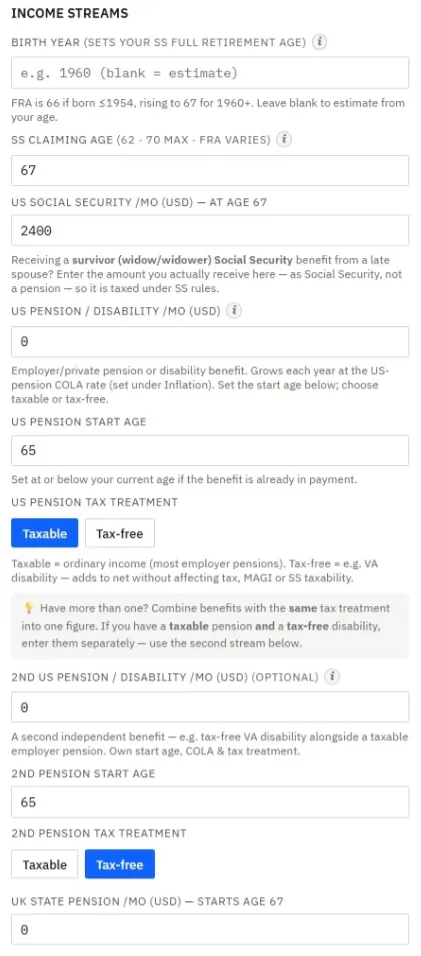
One detail matters: the benefit amount you enter is treated as the benefit at the claiming age you have set. Your SSA statement at ssa.gov gives estimates at 62, at full retirement age, and at 70, so enter the figure that matches the age you are modeling. When you change the claiming age, the planner reminds you that your entered amount now represents that age, and points you to the SS Optimizer to see the equivalents at other ages.
Use the SS Optimizer to See the Trade-Off
The SS Optimizer tab is built for exactly this decision. Enter your benefit at full retirement age and it calculates your lifetime payout for every possible claiming age from 62 to 70, correctly accounting for the early-claiming reduction and the delayed-retirement credits.
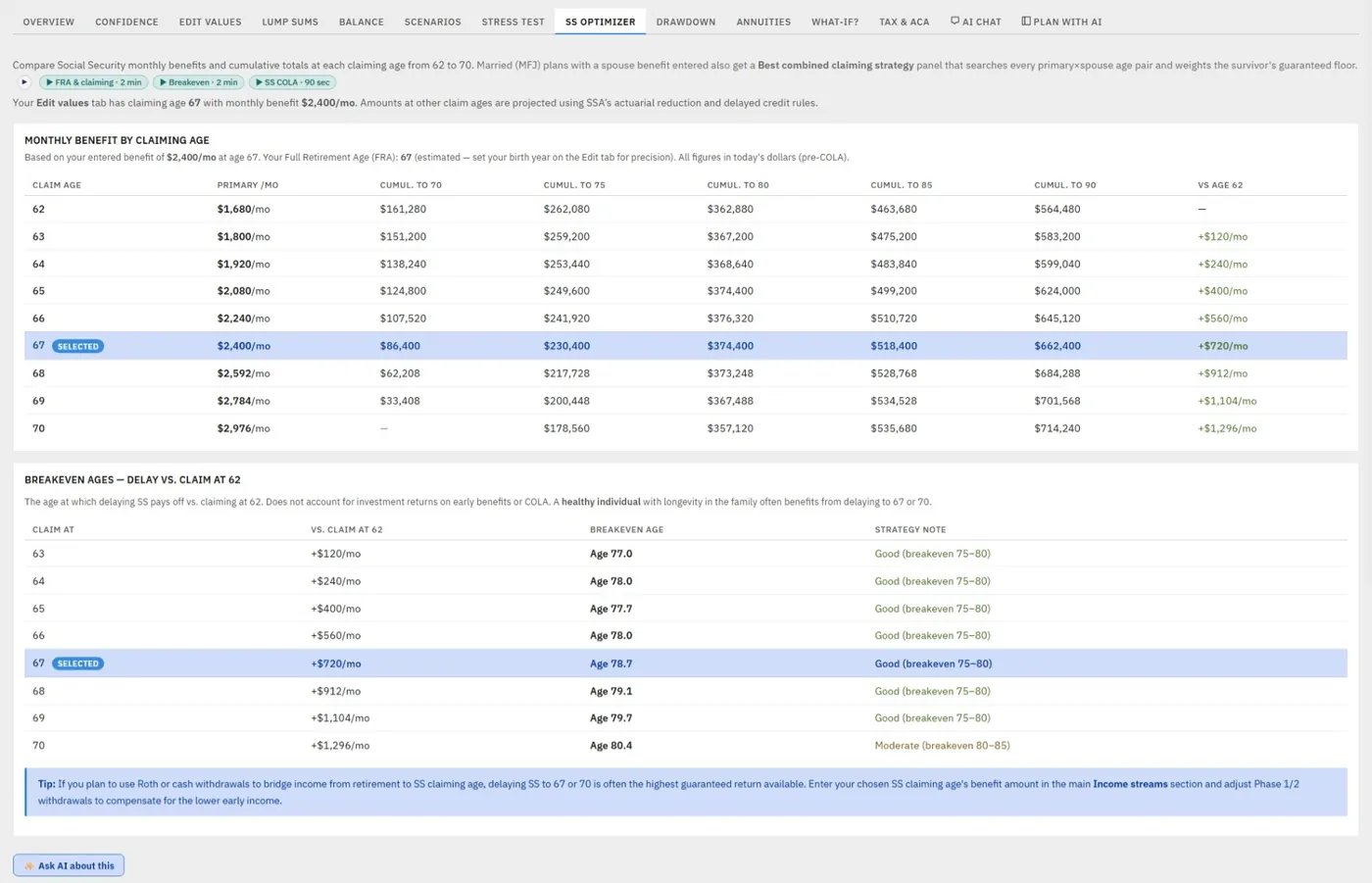
What you are looking for is the break-even age, the point where waiting longer starts to pay off given your spending. Claim at 62 and you get years of payments before someone who waited to 70 sees anything, but each year the gap between the two widens. The crossover is typically in the late 70s to around 80. If you are confident of living well past that, waiting wins by a growing margin. If you have health concerns or genuinely need the income sooner, claiming earlier can be the sensible choice, and that is not a failure, it is your own situation.
The Surprising Part: Claiming Age Meets Withdrawal Strategy
Here is the result that surprises most people. You might assume that a bigger Social Security check always means more monthly income. When you actually model it, that is not always true.
Consider waiting until 70. Social Security provides nothing in the bridge years from retirement to 70, so the portfolio has to do all the work. That means larger 401(k) withdrawals early, which drains the account before it has had time to grow. Claim at 62 instead, lean on cash and smaller early withdrawals, and the portfolio keeps compounding, which can leave you with a higher average monthly income across the whole plan, even though each Social Security check is smaller.
In the scenario walked through in the source video, claiming at 67 actually produced slightly more real monthly income than waiting to 70, for exactly this reason. The point is not that early claiming is better. It is that the claiming decision cannot be separated from how you draw down your accounts, and only a plan that models both together can show you the combined effect for your own numbers. This is closely tied to letting investments grow by choosing which account to draw from first, and to how much you can safely spend overall.
Two important balances to that result: waiting still provides valuable longevity insurance if you live a long time, and, for couples, it protects the survivor. Those benefits do not always show up in an average-monthly-income comparison, so weigh them alongside it.
Claiming Mid-Phase and Split Phases
Social Security does not always start neatly at a phase boundary. If you claim at an age that falls in the middle of a phase, say 63 or 70, the planner automatically splits that phase into two parts: a first part before your benefit starts and a second part after, each independently editable.
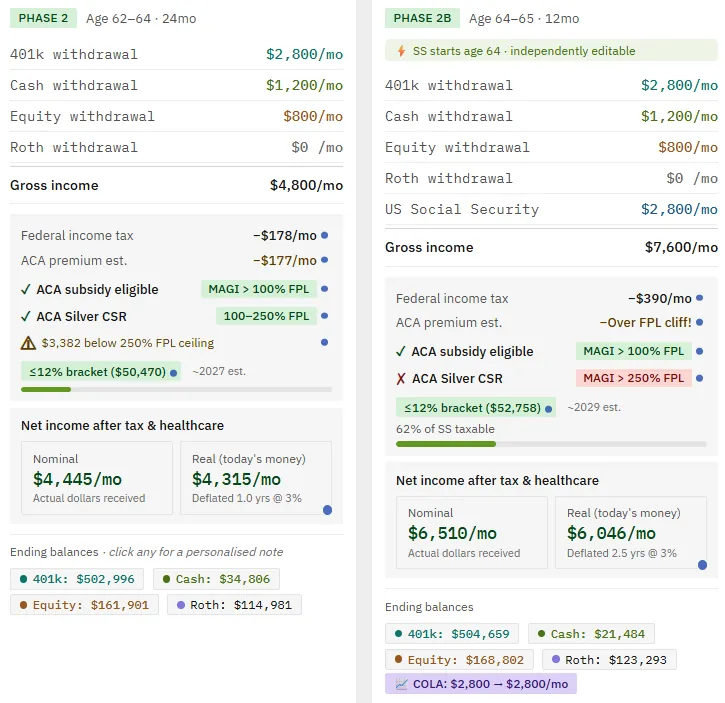
This matters for two reasons. First, it lets you dial back your portfolio withdrawals the moment those checks begin, since Social Security now covers more of the gap. Second, in the pre-benefit part you may need to keep withdrawals low to protect an ACA subsidy, which you can manage separately in that segment. If you combine an early retirement age with a delayed claim, you can end up with as many as seven phases; on smaller screens the phase row simply scrolls sideways so you can work on each part.
For Couples, Think About the Survivor
For married couples the decision is bigger than one person's break-even. When one spouse dies, the survivor keeps the larger of the two Social Security benefits, not both.
That changes the math entirely. If the higher earner delays to 70 and dies first, the surviving spouse can receive that larger benefit for the rest of their life, instead of their own smaller one. This is why the higher earner in a couple is often advised to wait as long as possible: it is not only about their own lifetime income, it is about buying the survivor a bigger, inflation-adjusted safety net. The planner lets you enter each spouse's benefit and claiming age separately, and its SS Optimizer can search across the combinations of primary and spouse claiming ages. The survivor scenario and the widow's tax cliff are worth modeling directly, because a plan that works for two can get much tighter for one.
A Simple Way to Decide
Once you have modeled it, the decision usually comes down to three questions:
- Health and family longevity. If you expect to live well past the break-even age, waiting tends to pay.
- Bridge savings. Do you have enough to fund the years before benefits start without straining the plan?
- Marriage and the survivor. If you are the higher earner, delaying can protect your spouse for life.
The best way to answer them is to build one plan, save it, then compare claiming ages side by side as separate scenarios. Put your real SSA estimate and your real balances in, and the answer is usually obvious once you can see the phases next to each other. If you have not built a baseline yet, start with the step-by-step setup guide.
FAQ
How much more is Social Security at 70 than at 62?
For someone with a full retirement age of 67, claiming at 62 is about a 30% permanent reduction, while waiting to 70 adds roughly 8% a year in delayed-retirement credits. The result is that a benefit at 70 is roughly 77% larger than the same person's benefit at 62. The planner's SS Optimizer shows your exact figures across every claiming age.
What is the break-even age for delaying Social Security?
It is the age at which the larger delayed benefit catches up with the total you would have collected by claiming early. For most people it falls in the late 70s to around 80. Living past it favors waiting; the risk of waiting is not living long enough to collect the larger benefit. The SS Optimizer shows your personal break-even.
Why might claiming later give me less monthly income?
Because waiting means your portfolio funds the bridge years alone, requiring larger early withdrawals that reduce future growth. If claiming earlier lets you lean on cash and leave investments to compound, your average monthly income across the plan can be higher even with a smaller check. This only shows up when you model claiming age and withdrawals together, which is what the planner does.
How do I model claiming at a different age?
Set the Social Security claiming age in the Edit values tab and enter the benefit you expect at that age from your SSA statement. If the age falls mid-phase, the planner splits that phase into a pre-benefit and post-benefit part automatically. Use the SS Optimizer to compare the lifetime trade-off across ages, and save each version to compare them side by side.
Should the higher earner in a couple wait?
Often, yes, because the surviving spouse keeps the larger of the two benefits. Delaying the higher earner's claim raises the floor the survivor will live on for the rest of their life. It is a personal decision that depends on health, savings, and age difference, so model both spouses' claiming ages and the survivor scenario before deciding.
Source Links
- Social Security Administration, When to Start Receiving Benefits: https://www.ssa.gov/benefits/retirement/planner/agereduction.html
- Social Security Administration, Delayed Retirement Credits: https://www.ssa.gov/benefits/retirement/planner/delayret.html
- Social Security Administration, Survivors Benefits: https://www.ssa.gov/benefits/survivors/
- Social Security Administration, Retirement Estimator: https://www.ssa.gov/benefits/retirement/estimator.html
- AI Retirement Income Planner: https://airetirementincomeplanner.com/
Educational Disclaimer
This article is for general education only. It is not financial, tax, investment, legal, healthcare, Social Security, Medicare, estate, or retirement advice. It does not provide personalized recommendations. Social Security rules and figures are set by law and administered by the Social Security Administration, and they change. Projections produced by any planning tool are estimates based on the assumptions entered. Confirm your own benefit estimates at ssa.gov and consult qualified professionals before making significant financial decisions.