
Quick Answer
In the years before Medicare, the single biggest lever on your retirement costs is not how much you spend. It is how much taxable income you show, and which accounts it comes from. The same monthly income can leave you comfortably subsidized or push you over a cliff that adds thousands of dollars a year in health insurance, depending on how you assemble it.

That is because one number, your modified adjusted gross income (MAGI), quietly controls your ACA health insurance subsidies before 65 and your Medicare surcharges after. The AI Retirement Income Planner tracks that number for you and flags the moment a withdrawal would cost a subsidy or trigger a surcharge, with the actual dollar cost built into the phase. This guide explains how taxes, ACA subsidies, and Medicare costs interact, and how the planner models them so you can keep more of your income.
Key Takeaways
- MAGI is the number that matters. It drives ACA subsidies before Medicare and IRMAA surcharges after. Managing it is the core skill of early-retirement tax planning.
- Not all withdrawals count the same. Cash is invisible to MAGI, 401(k) withdrawals count in full, and equity sales count only their gain. That difference is a planning tool.
- The ACA has a cliff and a sweet spot. Cross about 400% of the federal poverty level and the subsidy can disappear entirely. Staying under roughly 250% with a Silver plan unlocks extra cost-sharing help.
- Medicare has its own trap after 65. IRMAA adds surcharges to Part B and D when income crosses a threshold, on a two-year lookback.
- The planner inflates and flags everything for you. Brackets, deductions, and thresholds are carried forward automatically, and each phase card shows where you stand.
The Three Tax Buckets
The starting point is to stop thinking of your savings as one pot. Think of it as three buckets with different tax properties, because which one you draw from changes both your tax bill and your MAGI.
- Cash withdrawals are tax-free, because that money has already been taxed. Crucially, cash is invisible to MAGI, so drawing from it does not affect your ACA subsidies or Medicare surcharges at all.
- 401(k) or traditional IRA withdrawals are ordinary income. They push up your tax bracket and your MAGI, so they are the withdrawals to watch most closely before Medicare.
- Taxable brokerage sales are treated as capital returns rather than ordinary income, but the gain portion still counts toward MAGI for ACA purposes.
Because the buckets behave differently, the order and mix you draw from is itself a strategy, which is why choosing which account to withdraw from first matters so much. Leaning on cash in a year when you need to keep MAGI low is one of the most useful moves available in early retirement.
MAGI Is the Number That Controls Everything
Modified adjusted gross income is the figure the government uses to decide how much health help you get. Before 65 it sets your ACA subsidy. From 65 it sets whether you pay a Medicare surcharge. Get MAGI right and the rest tends to follow.
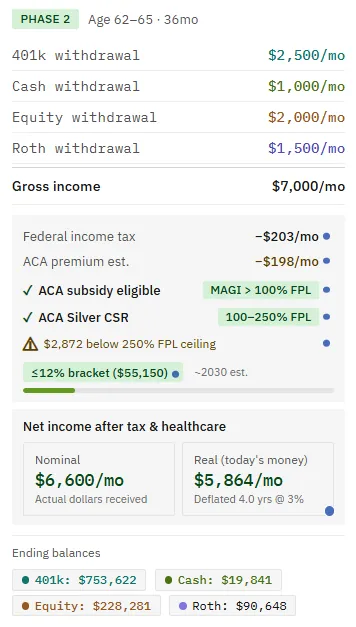
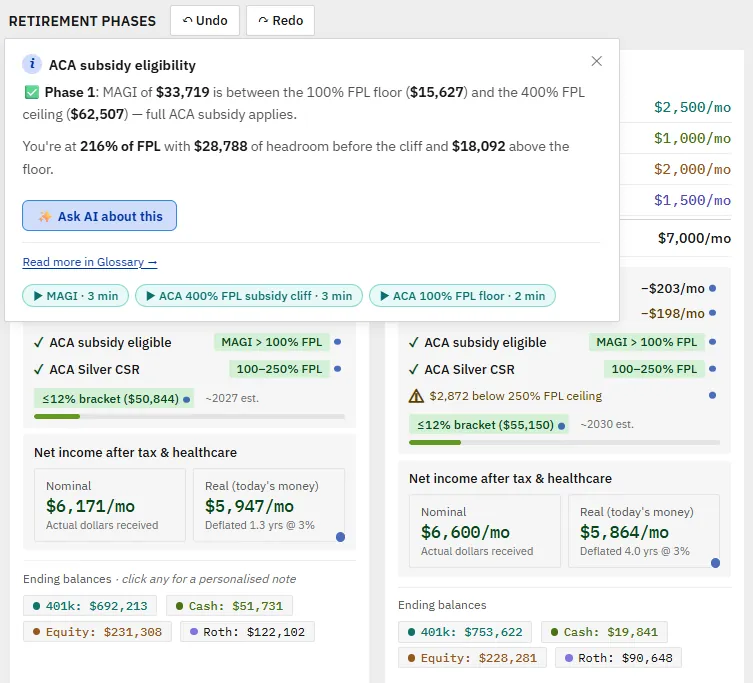
The planner calculates your MAGI in every phase and checks it against the thresholds that matter. When a withdrawal pushes you over a line, it flags it on the phase card, and the extra cost, a lost subsidy or a higher premium, is built into that phase's numbers so you see it in real money rather than as an abstract warning. You can click the figures on a card to see exactly how the subsidy and the MAGI were worked out.
The ACA Cliff and the Cost-Sharing Sweet Spot
If you retire before 65, marketplace health insurance is likely your coverage until Medicare, and its cost depends heavily on your income. Two thresholds matter.
The subsidy cliff. Premium subsidies phase out as income rises, and above roughly 400% of the federal poverty level (in the mid-$60,000s for a single person, though the exact figure changes each year) the subsidy can disappear entirely. Going over that line even slightly can cost thousands of dollars a year. The temporary enhanced subsidies that softened this cliff from 2021 through 2025 expired at the end of 2025, so the cliff is back in effect for 2026, and Congress is currently debating whether to restore some relief. Because this is set by law and can change, confirm the current year's rules.
The cost-sharing sweet spot. Separately, keeping MAGI below about 250% of the federal poverty level with a Silver plan unlocks cost-sharing reductions, which lower your deductibles, copays, and out-of-pocket maximums, with the strongest benefit at the lower end of that band. For many early retirees, deliberately keeping income in that band during the pre-Medicare phases is one of the highest-value optimizations available. The planner shows your cost-sharing band status on each relevant phase card.
One detail worth knowing: the marketplace uses the prior year's poverty-level figures when calculating subsidies for the current plan year, so if the planner's figures look a year behind, that is correct and deliberate. Getting this right is a big part of planning health insurance before Medicare.
IRMAA: the Medicare Surcharge After 65
The cliff is not the only income trap. Once Medicare starts, a high income triggers IRMAA, the income-related monthly adjustment amount, a surcharge added to your Part B and Part D premiums.
IRMAA begins when income crosses a threshold (around $106,000 for a single filer, changing each year), and it uses a two-year lookback, so the income that sets this year's surcharge is from two years earlier. The planner models the base Medicare premiums and flags when a phase's MAGI would push you into surcharge territory, which is often caused by large 401(k) withdrawals or required distributions later in the plan. The usual fixes are to reduce those withdrawals or to have done Roth conversions earlier, since Roth withdrawals do not count toward IRMAA income. Deciding how much to convert in each year, rather than whether to convert at all, is what the multi-year Roth conversion optimizer is for.
Everything Inflates Forward Automatically
A common worry is that you will have to keep updating tax brackets and thresholds by hand. You do not.
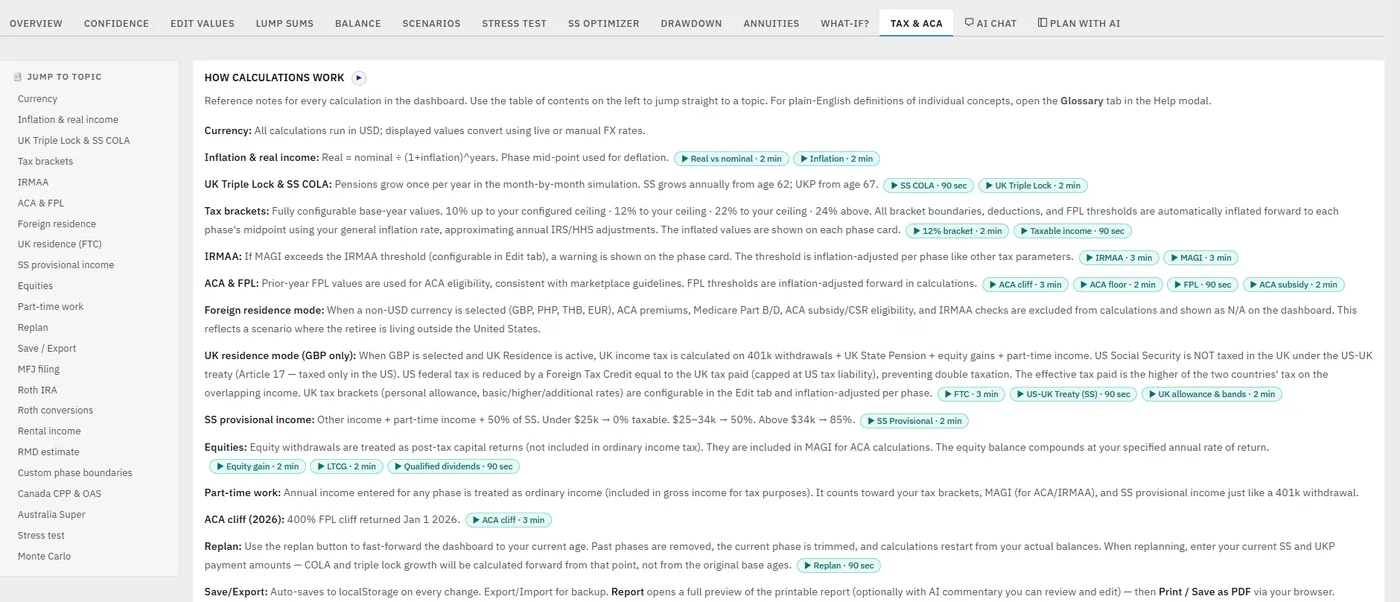
The planner takes the base-year values you enter, the tax brackets, standard and senior deductions, and the federal poverty levels, and automatically inflates them forward to each phase's midpoint using your general inflation rate, approximating the annual IRS and HHS adjustments. The inflated figures are what you see on each phase card. So you enter today's numbers once, keep them current with a quick annual rate refresh, and let the planner carry them forward across the decades of your plan.
If you want the rules spelled out rather than just applied, the planner has a dedicated Tax & ACA notes tab that explains each one in plain language, from how currency and inflation are handled to how MAGI, the subsidy cliff, and residency modes work.
Nominal Income Versus Real Income
Because those figures grow with inflation, the income numbers you see come in two forms, and the difference matters. Nominal income is the actual dollar amount you will withdraw in a future year. Real income is what that amount is worth in today's money.
When you are planning, you usually care about real income, because it tells you the lifestyle a withdrawal buys. When the time comes to actually take the money, the nominal figure is what lands in your account. A withdrawal that looks like $5,000 a month twenty years out might be worth only $3,500 in today's terms. The planner shows both for every phase, which is the heart of understanding gross, net, and real income and why inflation quietly reshapes a plan.
How Social Security Is Taxed
Social Security gets its own special treatment through "provisional income," which is your other income plus part-time earnings plus half of your Social Security benefit. For a single filer, below about $25,000 none of your benefit is taxable, between $25,000 and $34,000 up to half becomes taxable, and above $34,000 up to 85% is taxable. These thresholds are set in statute and are not adjusted for inflation, so more retirees drift into taxable territory over time. Provisional income also counts some sources people expect to be exempt, and tax-free municipal bond interest is added straight back in. The planner handles this calculation for you, so you see the effect on your net income without doing the arithmetic. When to start benefits is a related decision covered in claiming Social Security at 62 or waiting.
State Tax and Living Abroad
Two more situations change the picture, and the planner models both.
State income tax is optional in the planner. You can add a flat state rate, with toggles for whether your state exempts Social Security and pension income, and a cap on any pension deduction where your state applies one. For many retirees state tax is a meaningful line, especially where a state taxes retirement income differently from wages. How each state treats retirement income varies more than most people expect, so it is worth checking before you settle on where to live.
Living abroad changes taxes and healthcare substantially. Selecting the Philippine peso, Thai baht or euro puts the plan in a foreign-residence mode that excludes US ACA and Medicare costs, reflecting a retiree living outside the United States, while a UK-resident mode applies UK income tax with foreign tax credit handling. Because this reshapes the whole cost picture, it is worth comparing retiring abroad against staying put directly, and the free retirement tax calculator will show you the tax and healthcare difference in a couple of minutes, with no sign-up. The planner supports foreign-residence scenarios rather than modeling every country's local tax law in full, so confirm local rules for your destination.
Putting It Together, Phase by Phase
The reason all of this sits inside a phased plan is that the right move changes as retirement progresses:
- Before Social Security and before Medicare, lean on cash to keep MAGI low, protect your ACA cost-sharing reductions, and stay well under the subsidy cliff. This is usually the highest-value window.
- Once Social Security starts but before Medicare, your benefit raises your MAGI floor, so you may need to reduce 401(k) withdrawals to stay under the cliff.
- When Medicare begins at 65, the ACA concerns fall away and IRMAA becomes the threshold to watch instead.
- When required distributions begin, you may be forced to show more taxable income, so the earlier phases are where any Roth conversions or bracket-filling should already have happened.
Retiring well before 59½ stretches every one of these effects over a longer stretch, and adds one the later ages never face: a large part of the portfolio is not reachable yet. Am I ready to FIRE? covers that case.
The running total of estimated tax at the top of the planner acts as a rough score for all of this. Every time you adjust a withdrawal to keep MAGI in a good band and the tax figure comes down, that is money staying in your pocket. If you have not built a plan yet, the step-by-step setup guide shows how to get your numbers in first.
FAQ
What is MAGI and why does it matter so much in early retirement?
Modified adjusted gross income is the income figure used to determine your ACA subsidies before 65 and your Medicare IRMAA surcharges after. Because a lost subsidy or a surcharge can cost thousands of dollars, managing MAGI, mainly by choosing which accounts to draw from, is often the single most valuable tax skill in early retirement.
Is there really an ACA subsidy cliff in 2026?
Yes. The temporary enhanced subsidies that removed the cliff from 2021 through 2025 expired at the end of 2025, so for 2026 the subsidy can disappear entirely above roughly 400% of the federal poverty level. Congress is debating whether to restore some relief, so this is subject to change and you should confirm the current year's rules before relying on them.
How can I lower my MAGI without lowering my income?
By shifting where the income comes from. Cash withdrawals are tax-free and invisible to MAGI, and Roth withdrawals also do not count toward it, so substituting cash or Roth for 401(k) withdrawals in a given phase can bring MAGI down while keeping your spending the same. The planner shows the effect of each change immediately.
Does the planner update tax brackets and thresholds automatically?
It inflates the base-year values you enter forward to each phase automatically, so you do not adjust them by hand across the plan. You do need to set accurate current-year figures to start, which the planner's rate-refresh workflow makes quick, and re-check them annually.
Do I still owe US tax if I retire abroad?
Generally yes if you remain a US taxpayer, since the US taxes worldwide income, though foreign tax credits and treaties can reduce double taxation. The planner models US federal tax plus optional state tax, and includes UK-resident handling with a foreign tax credit. For other destinations it models foreign-residence assumptions rather than full local tax law, so confirm the specifics with a professional.
Source Links
- KFF, What We Know So Far About 2026 ACA Marketplace Enrollment and Premiums: https://www.kff.org/affordable-care-act/what-we-know-so-far-about-2026-aca-marketplace-enrollment-premiums-and-deductibles/
- HealthInsurance.org, Marketplace Enrollees Face Return of the Subsidy Cliff in 2026: https://www.healthinsurance.org/blog/marketplace-enrollees-face-return-of-the-subsidy-cliff/
- HealthCare.gov, Health Coverage If You Retire Before 65: https://www.healthcare.gov/retirees/
- Medicare.gov, Monthly Premium for Drug Plans (IRMAA): https://www.medicare.gov/drug-coverage-part-d/costs-for-medicare-drug-coverage/monthly-premium-for-drug-plans
- IRS, Is My Social Security or Railroad Retirement Tier I Benefit Taxable: https://www.irs.gov/help/ita/are-my-social-security-or-railroad-retirement-tier-i-benefits-taxable
- AI Retirement Income Planner: https://airetirementincomeplanner.com/
Educational Disclaimer
This article is for general education only. It is not financial, tax, investment, legal, healthcare, Social Security, Medicare, estate, or retirement advice. It does not provide personalized recommendations. Tax law, subsidy programs, and thresholds are set by law and change. Projections produced by any planning tool are estimates based on the assumptions entered. Consult qualified financial, tax, and legal professionals before making significant financial decisions.