
Short Answer
Yes, some people can retire at 55.
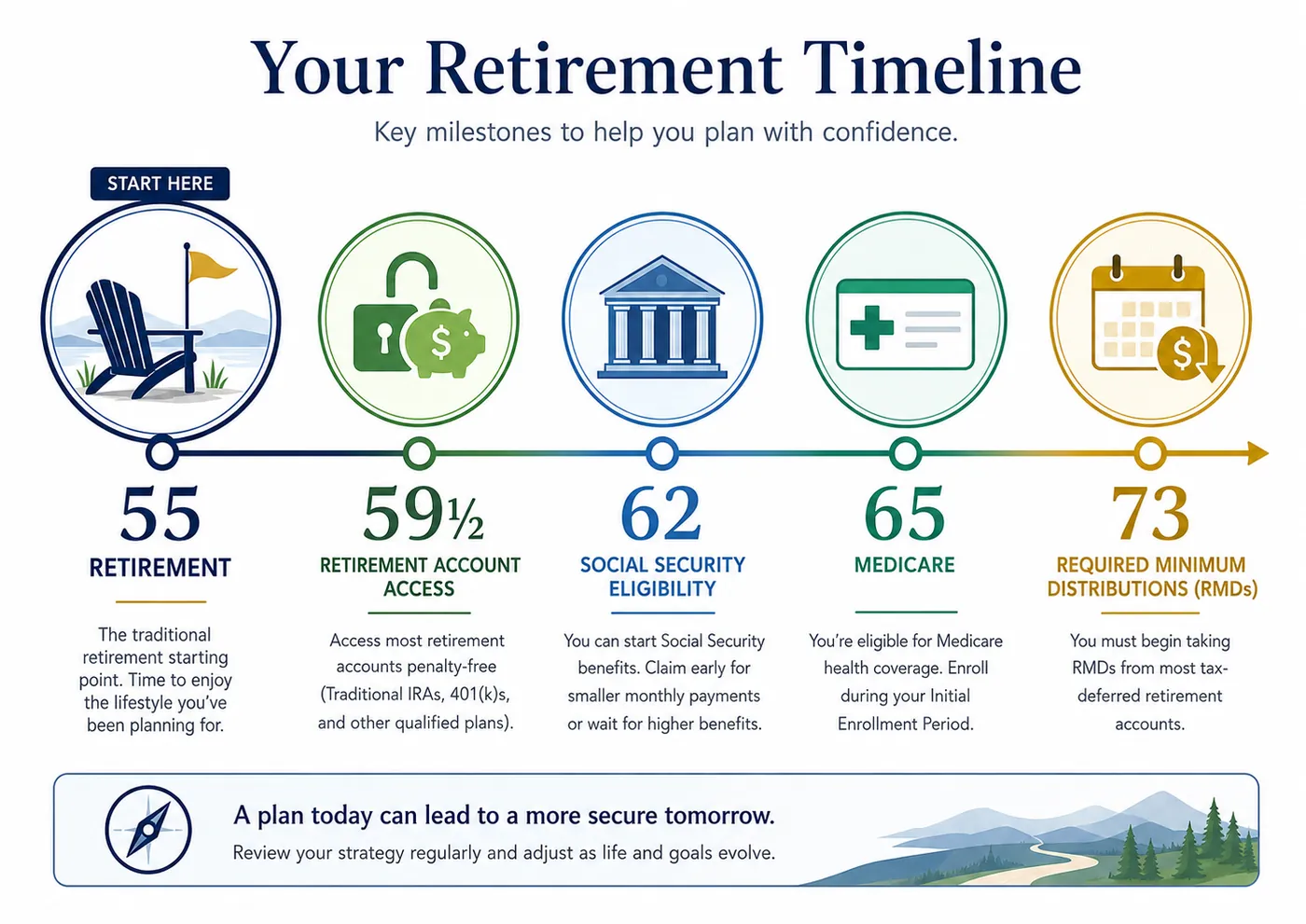
But retiring at 55 is very different from retiring at 62, 65, or 67.
At 55, you may have:
- Ten years before Medicare
- Seven years before Social Security can start
- More than four years before the usual age 59 and a half retirement account penalty line
- A longer portfolio withdrawal period
- More years exposed to inflation and market risk
- More uncertainty around healthcare costs
The question is not only whether your balance looks large enough today. The question is whether the plan can survive a long bridge period before the usual retirement safety rails begin.
Why Age 55 Is A Harder Retirement Age
Retiring at 55 can work, but it asks more from the plan.
Someone retiring at 67 may begin retirement with Social Security available, Medicare already started, and fewer years to fund from savings.
Someone retiring at 55 needs to solve:
- Healthcare before Medicare
- Income before Social Security
- Withdrawals before age 59 and a half
- Taxes during low-income bridge years
- Market risk over a longer retirement
- Inflation over 30 to 40 years
- Survivor planning, if married
That is why a simple savings target can be misleading.
The Healthcare Bridge
Healthcare is often the largest early-retirement question, so it helps to plan the health insurance bridge before Medicare first.
HealthCare.gov says that if you retire before age 65 and lose job-based health coverage, you can use the Health Insurance Marketplace to buy a plan. Losing job-based coverage can qualify you for a Special Enrollment Period.
At age 55, the bridge to Medicare may last about ten years.
Possible coverage options include:
- Spouse's employer plan
- Retiree health coverage
- COBRA
- Marketplace coverage
- Private coverage outside the Marketplace
- Medicaid, if eligible
The cost can vary widely based on income, household size, location, plan choice, health needs, and prescriptions.
HealthCare.gov also notes that Marketplace savings are based on income and household size. That means withdrawals, Roth conversions, capital gains, and part-time work can affect the healthcare plan.
Social Security Is Not Available Yet
SSA says you can start Social Security retirement benefits as early as age 62. If you retire at 55, that leaves at least seven years before Social Security can begin.
That creates a planning gap.
You need to answer:
- What pays the bills from 55 to 62?
- What happens if you delay Social Security past 62?
- How much will early withdrawals reduce the portfolio?
- Does delaying Social Security improve the long-life case?
- Does claiming early reduce pressure too much to ignore?
For many early retirees, deciding whether to claim Social Security at 62 or wait is not only a benefit decision. It is a bridge-funding decision.
The Age 59 And A Half Problem
The IRS says the law generally imposes a 10 percent additional tax on certain early distributions from retirement plans before age 59 and a half. The additional tax applies to the taxable portion of the distribution.
That means a 55-year-old retiree must be careful about which accounts are used for spending.
Common bridge assets may include:
- Cash
- Taxable brokerage
- Roth IRA contributions
- Employer plan distributions that qualify for an exception
- Planned Roth conversion ladder strategies
- Substantially equal periodic payments
- Part-time work
This is not an area for guesswork. A withdrawal mistake can create taxes and penalties.
The Age 55 Exception
The IRS says there are exceptions to the 10 percent additional tax for certain early distributions. For qualified plans other than IRAs, one exception applies to distributions made after you separate from service with your employer after attainment of age 55.
This is often called the age 55 exception or Rule of 55.
Important planning cautions:
- The exception applies to qualified plans other than IRAs.
- The distribution still may be taxable as income.
- Plan rules matter.
- Rolling money into an IRA may change available options.
- Public safety and firefighting employees may have special rules under IRS guidance.
Before relying on the age 55 exception, confirm the rules with the plan administrator and a tax professional.
Taxes Can Be Opportunity And Risk
Retiring at 55 may create lower-income years before Social Security, pensions, and RMDs begin.
That can create planning opportunities:
- Roth conversions
- Taxable account gain harvesting
- Planned IRA withdrawals
- Lower-income years before RMDs
- Social Security delay planning
But the same choices can affect healthcare costs before Medicare.
For example, a Roth conversion may look attractive from a tax-bracket view, but it may raise income during Marketplace coverage years. That could reduce premium tax credits or other savings.
At 55, taxes and healthcare need to be modeled together.
Withdrawal Order Matters More At 55
A 55-year-old retiree may need the portfolio to last 35 to 45 years.
That makes which account you withdraw from first important.
Compare:
- Cash first
- Taxable brokerage first
- Employer plan withdrawals under an age-55 exception
- Roth contributions
- Roth conversions for future years
- IRA withdrawals after 59 and a half
- Delayed Social Security
- Part-time work to reduce withdrawals
The goal is to preserve flexibility while avoiding unnecessary taxes, penalties, and healthcare surprises.
Market Risk Is Bigger In A Long Retirement
Retiring at 55 creates a longer exposure to market risk.
A bad market in the first few years can hurt more because withdrawals continue while the portfolio is down. A long retirement also gives inflation more time to raise spending.
Stress test:
- Market decline in year one
- Five years of weak returns
- Higher healthcare inflation
- Higher general inflation
- Long life to age 95 or 100
- One spouse living much longer
- Large home repair or medical cost
A Simple Example
Suppose a couple wants to retire at 55 with:
- $1.4 million in savings
- $100,000 in cash
- $500,000 in taxable investments
- $700,000 in pre-tax retirement accounts
- $100,000 in Roth accounts
- No pension
- Social Security planned at 67
- Marketplace coverage before Medicare
- $80,000 annual spending before tax
The plan may look possible at first.
But it needs to answer:
- How will they pay for healthcare from 55 to 65?
- Which accounts fund spending before 59 and a half?
- Will Roth conversions hurt Marketplace savings?
- How much tax will taxable account sales create?
- What happens if markets fall early?
- Can the plan survive one spouse living to 95?
- Would part-time work for three years change the result?
Changing one variable can change the answer.
If you are aiming considerably earlier than 55 — the FIRE case, where the gap before retirement accounts unlock runs to seventeen years or more — the same mechanics apply but the margins are thinner. Am I ready to FIRE? works through what a savings multiple cannot tell you about the years straight after you stop.
When Retiring At 55 May Be More Realistic
Retiring at 55 may be more realistic when:
- Spending is moderate and flexible.
- Debt is low.
- Healthcare coverage is solved.
- Cash and taxable accounts can bridge early years.
- Retirement account access is planned carefully.
- Social Security timing has been modeled.
- The plan survives stress tests.
- There is tax diversification.
- One spouse's survivor plan is strong.
- Part-time work is an option if needed.
When Retiring At 55 May Be Risky
Retiring at 55 may be risky when:
- Spending is high and fixed.
- Healthcare coverage is uncertain.
- Most savings are locked in pre-tax retirement accounts.
- The plan depends on strong market returns.
- Cash reserves are small.
- Roth conversions are planned without ACA modeling.
- Debt payments are large.
- One spouse would be financially vulnerable.
- There is no plan for age 55 to 59 and a half.
- Stress tests show repeated failures.
How To Model Retirement At 55 In The Planner
Use this workflow in the AI Retirement Income Planner:
- Enter age 55 as the retirement age.
- Enter spending goals, debts, healthcare assumptions, and inflation assumptions.
- Split savings into cash, taxable, tax-deferred, and Roth accounts.
- Add Social Security claiming ages.
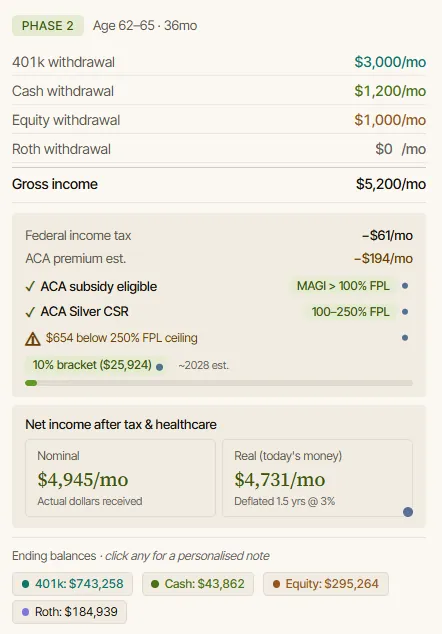
- Use Tax & ACA to model Marketplace years before Medicare.
- Use Edit values to set which accounts fund ages 55 to 59 and a half in each phase, keeping early spending in cash, taxable accounts, or an employer plan that qualifies for the age 55 exception.
- Use What-if? to test Roth conversions and part-time work.
- Use Scenarios to compare retiring at 55, 58, 60, and 62.
- Use Stress test for market, inflation, healthcare, and longevity risks.
- Review Balance for account depletion patterns.
- Open Plan Health for warnings.
- Review Confidence and ending balances.
- Test survivor outcomes if married.
Retire At 55 Checklist
Before retiring at 55, answer:
- What health insurance will I use before Medicare?
- What will coverage cost from 55 to 65?
- What income estimate will I use for Marketplace coverage?
- Which accounts can I use before age 59 and a half?
- Does the age 55 exception apply to my employer plan?
- Will any withdrawals trigger the 10 percent additional tax?
- Can I cover spending before Social Security starts?
- When should I claim Social Security?
- Should I model Roth conversions?
- How will taxes and healthcare interact?
- What happens in a bad market?
- What happens if inflation is higher?
- What happens if I live to 95 or 100?
- What happens if one spouse dies first?
- Would working two or three more years greatly improve the plan?
FAQ
Can you retire at 55?
Yes, some people can retire at 55, but the plan must cover healthcare before Medicare, income before Social Security, withdrawals before age 59 and a half, taxes, inflation, and a longer retirement period.
Can I get Social Security at 55?
No. SSA says retirement benefits can start as early as age 62, so a person retiring at 55 needs another income source before Social Security begins.
Can I get Medicare at 55?
Usually no. Medicare.gov says most people get Medicare Part A and Part B when first eligible, usually when turning 65. Some people qualify earlier due to disability or other specific situations.
Can I use Marketplace coverage if I retire before 65?
Yes. HealthCare.gov says if you retire before age 65 and lose job-based health coverage, you can use the Marketplace to buy a plan.
What is the age 55 exception?
The IRS says one exception to the 10 percent additional tax applies to distributions from a qualified plan other than an IRA made after separation from service after attaining age 55.
Does the age 55 exception apply to IRAs?
IRS Topic No. 558 describes the age-55 separation-from-service exception for qualified plans other than IRAs. IRA rules have their own exceptions, so check IRS guidance and a tax professional before taking money out.
Is retiring at 55 easier with taxable savings?
Often, yes. Cash and taxable accounts can help bridge the years before age 59 and a half, Social Security, and Medicare. But taxable account sales can create capital gains, so taxes still matter.
Sources
- IRS, Topic No. 558, Additional Tax On Early Distributions From Retirement Plans Other Than IRAs: https://www.irs.gov/taxtopics/tc558
- IRS, Retirement Topics: Exceptions To Tax On Early Distributions: https://www.irs.gov/retirement-plans/plan-participant-employee/retirement-topics-exceptions-to-tax-on-early-distributions
- HealthCare.gov, Health Coverage For Retirees: https://www.healthcare.gov/retirees/
- Medicare.gov, Prepare To Sign Up: https://www.medicare.gov/basics/get-started-with-medicare/sign-up
- SSA, Starting Your Retirement Benefits Early: https://www.ssa.gov/benefits/retirement/planner/agereduction.html
Educational Disclaimer
This article is for education only. Retiring at 55 can affect taxes, healthcare, retirement account access, Social Security, Medicare timing, withdrawals, and long-term income. Check IRS.gov, HealthCare.gov, Medicare.gov, SSA.gov, and qualified tax, financial, and healthcare professionals before making early retirement decisions.