
Short Answer
MAGI stands for modified adjusted gross income. It usually starts with adjusted gross income, or AGI, and then adds back certain income items for a specific rule or program.
In retirement planning, MAGI matters because it can affect ACA Marketplace savings before Medicare, Medicare IRMAA premiums after Medicare starts, Social Security taxation, Roth conversion planning, taxable-account sales, RMD years, and withdrawal-order choices.
There is not one universal MAGI definition. Four different ones matter in retirement: Marketplace MAGI, Medicare IRMAA MAGI, the Social Security taxation test, and the net investment income tax. They start from the same AGI and add back different things, so the useful question is never "what is my MAGI" but "which MAGI, in which year, against which threshold".
Key Takeaways
- MAGI usually starts with AGI and then adds back specific items.
- Different rules can define MAGI differently.
- ACA Marketplace savings use a Marketplace MAGI definition.
- Medicare IRMAA uses MAGI from tax-return information and can use income from an earlier tax year.
- Social Security taxation has its own income test that refers to modified adjusted gross income plus half of benefits.
- The net investment income tax uses a fourth definition, and its thresholds are not indexed for inflation.
- Roth conversions, IRA withdrawals, capital gains, pensions, work income, and tax-exempt interest can all matter.
- The planner's Tax & ACA tools help users see MAGI-sensitive years inside the full retirement plan.

MAGI In Plain English
Think of AGI as a starting point from the tax return. MAGI modifies that number for a specific purpose.
The word modified is doing the work. A program or tax rule may say, in effect:
Start with AGI, then add back certain items so we can decide whether this household qualifies for a credit, pays a premium surcharge, or has taxable benefits.
That is why MAGI can confuse retirees. The same household may hear the word MAGI in several places:
- ACA Marketplace coverage.
- Medicare IRMAA.
- Social Security benefit taxation.
- Net investment income tax.
- Roth IRA eligibility during working years.
- Student aid or other programs outside retirement planning.
This article focuses on retirement planning uses.
Marketplace MAGI
HealthCare.gov says Marketplace savings are based on expected household income for the year the household wants coverage. It also says the Marketplace uses MAGI to determine eligibility for premium tax credits and other savings.
For Marketplace purposes, HealthCare.gov describes MAGI as AGI plus certain additions, including untaxed foreign income, non-taxable Social Security benefits, and tax-exempt interest. HealthCare.gov also says Marketplace applications ask for current monthly income and yearly income.
For early retirees, this matters because income can be flexible.
A household may control timing for:
- IRA withdrawals.
- 401k withdrawals.
- Roth conversions.
- Taxable brokerage sales.
- Capital gains.
- Part-time work.
- Pension start dates.
- Social Security claiming.
- Cash use.
That timing can affect Marketplace income estimates before Medicare begins. The cost-sharing side of this is covered in more depth in ACA Silver plan cost-sharing reductions, and the wider picture in taxes, ACA subsidies and healthcare in early retirement.
Medicare IRMAA MAGI
Medicare IRMAA is an income-related monthly adjustment amount that can raise Part B and Part D costs for higher-income beneficiaries.
SSA Form SSA-44 shows that Medicare IRMAA uses modified adjusted gross income from tax-return information. The form describes MAGI for this purpose as adjusted gross income plus tax-exempt interest.
This matters because retirement income decisions can affect Medicare premium planning:
- Roth conversions.
- Large IRA withdrawals.
- RMDs.
- Pension income.
- Taxable capital gains.
- Annuity income.
- Part-time work.
- Survivor filing status changes.
IRMAA also has a timing issue because Medicare premiums can be based on tax-return information from an earlier year. A large income event may affect a later Medicare premium year.
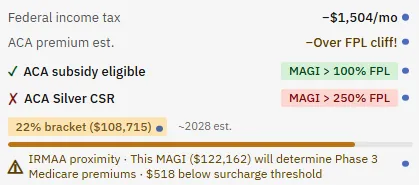
In the planner, review Medicare and IRMAA-sensitive years when testing Roth conversions, RMD pressure, taxable-account sales, or survivor scenarios. Conversions are the lever most likely to move this number, which is the subject of Roth conversions before RMDs.
MAGI And Social Security Taxation
Social Security taxation uses another income test.
IRS Topic No. 423 says benefits are not taxable unless the sum of modified adjusted gross income plus one half of Social Security benefits is more than the base amount for the filing status. The IRS points taxpayers to Publication 915 and Form 1040 instructions for worksheets.
For retirement planning, this means Social Security should not be modeled as a standalone check. Other income can affect how much of the benefit becomes taxable.
Income sources that can matter include:
- IRA withdrawals.
- RMDs.
- Pension income.
- Work income.
- Taxable interest.
- Dividends.
- Capital gains.
- Roth conversions.
- Rental income.
The planner's tax views can help show when Social Security timing and withdrawal timing interact, and how taxes change retirement income walks through that interaction in full.
MAGI And The Net Investment Income Tax
There is a fourth definition worth knowing, because it catches people who sell an investment or a property in retirement.
The net investment income tax adds 3.8% on investment income once MAGI passes a threshold. The IRS sets that threshold at $200,000 for single filers and $250,000 for married filing jointly. Two things make it different from the others.
First, this MAGI is AGI with certain foreign earned income added back, which is a narrower adjustment than the Marketplace version.
Second, and more useful to know: these thresholds are not indexed for inflation. ACA figures, tax brackets, the standard deduction and IRMAA tiers all move each year. The NIIT thresholds have not moved since the tax began. Every year of inflation therefore pulls slightly more households over the line without anyone earning more in real terms.
For most retirees this never bites. It matters in the year of a large one-off event: selling a rental, a business, or a concentrated stock position.
Three Definitions, One Table
This is the part most explanations skip. Here are the retirement-relevant MAGI definitions side by side.
| Rule | Roughly what MAGI means | When it bites |
|---|---|---|
| ACA Marketplace | AGI plus tax-exempt interest, non-taxable Social Security, and untaxed foreign income | Every year you buy Marketplace cover before 65 |
| Medicare IRMAA | AGI plus tax-exempt interest | Two years after the income year, once Medicare starts |
| Social Security taxation | Modified AGI plus half your benefits, against a fixed base amount | Any year you receive benefits alongside other income |
| Net investment income tax | AGI plus certain foreign earned income | Only above $200,000 single or $250,000 joint |
They overlap but they are not interchangeable. A plan that manages one can quietly worsen another, which is why the useful question is never "what is my MAGI" but "which MAGI, in which year, against which threshold".
Retirement Moves That Can Raise MAGI
Common retirement decisions that may raise MAGI include:
- Converting traditional IRA money to Roth.
- Taking larger IRA or 401k withdrawals.
- Selling investments with capital gains.
- Starting pension income.
- Starting Social Security.
- Receiving taxable interest and dividends.
- Taking RMDs.
- Selling rental property.
- Working part time.
- Losing a deduction that reduced AGI.
Some income sources may not raise MAGI in the same way. For example, HealthCare.gov says qualified distributions from a designated Roth account are not included in its retirement or pension income item. HSA distributions for qualified medical expenses are also generally treated differently from taxable IRA withdrawals, though HSA rules should be verified separately.
The key is not to memorize every rule. The key is to know which years and decisions are income-sensitive.
Example
Assume a 62-year-old retiree needs Marketplace coverage for three years before Medicare.
Base plan:
- $45,000 spending from cash and taxable accounts.
- No Social Security yet.
- No Roth conversion.
- Low taxable income.
Scenario A:
- Add a $40,000 Roth conversion.
- Keep spending the same.
- Review taxable income and Marketplace MAGI.
Scenario B:
- Use more cash for one year.
- Delay the Roth conversion.
- Review Marketplace MAGI and future RMD estimates.
The conversion may still be useful long term, but the retiree needs to see how it changes current-year income, healthcare cost assumptions, future RMDs, Medicare years, and ending balances.
That is why MAGI belongs in scenario planning rather than a glossary box alone.
How To Model MAGI In The Planner
Use this workflow:
- Enter current income, spending, balances, and healthcare assumptions.
- Open or review the Tax & ACA area.
- Save a base plan.
- Identify MAGI-sensitive years: ACA years, Medicare years, RMD years, Roth conversion years, and survivor years.
- Create one scenario at a time.
- Change one income item, such as a Roth conversion or withdrawal amount.
- Review tax, ACA, Medicare, IRMAA, RMD, balance, Plan Health, and Plan Confidence results.
- Save notes explaining what changed.
- Verify current rules with official sources and qualified professionals.
Common Mistakes
- Treating MAGI as the same number for every program.
- Looking only at federal tax and ignoring ACA or Medicare effects.
- Forgetting that Roth conversions can raise income in the conversion year.
- Forgetting taxable capital gains.
- Forgetting tax-exempt interest for some MAGI calculations.
- Assuming Social Security timing affects only monthly cash flow.
- Forgetting RMD years.
- Ignoring survivor filing-status changes.
- Using last year's income for Marketplace planning when the expected coverage-year income is different.
- Treating one low-tax year as the whole retirement plan.
FAQ
What does MAGI stand for?
MAGI stands for modified adjusted gross income.
Is MAGI the same as AGI?
Sometimes MAGI may be close to AGI, but it is not always the same. MAGI starts with AGI and then adds back items required by the rule being applied.
Why does MAGI matter for early retirees?
Early retirees may use ACA Marketplace coverage before Medicare. HealthCare.gov says Marketplace savings are based on expected household income for the coverage year and that MAGI is used for eligibility.
Why does MAGI matter after age 65?
Medicare IRMAA can raise Part B and Part D costs for higher-income beneficiaries. SSA Form SSA-44 shows that IRMAA uses MAGI from tax-return information.
Can a Roth conversion raise MAGI?
Usually, yes. A Roth conversion generally adds taxable income in the conversion year, which can increase AGI and may increase MAGI for tax, ACA, or Medicare planning.
Can Roth withdrawals help manage MAGI?
Qualified Roth distributions may be treated differently from taxable IRA withdrawals. The effect depends on the account, distribution type, and rule being applied. Verify the treatment before relying on it.
Source Links
- HealthCare.gov, what is included as income: https://www.healthcare.gov/income-and-household-information/income/
- HealthCare.gov, saving money on health insurance: https://www.healthcare.gov/lower-costs/
- IRS Topic No. 423, Social Security and equivalent Railroad Retirement benefits: https://www.irs.gov/taxtopics/tc423
- IRS Publication 915 information page: https://www.irs.gov/forms-pubs/about-publication-915
- SSA Form SSA-44, Medicare income-related monthly adjustment amount life-changing event: https://www.ssa.gov/forms/ssa-44.pdf
- IRS, questions and answers on the net investment income tax: https://www.irs.gov/newsroom/questions-and-answers-on-the-net-investment-income-tax
- IRS Topic No. 559, net investment income tax: https://www.irs.gov/taxtopics/tc559
Educational Disclaimer
This article is for general education only. It is not financial, tax, investment, legal, healthcare, insurance, Social Security, Medicare, estate, AI safety, software, or retirement advice. MAGI definitions vary by program and rule. Confirm tax, ACA Marketplace, Medicare, Social Security, RMD, Roth conversion, and planning decisions with official sources and qualified professionals.