
Quick Answer
The usual test is a multiple. Twenty-five times your annual spending, sometimes thirty-three if you want more margin. It is a good screening test, and if you are nowhere near it, it has told you something useful.
What it cannot tell you is whether the years immediately after you stop actually work.
A multiple is a single number describing a portfolio. It does not know which accounts your money sits in, and therefore cannot know that a large part of it may be unreachable for another seventeen years. It does not know that your health insurance premium before 65 is set by the income you choose to take. It does not know that the money leaving your portfolio is not the money arriving in your bank account. And the research it descends from was built to answer a thirty-year question, while a retirement starting at 42 is a fifty-year one.
So the honest version of "am I ready" is not have I hit the number. It is:
Do the first ten years survive contact with the tax code, the insurance market and a bad decade?
That is a different question, and it needs a plan with phases in it rather than a ratio.

Key Takeaways
- A multiple cannot see account structure. A million in a 401(k) and a million split across taxable, Roth and cash fund completely different early retirements.
- Before 65, your health insurance bill is a function of your withdrawals. The cost and the withdrawal chase each other, which no fixed withdrawal rate can model.
- Expenses are not withdrawals. If you need $60,000 to live on, you have to take out more than $60,000. How much more depends on which accounts you draw from.
- The 4% rule was derived for thirty years. Retiring at 42 asks a fifty-year question of a thirty-year answer.
- Your Social Security estimate is wrong the day you stop. The figure on ssa.gov assumes you keep earning until 62. It does not know you are stopping at 42.
- The answer is a comparison, not a verdict. Build the plan you would actually bet on, change one thing, look at the difference. That difference is the only genuinely useful output.
What The 4% Rule Was Actually For
It is worth being fair to the rule, because it is usually attacked for failing at a job it was never given.
It comes from work in the 1990s — Bengen, then the Trinity study — asking a specific question: given historical US market returns, what starting withdrawal rate, adjusted for inflation each year, would have survived a thirty-year retirement in every historical period tested? The answer was about four percent.
That is a genuinely useful piece of research, and as a screening test it still works. If your number implies drawing eight percent a year, no amount of planning detail will rescue it, and you have learned that in ten seconds.
The trouble starts when a screening test is used as a final answer. Three things get lost:
- The horizon. Thirty years from 42 gets you to 72. It is not the same question.
- The taxes and the insurance. The original work models a portfolio, not a household with a tax return and a health plan.
- The sequence. A rule expressed as an average conceals that the order of returns matters enormously when you are selling to live.
None of that makes the rule wrong. It makes it incomplete for the case FIRE actually describes, which is the longest and most tax-exposed retirement anyone plans deliberately.
Blind Spot 1 — The 59 And A Half Wall
This is the one that surprises people who have done everything else right.
A multiple treats your portfolio as one pool. The tax code does not. Money in a 401(k) or traditional IRA is, broadly, not available before 59½ without penalty. If you stop at 42, that is more than seventeen years in which a large part of your net worth is sitting there being counted by your FIRE number and unable to pay a single bill.
So the real question is not "do I have 25x?" but "do I have enough in reachable accounts to cover the years before the rest unlocks?"
That bridge has to come from somewhere: taxable brokerage, cash, Roth contributions, or a conversion ladder built years in advance. Which is why two people with identical net worth can have completely different answers.
The planner treats this as a phase in its own right. Set a retirement age below 59½ and a separate phase appears before everything else, where you say how you are reaching the 401(k): leave it untouched and fund the years from whatever else you have, or draw on it and have the ten percent priced in.
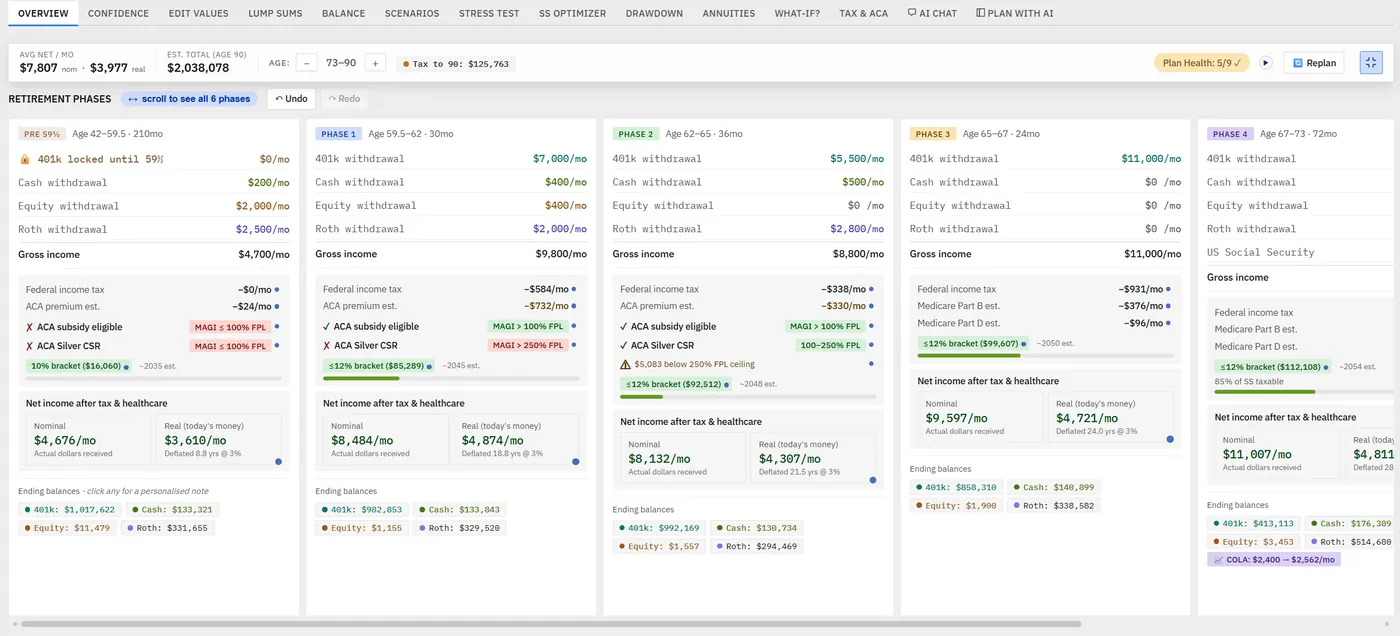
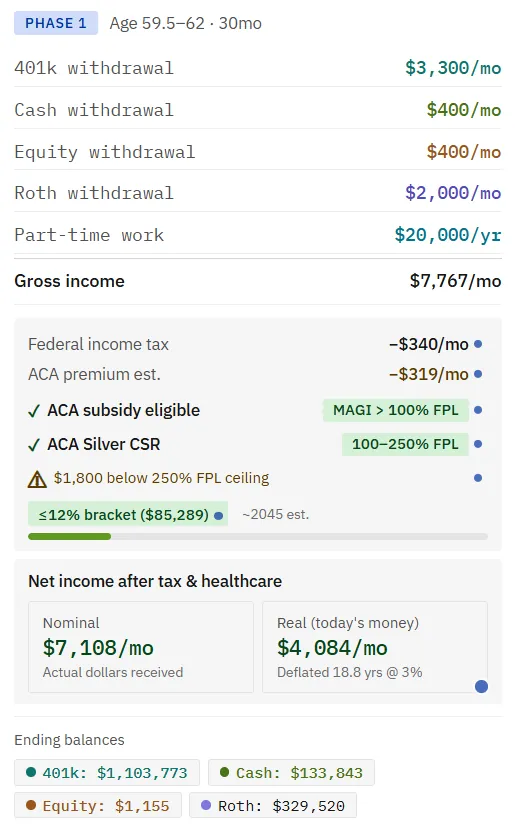
About the screenshots. These come from a constructed example built to show what the planner displays — not a finished plan, not a recommendation, and not anyone's real numbers. The figures are there to show where each answer appears and how the pieces move together. Yours will look different, and should.
One limit worth stating plainly, because this article is not going to pretend otherwise. The planner gives you three ways to handle those years — leave the 401(k) untouched, withdraw and pay the ten percent, or claim the Rule of 55 if you left work at 55 or later — and it does not model a 72(t)/SEPP series or the five-year seasoning on Roth conversions. Those two are the routes that actually fit a retirement starting in your forties, which is the awkward part: the Rule of 55 is no help to a 42-year-old, because it turns on separating from service at 55 or later, not on reaching 55. So if your bridge plan is a SEPP or a conversion ladder, model the withdrawals here and take the mechanics to a tax professional.
Blind Spot 2 — Health Cover Before 65
For anyone retiring in the US before Medicare, this is usually the largest single unknown, and it has a property that makes it genuinely hard to reason about.
Your marketplace premium depends on your income. In retirement, you largely choose your income, by deciding what to withdraw and from where. So the cost and the withdrawal chase each other in a loop. Take more from a traditional account and your income rises, your subsidy falls, and your insurance bill goes up — which means you need to take more.
There are two separate things worth watching, and people often only know about the first:
- The premium subsidy, which tapers as income rises.
- Silver cost-sharing reductions, which are a different benefit with a harder edge — they end above 250% of the federal poverty level. Cross that line and your deductible and out-of-pocket maximum can jump sharply while your premium barely moves.
That second one is the trap, because it is invisible in any spreadsheet that models only premiums. It is why the planner shows how much headroom is left before the ceiling rather than a yes or no.
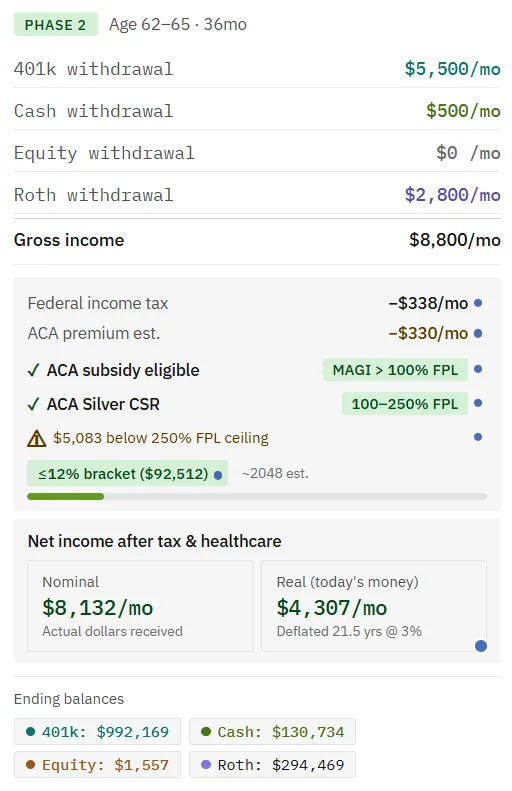
Roth withdrawals are the useful lever here: they do not count toward the income figure the subsidy is calculated on, which is exactly why a Roth balance is worth more to an early retiree than its face value suggests. See health insurance before Medicare and ACA Silver plan cost-sharing reductions for the mechanics.
Blind Spot 3 — Expenses Are Not Withdrawals
Most FIRE arithmetic runs on spending. You need $60,000 a year, so you need $1.5m, so 4% of $1.5m is $60,000, so you are fine.
But 4% of the portfolio is what leaves the portfolio. What arrives in your bank account is that figure minus federal tax, minus state tax, minus health insurance. To actually spend $60,000 you have to withdraw meaningfully more — and how much more depends entirely on which accounts you draw from, because a dollar from a Roth, a dollar of return-of-basis from a brokerage account and a dollar from a 401(k) are taxed completely differently.
This is where the gap between the headline and the reality shows up, and where a second gap opens as well: nominal against real. Money twenty years out does not buy what it buys now.
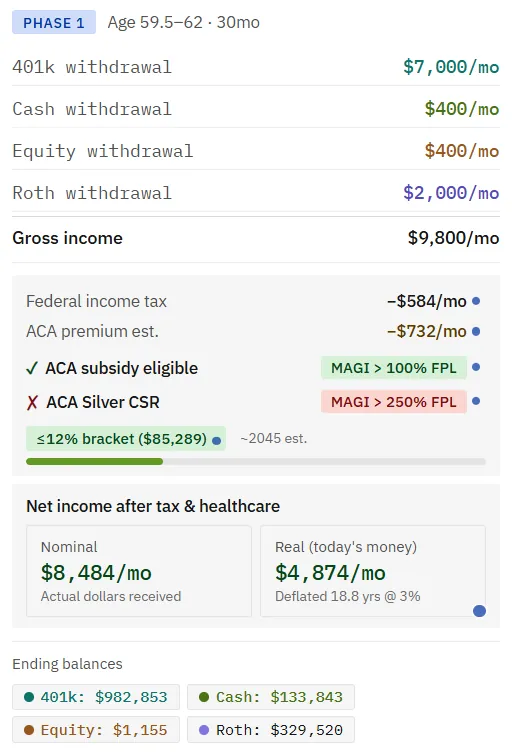
One thing to know about how this planner handles a taxable brokerage account. Only the gain inside a withdrawal is taxed, not the whole amount — but that gain is taxed at ordinary income rates, not the preferential 0/15/20 percent long-term rates. That is a deliberate simplification, and it is deliberately cautious. For a low-income early retiree whose real long-term rate would be zero, it reads high — which is exactly the bridge-year case this article is about. It always overstates that tax and never understates it, so a plan that survives here would survive with the real treatment too. If you are modeling a taxable bridge, treat that line as a ceiling rather than an estimate.
More on the three different numbers people mean by "income" in gross, net and real retirement income, and on drawing order in which account should I withdraw from first.
Blind Spot 4 — Fifty Years, Not Thirty
Two retirements with identical average returns can end very differently depending on when the bad years land. Selling shares to live during a crash removes them permanently; they are not there for the recovery. A downturn at 45 does damage that the same downturn at 85 simply does not.
That is sequence-of-returns risk, and stretching the horizon from thirty years to fifty does two things to it: it widens the range of outcomes, and it lengthens the window in which an early crash can do maximum harm.
There are two honest ways to look at it, and they answer different questions:
- Monte Carlo generates hundreds of random futures and counts how many left you solvent. Good for "how much room do I have?"
- Historical backtesting replays your plan through the sequences that actually happened — 1929, 1966, 2000 — with real crashes and real recoveries. Good for "what would this have done to someone who retired at the worst possible moment?"
Neither is a prediction. Both beat an average.
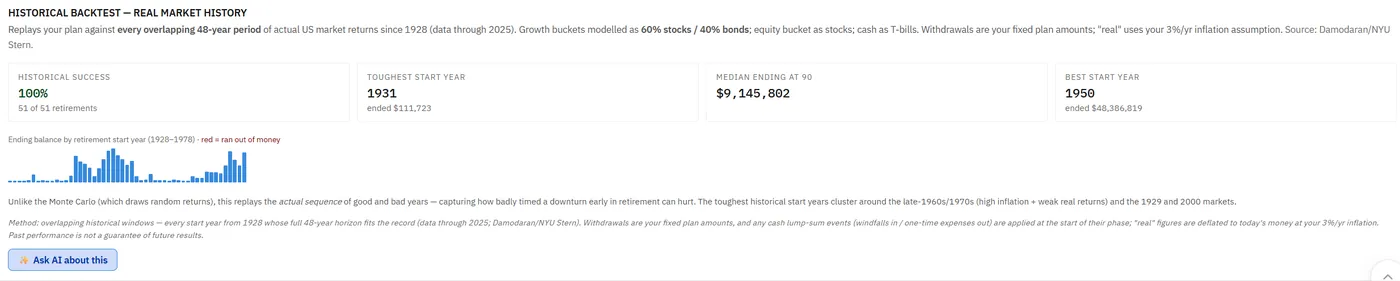
A word on reading a result like that. A high historical success rate is a statement about those assumptions against that history, not a promise. Change the spending, the retirement age or a large one-time cost and it moves. The useful part is not the percentage — it is the toughest start year, and what your plan looked like in it. The comparison between the two methods is in Monte Carlo versus historical backtesting.
Blind Spot 5 — Social Security, Twenty Years Late
Most FIRE planning treats Social Security as a bonus and ignores it. As conservatism that is defensible. As arithmetic it hides something worth knowing.
Your benefit is based on your highest 35 years of earnings. Stop at 42 and you may have twenty years in that average, which means fifteen zeros. That is a materially smaller benefit than the one you are probably looking at.
And here is the part that catches people: the estimate on your ssa.gov statement assumes you carry on earning at your current rate until you claim. It does not know you are stopping. If you retire at 42 and read the number off that page, you are reading a projection of a life you have decided not to live.
The fix takes ten minutes. Use the SSA's own calculator, enter future earnings as zero from your retirement year onward, and get the real figure. Then use that number in whatever you plan with. The planner takes the benefit as a single figure you supply — it does not compute one from an earnings record, so the quality of that input is entirely on you.
It still matters enormously, because it arrives at 62 or later and runs for the rest of your life, which in a fifty-year plan is the back half. On when to take Social Security the trade-offs are worked through in more detail.
Blind Spot 6 — Where You Live
Two people with identical portfolios and identical spending can have materially different outcomes because of geography, and it works at two levels.
Within the US, state income tax on retirement income varies from nothing to significant, and several states treat pension and retirement-account income differently again. Over fifty years that is not a rounding error.
Outside the US, it gets more interesting and cuts both ways. As a US citizen you keep filing US returns wherever you live — that does not go away. What changes is that you may also owe tax where you live, with the Foreign Tax Credit meaning you broadly pay the higher of the two rather than both. So the question is not "is that country's tax lower" but "is it higher than what I would owe anyway?"
Health care changes more than tax does. Marketplace subsidies do not follow you abroad, and Medicare essentially does not cover you outside the US. For some people that removes a large cost and replaces it with something cheaper paid directly. For others it is the thing that makes the idea unworkable.
There is a free Retire Abroad tool on this site that compares a US retirement against the UK, Canada and Australia using real tax rules on both sides rather than a cost-of-living index. No signup. And comparing retiring in the US versus abroad covers the method.
Which Kind Of FIRE Are You?
"FIRE" covers several quite different plans, and the blind spot that bites hardest depends on which one you are actually running.
| Flavor | The question a multiple cannot answer | Where to look |
|---|---|---|
| Full FIRE at 40–45 | Seventeen-plus years before the 401(k) unlocks penalty-free — is the bridge funded? | The pre-59½ phase |
| Barista FIRE | Is the part-time work still worth it after its effect on your subsidy? | Part-time income on the phase, and what happens to the FPL headroom |
| Coast FIRE | You stopped contributing — does it actually coast, or does it just look like it? | Two saved plans, compared side by side |
| Lean FIRE | Thin margin — what does a bad decade actually do? | Monte Carlo, historical backtest, guardrails |
| Fat FIRE | How much is tax and surcharge drag over fifty years? | Gross versus net, IRMAA, the 3.8% investment surtax |
| Geographic arbitrage | Cheaper to live — but what about the tax and the health cover? | Residence switching, Foreign Tax Credit |
Barista FIRE deserves a note, because it is the one where intuition most often fails. Earning $20,000 a year does more than its size suggests: every month you cover your own costs is a month you are not selling investments to do it, during exactly the years when selling does the most damage. But earned income is income, so it lifts the figure your subsidy is calculated on. Sometimes a smaller amount of work leaves you better off than a larger one — and that is arithmetic specific to your numbers, not a rule of thumb.
More on that trade-off in working part-time in retirement.
How To Test This In The Planner
The order matters, because each step changes what the next one shows.
- Set your real retirement age, even if it is 42. A pre-59½ phase appears automatically, and you choose there whether the 401(k) is left alone or drawn on with the ten percent priced in. If the bridge years cannot be funded, you will see it here rather than in year three.
- Enter your accounts separately — traditional, Roth, taxable brokerage, cash. Not one total. This is the single input that most changes the answer.
- Put in the Social Security figure you got from the SSA calculator with zero future earnings, not the one from your statement.
- Set the plan horizon out to 95 or 100. A fifty-year retirement is the whole point.
- Look at net, not gross. Then look at real, not nominal.
- Watch the marketplace headroom in the pre-65 phases and see what a larger 401(k) withdrawal does to it.
- Run the historical backtest, and look at the toughest start year rather than the headline percentage.
- Save it as your baseline. Then change exactly one thing and compare. Spend $500 a month less. Work part-time for three years. Claim at 70 instead of 67.
That last step is the one that actually answers the question, and it is covered in saving, loading and comparing scenarios. One plan gives you a verdict you cannot act on. Two plans give you a difference, and a difference tells you which decisions genuinely move your outcome and which you have been losing sleep over for nothing.
Questions To Ask Your Plan
- How much of my money is unreachable until 59½, and what is paying the bills until then?
- In each year before 65, what is my income, and how far is it from the cost-sharing ceiling?
- What do I actually withdraw to spend what I want to spend, after tax and insurance?
- What does the toughest historical start year do to this plan?
- What is my Social Security benefit with the zeros in it?
- If markets fall thirty percent in my second year, what changes — and what would I do?
- Which single change moves the outcome most: spending less, working longer, or claiming later?
FAQ
Is the 4% rule safe for early retirement?
It was derived for a thirty-year horizon using historical US returns. A retirement beginning in your forties can run fifty years or more, which is a different question — the range of outcomes is wider and an early downturn has longer to do damage. It remains a useful screening test; it is not a conclusion for a fifty-year plan.
How do I access retirement accounts before 59½?
The common routes discussed in FIRE circles are a Roth conversion ladder, substantially equal periodic payments under 72(t), withdrawing Roth contributions, or simply accepting the ten percent penalty. Each has conditions and consequences, and this is exactly the point to talk to a tax professional. The planner can price the last of those directly — the pre-59½ phase lets you withdraw and charges the ten percent — and it also covers the Rule of 55 if you left work at 55 or later. It does not model a 72(t) series or the five-year seasoning on conversions.
Does retiring early reduce my Social Security?
Usually yes. The benefit is based on your highest 35 years of earnings, so stopping in your forties leaves zeros in that average. Separately, the estimate on your ssa.gov statement assumes you keep earning until you claim — so re-run it through the SSA calculator with future earnings set to zero to see the figure that applies to you.
What is the difference between coast FIRE and barista FIRE?
Coast FIRE means you have saved enough that existing investments will grow into your retirement number without further contributions, so you keep working but stop saving. Barista FIRE means you have stopped your career but keep some part-time income, often partly for the health cover. They stress different parts of a plan: coast FIRE is a growth-assumption question, barista FIRE is an income-and-subsidy question.
Do I need to include Social Security in a FIRE plan?
You do not have to, and leaving it out is conservative. But it arrives at 62 or later and runs for life, so in a fifty-year plan it shapes the back half considerably. Modeling it with a realistic figure — including the zero-earning years — tells you more than ignoring it.
Can I model retiring abroad?
Yes. The free Retire Abroad tool on this site compares a US retirement against the UK, Canada and Australia using real tax rules on both sides, and the planner supports switching residence along with the currency, tax regime and healthcare assumptions that go with it.
Source Links
- IRS, Topic no. 558, additional tax on early distributions: https://www.irs.gov/taxtopics/tc558
- IRS, Retirement topics — exceptions to tax on early distributions: https://www.irs.gov/retirement-plans/plan-participant-employee/retirement-topics-tax-on-early-distributions
- IRS, Roth IRAs: https://www.irs.gov/retirement-plans/roth-iras
- IRS, Retirement topics — required minimum distributions: https://www.irs.gov/retirement-plans/retirement-topics-required-minimum-distributions-rmds
- Social Security Administration, Benefit calculators: https://www.ssa.gov/benefits/calculators/
- Social Security Administration, How retirement benefits are calculated: https://www.ssa.gov/benefits/retirement/planner/agereduction.html
- HealthCare.gov, Saving money on health insurance: https://www.healthcare.gov/lower-costs/
- HealthCare.gov, Cost-sharing reduction: https://www.healthcare.gov/glossary/cost-sharing-reduction/
- Medicare.gov, Part B costs: https://www.medicare.gov/basics/costs/medicare-costs
- Consumer Financial Protection Bureau, Planning for retirement: https://www.consumerfinance.gov/consumer-tools/retirement/
Educational Disclaimer
This article is for education only. Retiring decades early affects taxes, health insurance, retirement account access, Social Security credits, Medicare timing and long-term income, and the rules described here change. Check IRS.gov, HealthCare.gov, SSA.gov and Medicare.gov for current figures, and speak to qualified tax, financial and healthcare professionals before making decisions. Every projection is an estimate based on assumptions you supply.