
Quick Answer
No. There is no single amount that makes retirement work, and a million dollars is neither a floor nor a finish line. It is a national average of what people believe they will need, which is a different thing from what you will need. The useful question is not "have I hit the number." It is "what monthly income does the money I actually have produce, after tax and healthcare, and does that cover what I actually spend?" That question has an answer specific to you, and you can work it out.
Key Takeaways
- The widely quoted target is a survey of expectations, not a calculation about your household.
- It rose from $1.26 million to $1.46 million in a single year. Nothing about any individual reader's life changed by $200,000 in that time.
- Two households with the same savings can have completely different outcomes, because guaranteed income, location, healthcare timing, and tax treatment all sit outside the balance.
- A balance is not an income. The number that determines whether you can retire is monthly, net, and inflation-adjusted.
- Start from your spending, subtract the income you do not have to fund yourself, and the remainder is the only part your savings has to cover.
Where the Million-Dollar Number Comes From
It comes from surveys.
Northwestern Mutual's 2026 Planning & Progress Study asked Americans how much they think they need to retire comfortably. The answer averaged $1.46 million. That figure gets picked up, repeated, and gradually hardens into something that sounds like a rule.
It is worth being precise about what was measured. Respondents were not asked to model their spending, count their Social Security, or price their healthcare. They were asked for a number. The result is an average of expectations, and the people who collect it report it as such.
There is a second route to the same figure, and it is more defensible but still not personal. Take the 4% rule, apply it to a million dollars, and you get $40,000 a year. If someone assumes they need roughly $40,000 to $50,000 from their portfolio, a million looks like the target. That arithmetic is fine as far as it goes. The problem is everything it leaves out.
The Number Moved $200,000 in a Year
In 2025 the same study reported $1.26 million. In 2026 it reported $1.46 million.
That is a rise of more than 15% in twelve months. No reader's grocery bill, mortgage, or life expectancy moved by $200,000 in that window. What moved was sentiment: inflation was in the news, longevity estimates crept up, and people felt less certain about Social Security.
This is the clearest evidence that the target is not a measurement of your situation. A number that can swing $200,000 based on how a few thousand survey respondents were feeling in January is not a threshold you have failed to clear.

What a Target Number Cannot Know About You
Four things sit entirely outside a portfolio balance, and each can move the answer by more than the balance itself.
Guaranteed income you already have
The average Social Security retirement benefit is around $2,071 a month as of January 2026. For a couple with two average benefits, that is roughly $4,100 a month, or close to $50,000 a year, arriving for life and adjusted for inflation.
Consider what that means. If a household spends $70,000 a year, and $50,000 arrives from Social Security, the portfolio is being asked to produce $20,000, not $70,000. A pension changes it again. So does rental income, part-time work, or a spouse still earning.
The million-dollar target assumes your savings has to do all the work. For most households it does not.
Where you live, and where you will live
State income tax treatment of retirement income varies enormously, and so does the cost of everything else. A paid-off house in a low-cost state and a mortgage in a high-cost one are not the same retirement with the same number attached. If you are considering another country, the gap widens further.
The healthcare years before 65
This is the one that catches people, and it is the reason a retirement at 60 and a retirement at 66 are different problems rather than the same problem six years apart.
Before Medicare, you are buying your own cover, and what you pay depends on your income, which depends on your withdrawals. That creates a genuine trade-off in the bridge years that no target number can express. Retire at 62 and you may have three years where withdrawing more money makes your healthcare more expensive.
Taxes, which the target quietly ignores
A million dollars in a 401k is not a million dollars. Every withdrawal is ordinary income. A million in a Roth behaves completely differently, and a million in a taxable brokerage differently again. Two people with identical balances and identical spending can face materially different tax bills purely because of which accounts the money sits in.
A target number treats savings as one pile. Your tax return does not.
A Balance Is Not an Income
This is the core of it, and it is worth stating plainly.
Net worth answers "what do I own." Retirement answers "what arrives every month, and what is left after tax and healthcare." Those are different questions, and the second one is the one you live on.
The gap between them shows up in specific ways:
- Home equity does not pay bills. It is real wealth that produces no monthly income unless you sell or borrow.
- Tax-deferred balances are not spendable at face value. A withdrawal is taxed on the way out.
- Timing is invisible in a balance. A million that has to fund thirty-five years is not the same as a million funding twenty.
- Sequence matters. A poor run of returns in the first few years of drawdown does more damage than the same run later, because you are selling into it.
A balance is a photograph. An income plan is the film. Reading about gross, net and real retirement income is the fastest way to stop confusing the two.

Turn the Question Around
Instead of asking whether you have enough, work out how much you need from your savings. It is four steps, and the first three are pen and paper.
Step 1: Find your real monthly spending
Not a budget. What actually leaves your account. Twelve months of statements, averaged. Most people are within a few hundred dollars of what they expected on the essentials and considerably out on the irregular things: car replacement, home repairs, travel, gifts, one large annual bill they had forgotten.
Do this before anything else. Every later step depends on it, and a target derived from someone else's spending is worthless.
Step 2: Add the two costs people leave out
Healthcare and taxes. If you retire before 65, price the cover you would actually buy, at the income level you would actually have. Then remember that the money to pay your tax bill has to come out of the same withdrawals.
Step 3: Subtract the income you do not have to fund
Social Security, any pension, annuity income, rental income, part-time earnings, a spouse's income. Write down when each one starts, because that timing is most of the difficulty. A benefit starting at 67 does nothing for a gap at 61.
Step 4: What remains is the only thing your savings has to cover
That number, not the million, is your target. And it is almost never one number for the whole of retirement, because the gap is largest in the years before Social Security and Medicare arrive, then shrinks.
That is why a plan built in phases beats a single lifetime average. The bridge years are the hard part, and averaging them away hides exactly the problem you were trying to find. Not every tool works this way, which is part of what separates them: retirement planning software without a subscription compares what the main options actually model.
What Your Actual Savings Produces
Now the other direction. You have the amount you need per month. What does the money you already have actually pay?
The AI Retirement Income Planner has a tool for this in the What-if explorer, called Maximum sustainable spending. It searches for the highest withdrawal level your plan supports, by scaling every phase's withdrawals together and testing the result in the simulator. Your guaranteed income is left untouched, and your saved plan is not changed.
You choose what "sustainable" has to mean:
- Stays solvent to plan end. Your drawn-from accounts stay positive to the last year of the plan.
- Monte Carlo success. It stays solvent in at least a percentage you set of randomized market runs.
- Survives market history. It survives at least a percentage you set of actual historical retirement periods.
The result is a maximum sustainable net monthly income, after tax and healthcare, shown against what your current plan spends, in both nominal terms and today's money.
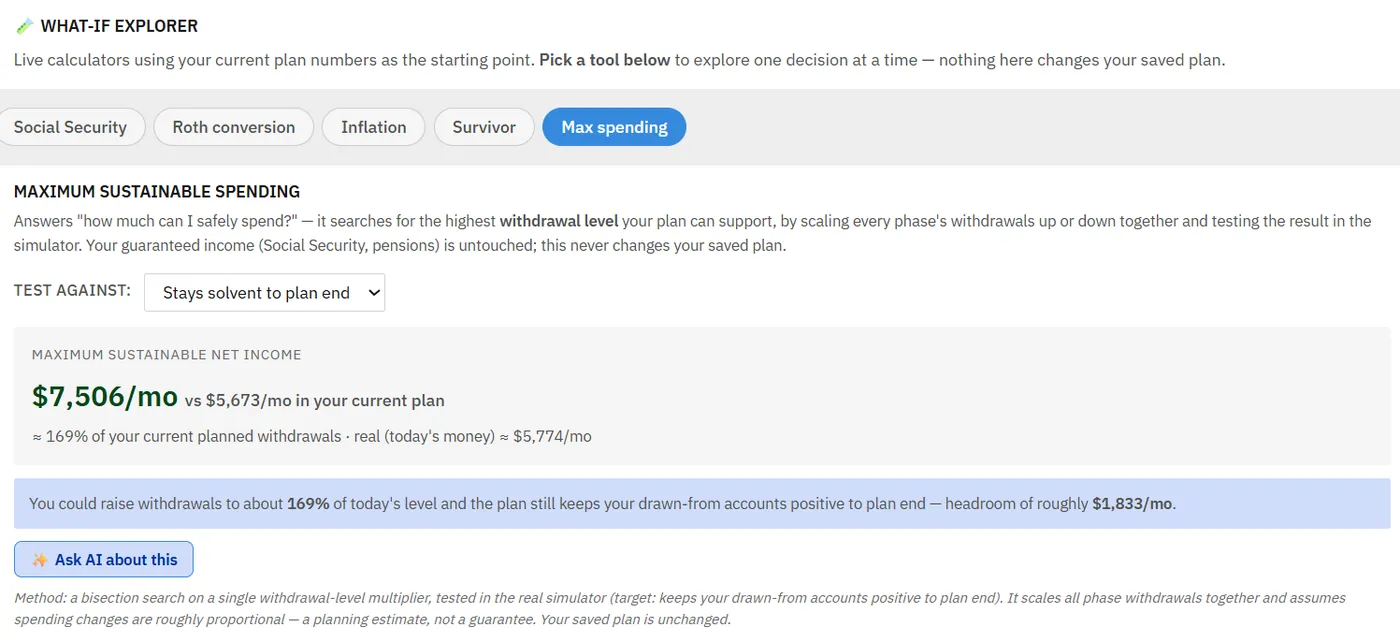
That figure is the honest version of "is a million enough," because it is computed from your accounts, your Social Security, your healthcare situation, and your tax position, rather than from a national average.
A worked example on exactly one million dollars
Here is a sample plan built to the million-dollar figure, so you can see what it actually produces.
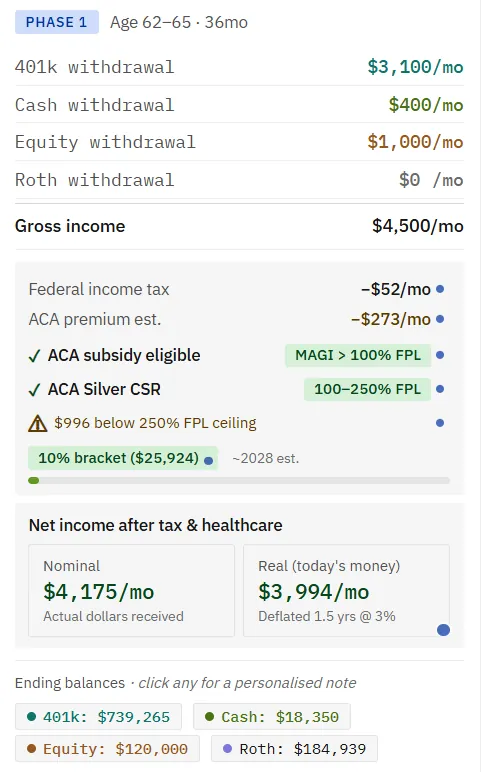
A couple retires at 62 with $1,000,000 spread across four account types: $700,000 in a 401k, $150,000 in a Roth, $120,000 in a taxable equity account, and $30,000 in cash. They take Social Security at 67, two average benefits of $2,071 each. They plan through to age 90, with inflation at 3%. Their withdrawals are heavier in the bridge years from 62 to 67, when there is no Social Security and they are buying their own healthcare, then drop once the benefits start.
That plan currently spends about $5,673 a month net. Tested against the plain solvency gate, the maximum it sustains is about $7,506 a month net, which is roughly 169% of the withdrawals they had planned, and about $5,774 a month in today's money after inflation is stripped out.
So a million dollars, for this household, supports around $69,000 a year in today's money to age 90. That is a good retirement, and it is nowhere near the $40,000 the 4% rule alone would have suggested, because the 4% rule was never counting the $50,000 a year of Social Security arriving alongside it.
Change one thing and the answer moves. Put the whole million in the 401k instead of spreading it, and more of every withdrawal is taxable. Retire at 58 rather than 62 and seven years of self-funded healthcare arrive before Medicare does. Plan to 95 instead of 90 and the sustainable figure falls. None of those changes touch the balance, and all of them change the answer.
One thing to be clear about: the planner works forwards. It tells you what a given set of balances produces. It does not solve backwards for the balance you need. So finding your number is an iteration rather than a single click. Run your real figures, read the maximum sustainable income, compare it to the spending you worked out in step 1, then adjust and run it again. Three or four passes usually settles it.
If the Number Comes Up Short
A shortfall is information, not a verdict, and there are more levers than "save more." The levers are much the same if the shortfall only shows up after you have retired, though the order you reach for them changes.
- Work longer, even partly. Part-time income in the bridge years is disproportionately valuable, because it covers the most expensive gap and lets balances keep growing.
- Delay Social Security. Each year past full retirement age adds roughly 8% to the benefit, for life, inflation-adjusted. That is a larger guaranteed income and a smaller job for the portfolio.
- Change the withdrawal order. Which account you draw first changes the tax bill, and in the pre-Medicare years it changes healthcare costs too.
- Reduce spending selectively. Not across the board. Find the two or three largest discretionary lines and test the plan without them.
- Change where you live. The most effective single change for some households, and irrelevant for others.
Test them one at a time. Changing three things at once tells you the plan improved but not which lever did it.
If You Are Already Over
This happens more often than people expect, and it has its own cost.
If the maximum sustainable figure comes back well above what you spend, you have been given a genuine choice: retire earlier, spend more, give more away while you are alive to see it, or keep the margin as protection. All four are legitimate. The one option that is not neutral is doing nothing while assuming you are still short, because that decision spends years you do not get back.
The common version of this is someone who reached a comfortable position several years ago and never re-ran the numbers, because the target in their head was still a million.
Two Households, One Million Dollars
The same balance, two different retirements.
Household A retires at 66. Both take Social Security at full retirement age, roughly $4,100 a month between them. The house is paid off, they are on Medicare from day one, and they spend $68,000 a year. Their portfolio needs to produce around $18,000 a year before tax. That is a modest draw on a million dollars, and most of their savings sits in a Roth, so the tax on it is minimal.
Household B retires at 58. No Social Security for four to nine years depending on when they claim, seven years of buying their own health cover before Medicare, a mortgage with eleven years left, and $85,000 of annual spending. Almost all of the savings is in a 401k, so every dollar withdrawn is ordinary income, and the withdrawals they need push their income high enough to reduce the healthcare help they might otherwise qualify for.
Same million. One household is comfortable, the other is running a genuinely tight plan. No target number distinguishes them, because everything that separates them lives outside the balance.
What Tips the Answer Either Way
Across the two households above, the same handful of factors keep doing the work. If you want a quick read on which side of the line you are likely to fall, these are the ones that matter.
A million dollars is more likely to be enough when:
- Retirement starts at or near Medicare age, so there are no expensive bridge years to fund.
- Social Security covers a meaningful share of the spending, rather than a token amount.
- Spending is moderate relative to the portfolio, and some of it is genuinely discretionary.
- Housing costs are stable and the mortgage is gone or nearly gone.
- Savings are spread across account types, so withdrawals can be managed for tax.
- The household could cut back in a bad market year without real hardship.
- Large one-time costs, such as a roof or a car, are already in the plan rather than waiting to surprise it.
- The survivor is provided for, because one benefit stops and the tax brackets narrow.
It is less likely to be enough when:
- Retirement starts well before 65, adding years of self-funded healthcare.
- Nearly all the savings sit in pre-tax accounts, so every dollar out is ordinary income.
- Annual spending is high and most of it is fixed.
- Debt payments are large and run well into retirement.
- The plan only works if returns are good, with no margin for a poor first decade.
- There is no flexibility, so a bad market forces a decision rather than an adjustment.
- Long-term care risk is simply left out.
- The survivor would be materially worse off and nothing offsets it.
Notice that only one item on either list is about the size of the portfolio. The rest are about timing, structure, and flexibility.
How to Run This on Your Own Numbers
- Average twelve months of real spending.
- Add healthcare at the income level you will actually have, and add tax.
- List every income source and the age it starts.
- Enter your balances by account type, because the tax treatment differs.
- Read the maximum sustainable net monthly income, with the confidence gate you are comfortable with.
- Compare it to step 1, adjust one variable, and run it again.
If your plan is close to the line, run it against market history and randomized returns as well as the plain solvency test. A plan that works on average and fails in a third of historical retirements is worth knowing about before you rely on it.
For the reverse view of this question, once you know your balances and want to know what they support month to month, see how much can I spend in retirement. If you are looking at a specific age, can I retire at 60 and health insurance before Medicare both deal with the bridge years in detail.
FAQ
Do I need $1 million to retire?
No. There is no universal amount. The widely quoted million-dollar figure comes from surveys of what people believe they will need, not from a calculation about any particular household. What you need depends on your spending, your guaranteed income, where you live, when you retire relative to Medicare, and which account types hold your savings.
Where does the million-dollar retirement figure come from?
Mostly from surveys of expectations. Northwestern Mutual's 2026 Planning & Progress Study put the average expectation at $1.46 million, up from $1.26 million a year earlier. A second route is applying the 4% rule to a million dollars to get $40,000 a year, which is reasonable arithmetic but ignores taxes, healthcare, guaranteed income, and timing.
Is $1 million enough to retire on?
For some households, comfortably. For others, not. A couple retiring at 66 with two Social Security benefits, no mortgage, and Medicare from the start is in a very different position from a couple retiring at 58 with a mortgage, seven years of private health cover to buy, and everything in a 401k. The balance is the same and the outcomes are not.
How do I work out my own retirement number?
Start with twelve months of actual spending, add healthcare and taxes, then subtract the income you do not have to fund yourself, such as Social Security and any pension. What remains is the amount your savings has to produce. Then check what your current balances actually support per month after tax, and adjust until the two meet.
Does Social Security count toward my retirement number?
Yes, and it is usually the largest single item people leave out. The average retirement benefit is around $2,071 a month as of January 2026, and it is adjusted for inflation each year. Two average benefits come to roughly $50,000 a year, which is a large share of many households' spending, and it reduces what the portfolio has to cover by exactly that much.
Why does the account type matter as much as the balance?
Because withdrawals from a traditional 401k or IRA are ordinary income, Roth withdrawals generally are not, and a taxable brokerage account is taxed differently again. Two identical balances can produce noticeably different spendable income. Before 65 there is a second effect: higher income can reduce the healthcare help you qualify for, so the account you draw from changes your premiums as well as your tax bill.
What if my number comes up short?
Treat it as a starting point rather than a conclusion. Working part-time through the bridge years, delaying Social Security, changing which account you withdraw from first, trimming two or three large discretionary lines, or changing where you live are all levers, and they are not equally effective for everyone. Test them one at a time so you can see which one actually moved the result.
Source Links
- Northwestern Mutual, 2026 Planning & Progress Study: https://news.northwesternmutual.com/2026-04-01-Americans-Believe-They-Will-Need-1-46-Million-to-Retire-Comfortably,-Up-More-Than-15-Since-Last-Year,-According-to-Northwestern-Mutual-2026-Planning-Progress-Study
- Social Security Administration, average monthly benefit for a retired worker: https://www.ssa.gov/faqs/en/questions/KA-01903.html
- Social Security Administration, 2026 Cost-of-Living Adjustment fact sheet: https://www.ssa.gov/news/en/cola/factsheets/2026.html
- Social Security Administration, benefits by year of birth and claiming age: https://www.ssa.gov/oact/cola/Benefits.html
- Medicare.gov, Medicare costs: https://www.medicare.gov/basics/costs/medicare-costs
- HealthCare.gov, saving money on health insurance: https://www.healthcare.gov/lower-costs/
- IRS, retirement topics on required minimum distributions: https://www.irs.gov/retirement-plans/retirement-topics-required-minimum-distributions-rmds
- Consumer Financial Protection Bureau, planning for retirement: https://www.consumerfinance.gov/consumer-tools/retirement/
- AI Retirement Income Planner: https://airetirementincomeplanner.com/
Educational Disclaimer
This article is for general education only. It is not financial, tax, investment, legal, healthcare, Social Security, Medicare, insurance, or retirement advice. Survey figures, Social Security benefit amounts, cost-of-living adjustments, tax rules, and healthcare costs change over time, and any projection depends on assumptions that may not hold. The two households described are illustrative examples, not real people, and screenshots show a sample plan. Verify important numbers with official sources such as SSA.gov, IRS.gov, Medicare.gov, and HealthCare.gov, and confirm decisions with a qualified professional before acting.