
Short Answer
If retirement balances are lower than expected, do not make a panic move. First, update the plan with current balances and current spending. Then identify why the balances are lower: market decline, higher withdrawals, taxes, healthcare, one-time expenses, poor tracking, or an old assumption that no longer fits.
After that, compare realistic adjustments. Smaller withdrawals, delayed discretionary spending, part-time work, Social Security timing, housing changes, tax-aware withdrawal order, and healthcare cost reviews can each change the outcome.
Key Takeaways
- Lower balances are a signal to update the plan, not proof that retirement has failed.
- Find the cause before choosing the fix.
- Compare current withdrawals with current balances and remaining life expectancy.
- Check taxes, healthcare, and RMD projections before cutting spending blindly.
- Build fallback scenarios instead of relying on one new projection.
- Use Stress Test, What-if tools, Plan Health checks, Plan Confidence, Monte Carlo, and historical backtesting to see which adjustment helps most.
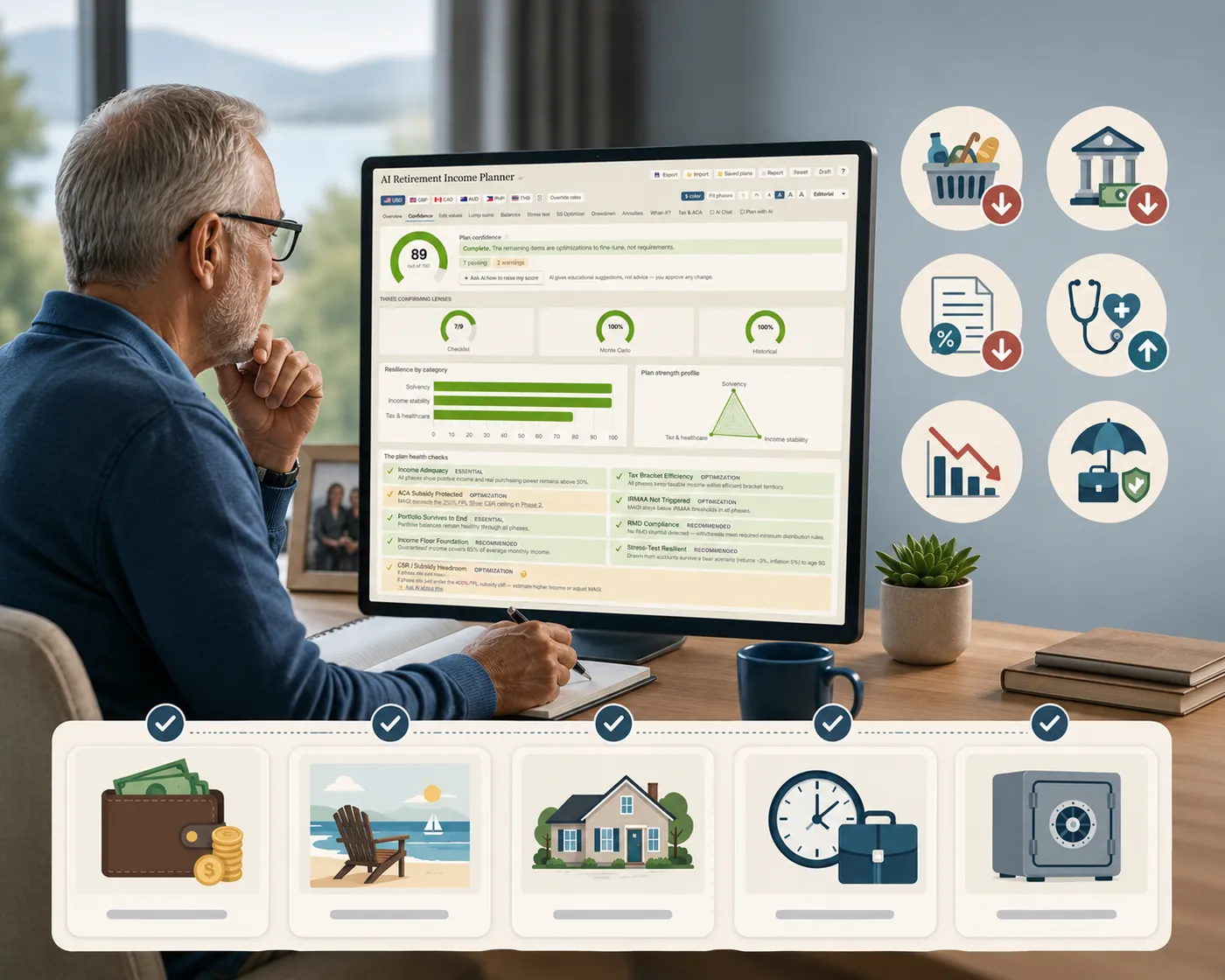
Step 1: Confirm The Shortfall
First, make sure the balance comparison is fair.
Compare today's balances with the projection using the same categories:
- Cash.
- Taxable brokerage.
- Traditional IRA.
- 401k or similar employer plan.
- Roth accounts.
- HSA.
- Pension lump-sum value, if applicable.
- Home equity, if it was included before.
Then check whether the old projection assumed contributions, growth, or spending that did not happen. A balance can look lower simply because the original comparison included accounts you no longer count, home equity you no longer plan to use, or investment returns that were too smooth.
Step 2: Identify The Cause
Lower balances usually come from one or more causes:
- Market decline.
- Larger withdrawals than planned.
- Higher taxes.
- Higher healthcare costs.
- Major home repair.
- Vehicle purchase.
- Family support.
- Travel or lifestyle spending.
- Debt payments.
- Inflation.
- One spouse retiring earlier than expected.
- Social Security claimed earlier than expected.
The cause matters. A temporary market decline calls for a different response than a permanent spending increase.
Step 3: Measure Withdrawal Pressure
This is the same question as is my retirement income sustainable, asked after a fall rather than as a routine check.
Look at how much the portfolio is being asked to provide.
Calculate:
- Total withdrawals over the last 12 months.
- Taxes paid from withdrawals.
- One-time expenses.
- Normal recurring spending.
- Cash reserve changes.
- Withdrawal by account type.
Then compare that number with current balances. If the plan is drawing heavily from one account, the overall portfolio may look better or worse than the single account suggests.
Also separate temporary and ongoing spending. A roof replacement, medical bill, or family emergency may explain one bad year, and a single large expense is worth modeling as its own event rather than folded into an average. A new recurring lifestyle level changes the whole plan.
Step 4: Check Income Timing
Lower balances may be a spending problem, but they can also be an income-timing problem.
Review:
- Social Security claiming age.
- Spousal and survivor Social Security assumptions.
- Pension start dates.
- Annuity income.
- Rental income.
- Part-time work.
- Delayed retirement for one spouse.
SSA provides guidance for people receiving retirement benefits while working. If work income is part of the recovery plan and the retiree is younger than full retirement age, the earnings-test rules should be checked before assuming every dollar of work income flows through cleanly.
Step 5: Review Taxes Before Changing Withdrawals
When balances are lower than expected, it is tempting to move withdrawals wherever cash is available. That can create tax side effects, because which account you draw from first changes the tax bill as much as the amount you draw.
Before changing withdrawal sources, review:
- Traditional IRA withdrawals.
- 401k withdrawals.
- Roth withdrawals.
- Taxable brokerage sales.
- Capital gains.
- Social Security taxation.
- Medicare IRMAA.
- State tax.
- Estimated tax payments.
- Future RMDs.
The IRS says retirees generally have to begin required minimum distributions from many tax-deferred retirement accounts at age 73, or 75 for anyone born in 1960 or later. If large tax-deferred balances remain, RMDs may become part of the later plan even if balances feel lower today, and converting before they begin is the main lever for reducing them.
Step 6: Update Healthcare Costs
Healthcare can be a quiet reason balances fall faster than expected.
Medicare.gov provides current Medicare cost information, but retirees should also update:
- Medigap premiums.
- Medicare Advantage premiums.
- Part D costs.
- Prescription costs.
- Dental, vision, and hearing costs.
- Long-term care assumptions.
- Out-of-pocket medical spending.
- Healthcare inflation.
If healthcare costs are rising, a spending cut in travel or dining may help, but it may not fully offset the pressure. Model healthcare separately so the plan does not hide the problem inside one broad spending number.
Step 7: Build Recovery Scenarios
Do not pick one fix too early. Compare several.
Scenario 1: Current Reality
Use today's balances, current income, current spending, and current withdrawals.
Scenario 2: Spending Reset
Reduce flexible spending by a realistic amount. This may include travel, gifts, vehicles, dining, subscriptions, or home projects.
Scenario 3: Income Boost
Add part-time work, rental income, delayed Social Security if still available, or pension timing changes if relevant.
Scenario 4: Withdrawal Rebalance
Change which accounts fund spending, while checking taxes, RMDs, Roth reserves, and taxable gains.
Scenario 5: Housing Change
Test downsizing, relocating, paying off a mortgage, renting, or using home equity. There is no housing or mortgage field in the planner, so a housing change is modeled on the Lump sums tab: the sale proceeds or the payoff goes in as a one-off cash event in the phase it happens, alongside the change it makes to ongoing spending. This scenario deserves care because housing changes are hard to reverse.
Scenario 6: Stress Case
Add a market decline, higher healthcare costs, higher inflation, or a survivor-income change. These come from three different places. The Stress test tab varies weaker returns against higher inflation across the whole projection, healthcare costs are fields you raise on the Edit values tab, and the survivor case is one of the What-if tools.
The best next step is usually the adjustment that improves the plan without creating a bigger risk somewhere else.
How To Model This In The AI Retirement Income Planner
Use this workflow:
- Run the Replan workflow with today's age and today's balances. Balances go into four buckets: tax-deferred, cash, taxable brokerage, and Roth. A traditional IRA and a 401k share the tax-deferred bucket, and anything the planner has no bucket for, such as an HSA, has to be folded in deliberately or left out on purpose.
- Update spending to the current level.
- Enter Social Security, pensions, rental and passive income, and part-time work. Annuity income is added from the Annuities tab rather than typed in as an income field.
- Enter withdrawals by account type.
- Update healthcare costs and inflation assumptions.
- Review tax settings, Medicare, IRMAA, and RMD start age.
- Save the current-reality plan into one of the three saved-plan slots. That version is the reference everything else is measured against.
- Change one lever at a time, and compare each version against the saved reference: spending reset, income boost, withdrawal rebalance, housing change. The comparison view puts the current plan beside one saved plan at a time, so work through them in turn rather than expecting all five on screen together, and export a plan to a JSON file whenever you need to keep more than three.
- Use What-if tools for inflation, Social Security, Roth conversion size, survivor scenario, and maximum sustainable spending.
- Run Stress Test.
- Review Monte Carlo and historical backtesting, which ask different questions of the same plan.
- Compare Plan Health checks and Plan Confidence.
This approach turns a scary lower balance into a set of choices that can be compared.
A Lower-Balance Example: What Actually Changed
A retired couple expected to have $1.1 million at age 68. They now have $880,000.
The first reaction is fear. The planning review shows:
- $70,000 of the difference came from market decline.
- $45,000 came from a home repair and vehicle purchase.
- $30,000 came from higher travel spending.
- Taxes were higher because IRA withdrawals funded several one-time costs.
- Healthcare premiums rose faster than expected.
The current plan still works if flexible spending drops by $9,000 per year and the couple keeps a larger cash reserve. The stress case shows that a major healthcare event would still be a weak point.
That is useful. The lower balance did not produce one answer. It showed which levers matter most.
FAQ
What should I do first if my retirement balances are lower than expected?
Update the plan with current balances, current spending, current income, current withdrawals, current healthcare costs, and current tax assumptions. Then identify what caused the shortfall.
Does a lower balance mean I need to cut spending right away?
Not always. It depends on the cause, current withdrawal pressure, reliable income, taxes, healthcare costs, cash reserves, and how flexible future spending is.
Should I change investments after balances fall?
Investment decisions should be reviewed carefully with a qualified professional. From a planning standpoint, first test whether spending, income timing, taxes, withdrawals, or housing choices can improve the plan.
Can RMDs still matter if my balances are lower?
Yes. RMDs can still affect taxable income, Medicare IRMAA, Social Security taxation, and survivor planning. They should be projected even if balances are below the old target.
Can the planner help compare recovery options?
Yes, with one point about how the comparison works. You can build current-reality, spending-reset, income-boost, withdrawal-rebalance, housing-change, and stress-case versions, and test each one with What-if tools, Stress Test, Monte Carlo, historical backtesting, Plan Health checks, and Plan Confidence. The side-by-side view compares your current plan against one saved plan at a time, and there are three saved-plan slots, so keep the current-reality version in a slot as the fixed reference and export the others to JSON files.
Source Links
- IRS required minimum distributions: https://www.irs.gov/retirement-plans/plan-participant-employee/retirement-topics-required-minimum-distributions-rmds
- SSA receiving benefits while working: https://www.ssa.gov/benefits/retirement/planner/whileworking.html
- Medicare costs: https://www.medicare.gov/basics/costs/medicare-costs
- Investor.gov retirement planning glossary: https://www.investor.gov/introduction-investing/investing-basics/glossary/retirement-planning
- AI Retirement Income Planner: https://airetirementincomeplanner.com/
Educational Disclaimer
This article is for general education only. It is not financial, tax, investment, legal, healthcare, insurance, Social Security, Medicare, estate, AI safety, software, or retirement advice. Confirm tax, Medicare, Social Security, RMD, withdrawal, investment, insurance, healthcare, housing, and estate details with official sources and qualified professionals.