
Short Answer
To check whether current retirement income is sustainable, compare reliable income with essential spending, measure current withdrawals against current account balances, project taxes and healthcare costs, test future RMDs, and run stress scenarios for inflation, market declines, higher spending, and survivor income.
A sustainable retirement income plan is not a single withdrawal percentage. It is a plan that can keep funding the household after bad markets, rising costs, tax changes, healthcare surprises, and the death of a spouse.
Key Takeaways
- Start with current spending, not the budget you hoped to have.
- Separate reliable income from portfolio withdrawals.
- Look at after-tax income and after-healthcare cash flow.
- Check whether withdrawals are shrinking accounts faster than expected.
- Project future RMDs before they begin.
- Test inflation, market declines, healthcare costs, and survivor income.
- Use Stress Test, Plan Health checks, Plan Confidence, Monte Carlo, historical backtesting, and maximum sustainable spending tools together.

Why Sustainability Is More Than A Withdrawal Rate
Withdrawal rates are useful, but they can hide the real question.
Two retirees can both withdraw 5 percent of their portfolios and have very different risk levels. One may have Social Security, a pension, low housing costs, and flexible travel spending. Another may have no pension, high healthcare costs, debt, and a portfolio that must cover essentials.
Sustainability depends on the full structure:
- Reliable income.
- Essential spending.
- Flexible spending.
- Taxable withdrawals.
- Healthcare costs.
- Inflation.
- Account mix.
- RMDs.
- Market sequence.
- Survivor income.
- Longevity.
The plan is sustainable only if the whole structure works together. If you have not yet separated what your balance is from what it pays you each month, a balance is not an income makes that distinction first.
Step 1: Measure The Income Floor
Start with income that does not require selling investments.
List:
- Social Security.
- Pension income.
- Annuity income.
- Rental income after expenses.
- Part-time work.
- Other recurring income.
Then compare that income with essential expenses:
- Housing.
- Utilities.
- Food.
- Insurance.
- Healthcare.
- Taxes.
- Debt payments.
- Basic transportation.
If reliable income covers most essentials, the portfolio has a different job than if withdrawals are paying for core living costs. This distinction matters more than a headline withdrawal rate.

Step 2: Calculate Current Withdrawal Pressure
Next, compare actual withdrawals with current balances.
Look at:
- Total withdrawals over the last 12 months.
- Withdrawals from cash.
- Withdrawals from taxable accounts.
- Withdrawals from IRAs or 401k accounts.
- Roth withdrawals.
- HSA withdrawals.
- One-time withdrawals.
- Taxes withheld or paid separately.
Then ask:
- Did withdrawals cover normal spending or one-time expenses?
- Were taxes included in the withdrawal number?
- Did market losses force larger withdrawals?
- Did cash reserves shrink?
- Did one account do too much of the work?
A withdrawal number is easy to misread. A $70,000 withdrawal may be fine if it includes a one-time roof replacement and taxes. It may be a warning sign if it is the new normal and balances are falling quickly, which is the point to stop and work out what actually caused the fall before changing anything.
Step 3: Check After-Tax Cash Flow
Retirement income sustainability should be checked after tax.
Taxable IRA withdrawals, pensions, Social Security taxation, capital gains, interest, dividends, Roth withdrawals, state tax, and Medicare IRMAA can all affect how much income is available to spend.
Review:
- Federal tax.
- State tax.
- Social Security taxation.
- IRA and 401k withdrawals.
- Pension withholding.
- Taxable brokerage gains.
- Roth withdrawal assumptions.
- Estimated tax payments.
- Medicare IRMAA exposure.
If a plan looks sustainable before tax but tight after tax, the withdrawal strategy needs more review. The gap between the two is the subject of gross, net and real retirement income, and the income figure that drives your healthcare costs is explained in what MAGI is.
Step 4: Update Healthcare Costs
Healthcare can change the sustainability answer because it often grows faster than the retiree expects.
Medicare.gov provides current Medicare cost information, including premiums, deductibles, coinsurance, and copayments. Retirees should also track:
- Medigap premiums.
- Medicare Advantage premiums.
- Part D premiums.
- Prescription costs.
- Dental, vision, and hearing costs.
- Out-of-pocket limits.
- Long-term care assumptions.
- Healthcare inflation.
Healthcare belongs in the sustainability test because it is both essential and hard to reduce. If healthcare costs rise, discretionary spending cuts may not fully solve the problem.

Step 5: Look Ahead To RMDs
The IRS says retirees generally have to start taking withdrawals from IRA, SIMPLE IRA, SEP IRA, or retirement plan accounts at age 73 (75 for anyone born in 1960 or later). The IRS also says RMDs are minimum annual withdrawals, and those withdrawals are generally included in taxable income except for amounts already taxed or received tax-free.
For sustainability, RMDs can be a mixed signal.
They may provide cash flow. They may also raise taxable income, Medicare IRMAA exposure, Social Security taxation, and survivor tax pressure. A retiree who is 68 today should still test what happens at 73 and later.
Ask:
- How large could RMDs become?
- Will RMDs exceed spending needs?
- Could RMDs push income into a higher tax range?
- Could RMDs affect Medicare IRMAA?
- Would Roth conversions or qualified charitable distributions be worth asking about?
- How would RMDs change for a surviving spouse?
Do this before RMDs begin, while there may still be time to compare scenarios. Roth conversions before RMDs covers the main lever for reducing them.
Step 6: Test Inflation And Market Sequence Together
Inflation and market timing can hurt most when they arrive together.
A retiree can survive higher inflation more easily if markets are strong. A retiree can survive a bear market more easily if spending is flexible. The tougher case is a weak market plus rising expenses.
Test:
- Normal inflation.
- Higher general inflation.
- Higher healthcare inflation.
- Market decline early in the projection.
- Lower long-term returns.
- Higher withdrawals during down markets.
- Spending that rises faster than planned.
The goal is not to scare yourself. The goal is to see whether the current plan has enough room to adapt.
Step 7: Check Survivor Sustainability
For couples, the current plan should be tested after either spouse dies first.
Survivor planning can change:
- Social Security income.
- Pension income.
- Tax filing status.
- RMD calculations.
- Healthcare costs.
- Housing decisions.
- Spending.
- Long-term care risk.
Many couple plans look strong while both people are alive and weaker for the survivor. A sustainable retirement income plan should show both versions.
Step 8: Use Multiple Tests, Not One Score
No single test proves that income is sustainable.
Use several lenses:
- Current cash-flow test.
- Withdrawal pressure test.
- Tax projection.
- Healthcare stress test.
- RMD projection.
- Survivor scenario.
- Monte Carlo simulation.
- Historical backtesting.
- Maximum sustainable spending estimate.
- Plan Health checks.
- Plan Confidence score.
If several tests point to the same concern, pay attention. If one test looks weak and others look strong, look at the assumptions before changing the plan. Monte Carlo vs historical backtesting explains why those two lenses can disagree and which to trust when they do.
How To Model This In The AI Retirement Income Planner
Use this workflow:
- Enter current ages and current balances.
- Enter current reliable income.
- Enter current spending and separate essentials from flexible expenses where possible.
- Enter withdrawals by account type.
- Add current healthcare costs and healthcare inflation assumptions.
- Review tax settings, Medicare, IRMAA, and RMD start age.
- Save the current plan.
- Duplicate it into a lower-spending case, higher-healthcare case, and survivor case.
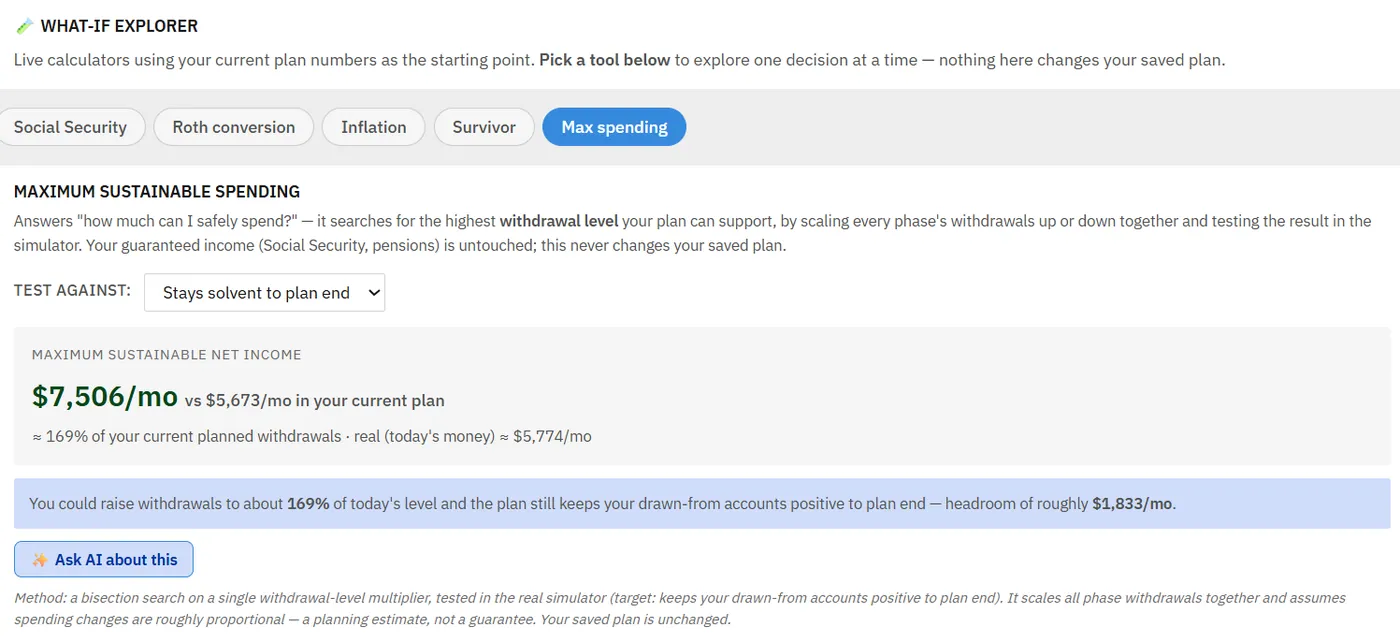
- Use What-if tools for inflation, Social Security, Roth conversion size, survivor scenario, and maximum sustainable spending.
- Run Stress Test.
- Review Monte Carlo and historical backtesting.
- Compare Plan Health checks and Plan Confidence.
This gives you a sustainability picture that is broader than a withdrawal-rate calculator.
A Sustainability Check On A Real Set Of Numbers
A 71-year-old retiree has:
- $34,000 in Social Security.
- $18,000 from a pension.
- $48,000 of portfolio withdrawals.
- $22,000 in annual healthcare and insurance costs.
- $950,000 across IRA, Roth, taxable, and cash accounts.
- No mortgage.
At first glance, the plan may look comfortable. The sustainability check asks:
- Are withdrawals rising faster than inflation?
- How much of the withdrawal is tax?
- What happens when RMDs begin?
- What happens if healthcare rises by 25 percent?
- What happens if markets fall early?
- What happens if the pension has no survivor benefit?
- What spending could be reduced if needed?
The answer may be that the plan is strong. Or it may be that the plan is strong only if travel spending stays flexible. Either answer is useful.
FAQ
What does sustainable retirement income mean?
Sustainable retirement income means the plan can keep funding the household over time after considering spending, reliable income, withdrawals, taxes, healthcare, inflation, market risk, longevity, and survivor outcomes.
Is a 4 percent withdrawal rate enough to know if retirement income is sustainable?
No. A withdrawal rate is only one input. Taxes, healthcare, account mix, Social Security, pensions, RMDs, inflation, and survivor income can change the answer.
How often should retirees check income sustainability?
Many retirees review sustainability annually and after major changes such as market declines, healthcare changes, widowhood, large withdrawals, home sales, tax changes, or Social Security decisions.
Why do RMDs matter for sustainability?
RMDs can affect taxable income, Medicare IRMAA, Social Security taxation, withdrawal order, and survivor tax exposure. They should be projected before they begin.
Can the planner check sustainable retirement income?
Yes. The planner can model current balances, income, withdrawals, taxes, healthcare, RMD estimates, What-if tools, maximum sustainable spending, Stress Test, Monte Carlo, historical backtesting, Plan Health checks, and Plan Confidence.
Source Links
- IRS required minimum distributions: https://www.irs.gov/retirement-plans/plan-participant-employee/retirement-topics-required-minimum-distributions-rmds
- SSA receiving benefits while working: https://www.ssa.gov/benefits/retirement/planner/whileworking.html
- Medicare costs: https://www.medicare.gov/basics/costs/medicare-costs
- Investor.gov retirement planning glossary: https://www.investor.gov/introduction-investing/investing-basics/glossary/retirement-planning
- AI Retirement Income Planner: https://airetirementincomeplanner.com/
Educational Disclaimer
This article is for general education only. It is not financial, tax, investment, legal, healthcare, insurance, Social Security, Medicare, estate, AI safety, software, or retirement advice. Confirm tax, Medicare, Social Security, RMD, withdrawal, investment, insurance, healthcare, and estate details with official sources and qualified professionals. Screenshots show a sample plan with invented figures and are illustrative only.