
Short Answer
IRMAA stands for Income-Related Monthly Adjustment Amount. It is an extra amount some Medicare beneficiaries pay for Medicare Part B and Part D when their income is above certain levels.
Medicare.gov says the standard Part B premium in 2026 is $202.90 per month, or higher depending on income. Medicare.gov also says Part D premiums vary by plan and may be higher depending on income. The income figure that decides which of those you pay is MAGI, and it is not one number: the version Medicare uses differs from the one the ACA marketplace uses.
Medicare sets IRMAA from your tax return two years earlier, so 2026 premiums are based on 2024 income.
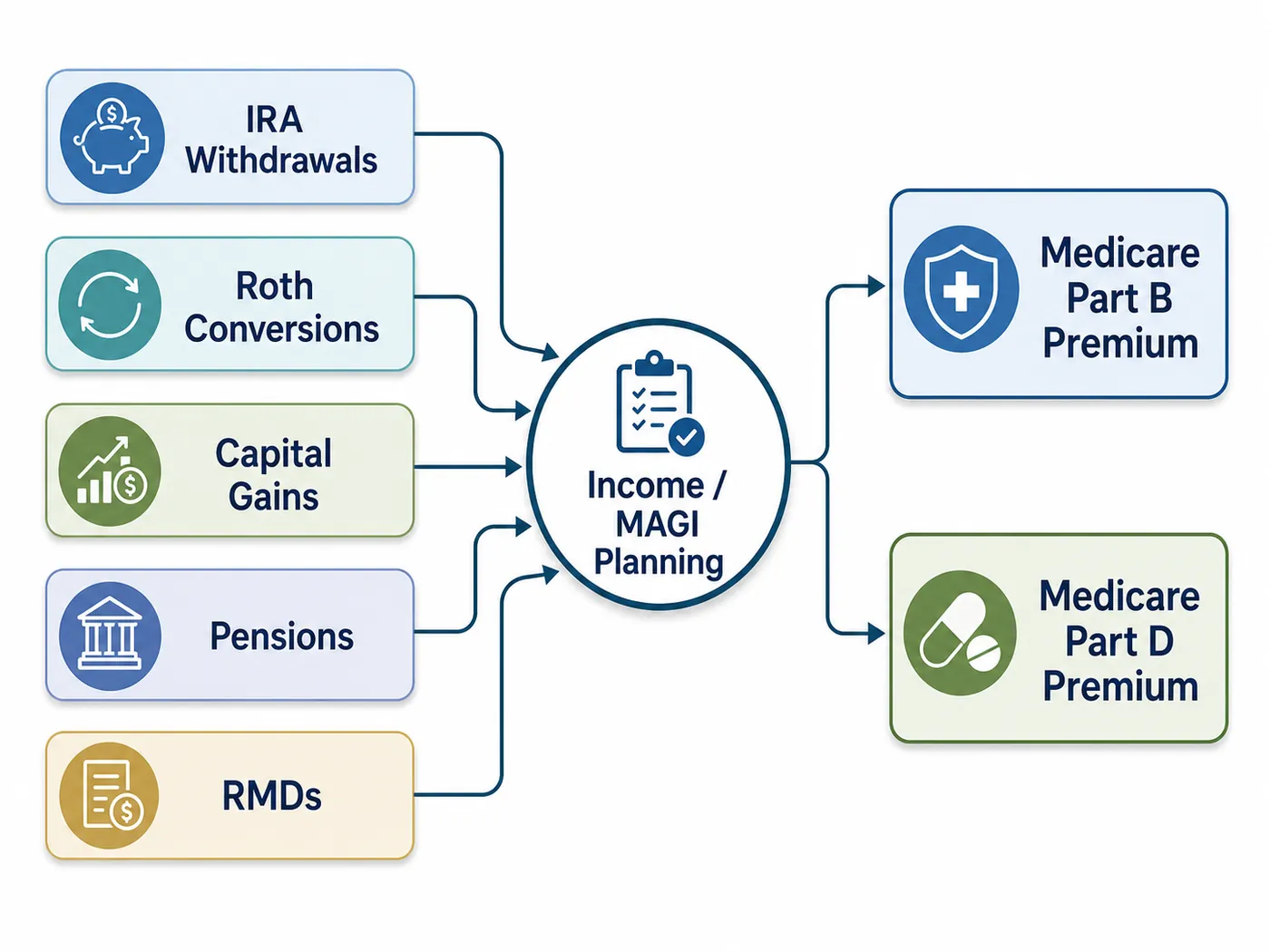
That means retirement income planning can affect healthcare costs after age 65, and the income you have in the two years before 65 already counts. A Roth conversion, large IRA withdrawal, capital gain, pension start date, or required minimum distribution may raise income enough to increase Medicare premiums.
The point is not to fear income. The point is to model it.
Why IRMAA Surprises Retirees
Many retirees think of Medicare as a fixed monthly cost. It is not always fixed.
The base Medicare costs are only part of the story. Medicare.gov lists standard Part B costs, deductibles, coinsurance, and Part D plan costs. It also notes that Part B and Part D premiums can be higher depending on income.
That income link is what catches people off guard.
A retiree might sell an investment property, convert part of a traditional IRA to Roth, take a large withdrawal for a home project, or begin RMDs. The event may be perfectly reasonable, but it can still change Medicare costs.
The planning mistake is looking only at tax.
What Income Events Can Matter?
IRMAA planning starts with a simple question:
Which decisions could raise income in a Medicare year?
Common examples include:
- Roth conversions
- Traditional IRA withdrawals
- 401k withdrawals
- Required minimum distributions
- Capital gains from selling investments
- Sale of a second home or investment property
- Pension income
- Part-time work
- Business sale income
- Large taxable interest or dividend income
- Tax-exempt interest, such as municipal bond interest, which Medicare adds back when it measures income
Some of these income events are voluntary. Others are built into the plan. RMDs are a good example. The IRS says many traditional retirement accounts generally require minimum distributions starting at age 73. Under the SECURE 2.0 Act that age becomes 75 for anyone born in 1960 or later.
That means Medicare cost planning should begin before age 65, because Medicare reads income from two years back, and continue well before RMDs start.
The Medicare Years Are Not All The Same
Medicare planning often happens in phases.
Age 62 To 64
These may be pre-Medicare years for early retirees. Healthcare planning may involve Marketplace coverage, COBRA, employer retiree coverage, spouse coverage, or private insurance.
HealthCare.gov says retirees may qualify for Marketplace savings based on income and household size. That makes income planning important before Medicare too. It counts again later: Medicare reads income from two years back, so the year you turn 63 sets the premiums for the year you turn 65.
Age 65 Until RMDs Start
Medicare usually begins at 65. This is also a window when some retirees have Medicare coverage but have not started RMDs yet.
This period can include:
- Social Security decisions
- Roth conversions
- Portfolio withdrawals
- Pension start dates
- Capital gains planning
- Medicare premium planning
Once RMDs Start
The IRS says RMDs generally begin at age 73 for many pre-tax retirement accounts, and SECURE 2.0 moves that to 75 for anyone born in 1960 or later. RMDs can add taxable income each year, which is covered in how RMDs change your retirement tax bill.
That income can affect the overall tax plan and may also affect Medicare premiums.
This is why a retirement income plan should not stop at the first year of retirement.
An IRMAA Example: One Conversion, Two Years Later
Suppose a retired couple reaches Medicare age with these income sources:
- Social Security
- A pension
- Taxable investment income
- A traditional IRA
- A Roth IRA
Their base plan looks comfortable. Then they decide to convert part of the traditional IRA to Roth in one year.
The conversion may help reduce future RMDs. It may also raise current taxable income. That can affect federal tax, state tax, and Medicare premium planning. If they convert in the year they turn 66, Medicare reads that income two years later, so any IRMAA it causes shows up in their premiums for the year they turn 68.
The same is true if they sell appreciated investments or take a large IRA withdrawal.
None of these moves are automatically wrong. The problem is making the move without checking the whole retirement income picture.
IRMAA And Roth Conversions
Roth conversions are one of the most common IRMAA planning topics.
A Roth conversion can be useful because it moves money from a pre-tax retirement account into a Roth account. That may reduce future RMD pressure and create more tax diversification.
The tradeoff is that the conversion may increase income in the year it happens.
For some retirees, that is still a good trade. For others, the added tax and Medicare cost may make the conversion less attractive.
A good model compares:
- No conversion
- Small conversion
- Moderate conversion
- Larger conversion
Then it checks:
- Current tax
- Future RMDs
- Medicare premium exposure
- Survivor income
- Ending balances
- Confidence score
IRMAA And RMDs
RMDs can also create Medicare cost pressure because they may raise income every year once they start, at 73 or 75.
The IRS says traditional IRA and many employer plan account owners are responsible for taking the correct RMD amount on time. It also says RMD withdrawals are taxed at the account owner's income tax rate except for amounts that are already-taxed basis or tax-free qualified Roth distributions.
If a retiree has large pre-tax balances, RMDs may become a major annual income source.
That is why the best IRMAA planning may happen years before the first RMD.
Can You Appeal IRMAA?
Sometimes.
The Social Security Administration says that if you had a life-changing event that reduced household income, you can ask to lower the additional amount you pay for Medicare Part B and Part D.
SSA lists examples including:
- Marriage
- Divorce
- Death of a spouse
- Loss of income
- Employer settlement payment
SSA also provides Form SSA-44 for these requests. The form breaks loss of income down further: stopping work, cutting back work, and losing pension income or income-producing property. Retiring counts as stopping work, which matters when your first Medicare premiums are set from a year when you still had a salary.
This process matters, but it should not be treated as the main plan. It is better to model income before the Medicare premium year when you can.
How To Model IRMAA Risk In The Planner
Use the AI Retirement Income Planner to compare income choices before they happen. The lever most likely to move this number is a conversion, which Roth conversions before RMDs works through year by year.
A practical workflow:
- Enter current ages, retirement age, Social Security timing, pensions, account balances, and spending goals.
- In Edit values, check the Healthcare costs card: the Medicare Part B and Part D estimates, the IRMAA brackets, and your income in the two years before you retire, which sets your first Medicare premiums.
- Read each phase card after 65. If the income Medicare reads from two years earlier is over an IRMAA threshold, or close to one, the card says so, and when the surcharge is charged it shows the monthly amount added to healthcare.
- Open Plan Health and look at the IRMAA Not Triggered and RMD Compliance checks.
- On the Tax & ACA tab, the IRMAA surcharge ladder marks where your plan's income sits against the brackets.
- Use What-if? to test the size of a Roth conversion. Its chart shows the tax each size adds and marks the amount at which IRMAA starts.
- Add a large one-off withdrawal on the Lump sums tab, paid from the account it would really come from. Money from the 401k or IRA, or the gain on investments sold, counts as income that year, and if it pushes the year over the IRMAA line, the phase card flags it.
- Check the Balance tab for account balances before and after RMDs start.
- Keep different versions in Saved plans and use Compare to see them side by side.
- Review the Confidence tab after each change.
- If you are married, run the survivor scenario on What-if?. It taxes the surviving spouse as a single filer, and the single IRMAA thresholds start at half the joint ones ($109,000 against $218,000 in 2026).
The goal is not to chase a single perfect number. The goal is to understand tradeoffs before a tax year is over.
Income Choices To Test
Here are useful comparisons to run:
Roth Conversion Timing
Compare conversions before Medicare, during early Medicare years, and after RMDs begin.
Withdrawal Order
Compare spending taxable cash first, using IRA withdrawals earlier, preserving Roth assets, or blending withdrawals from several accounts.
Social Security Timing
Social Security timing changes income patterns. Delaying benefits can create lower-income years earlier, but it may increase guaranteed income later.
Capital Gains Timing
A large capital gain may affect the Medicare income picture. Compare spreading gains across years against taking one large gain in a single year.
RMD Preparation
If projected RMDs look large, compare Roth conversions or earlier planned withdrawals before RMDs start.
An IRMAA Checklist Before Age 65
Before Medicare starts, ask:
- What income year will Medicare use for premium calculations?
- Will I have unusually high income in the years before Medicare?
- Am I planning a Roth conversion?
- Am I selling a business, property, or large taxable investment?
- Will I still have earned income?
- Will my spouse still be working?
- Could a lower-income retirement year create planning room?
- Do I understand how future RMDs may change the plan?
A Planning Checklist After Medicare Starts
After Medicare starts, ask:
- Will this year's income be much higher than usual?
- Is the income increase temporary or permanent?
- Would spreading income across years help?
- Are Roth conversions still worth the current tax and Medicare cost?
- Are RMDs likely to increase future income?
- Would survivor filing status change the Medicare and tax picture?
- Did a life-changing event reduce income enough to review SSA-44?
FAQ
What is IRMAA?
IRMAA stands for Income-Related Monthly Adjustment Amount. It is an additional amount some Medicare beneficiaries pay for Part B and Part D when income is higher.
Which Medicare parts can have IRMAA?
Medicare.gov says Part B premiums can be higher depending on income, and Part D premiums may also be higher depending on income.
Can a Roth conversion trigger IRMAA?
It can. A Roth conversion increases taxable income in the conversion year, and Medicare reads that year two years later when it sets your premiums.
Can RMDs affect Medicare premiums?
They can. RMDs from pre-tax accounts generally increase taxable income, and higher income can affect Medicare Part B and Part D premium costs.
Can I appeal IRMAA?
SSA says you can ask to lower the additional Medicare Part B and Part D amount if you had a life-changing event that reduced household income. SSA lists marriage, divorce, death of a spouse, loss of income, and employer settlement payment as examples, and Form SSA-44 adds stopping or cutting back work and losing pension income or income-producing property.
Should I avoid all income that could cause IRMAA?
No. Avoiding income at all costs can be a poor planning goal. A higher-income year may still be worth it if it improves the overall plan. The right question is whether the tax, healthcare, cash-flow, and long-term effects are acceptable.
Sources
- Medicare.gov, Costs: https://www.medicare.gov/basics/costs/medicare-costs
- Social Security Administration, Request to Lower an Income-Related Monthly Adjustment Amount: https://www.ssa.gov/medicare/lower-irmaa
- Social Security Administration, Form SSA-44, Medicare Income-Related Monthly Adjustment Amount - Life-Changing Event: https://www.ssa.gov/forms/ssa-44.pdf
- IRS, Required Minimum Distributions FAQs: https://www.irs.gov/retirement-plans/retirement-plan-and-ira-required-minimum-distributions-faqs
- HealthCare.gov, Health Care Coverage for Retirees: https://www.healthcare.gov/retirees/
Educational Disclaimer
This article is for general education only. It is not financial, tax, investment, legal, healthcare, insurance, Social Security, Medicare, estate, or retirement advice. Tax rules, benefit rules, healthcare costs and thresholds change over time, and any projection depends on assumptions that may not hold. Screenshots show a sample plan with invented figures and are illustrative only. Verify important figures with official sources such as IRS.gov, SSA.gov, Medicare.gov and HealthCare.gov, and confirm decisions with a qualified professional before acting.