
Short Answer
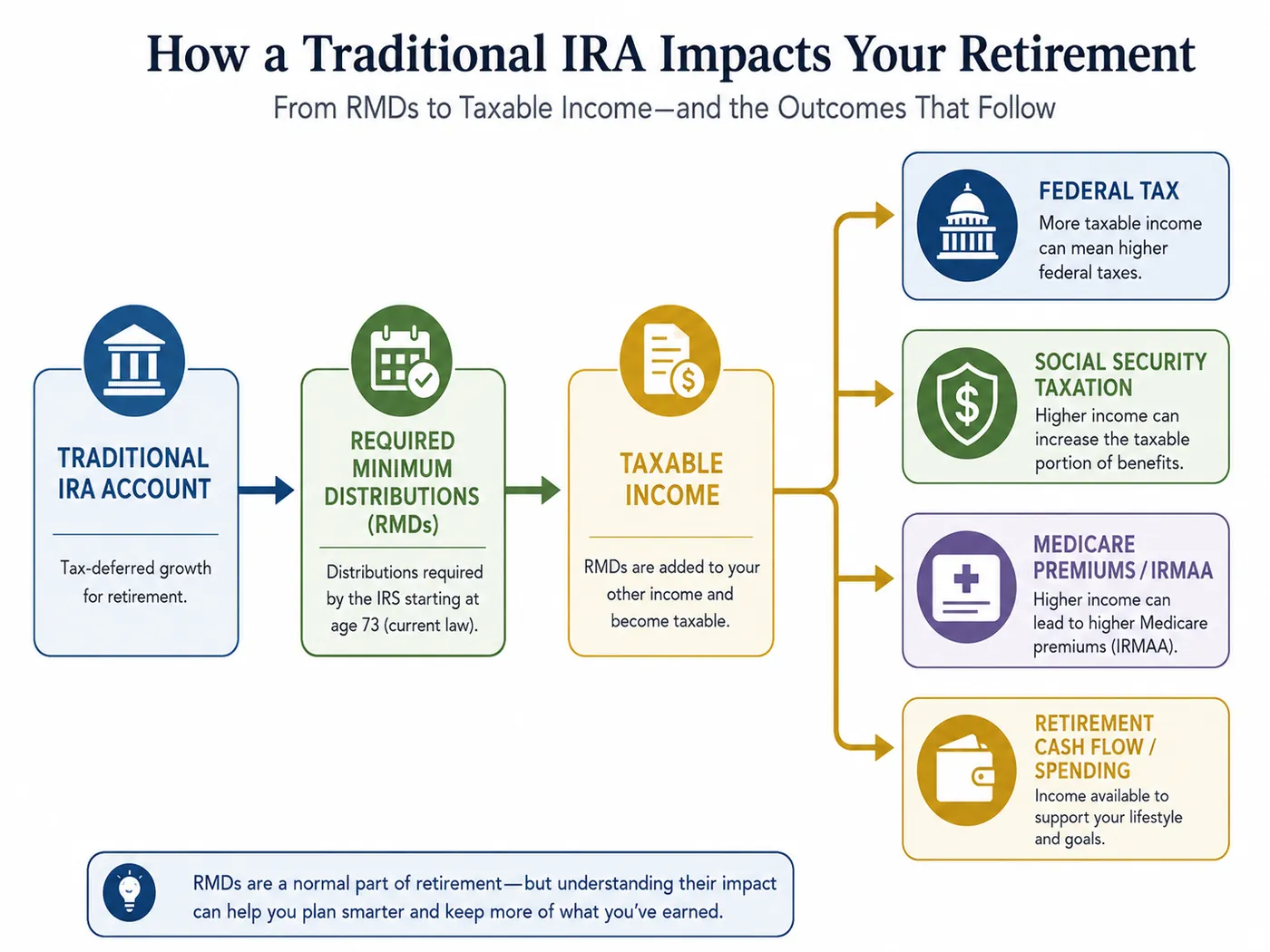
Required minimum distributions can change your retirement tax bill because they force taxable withdrawals from many pre-tax retirement accounts once you reach RMD age.
The IRS says RMDs generally begin at age 73 for traditional IRAs, SEP IRAs, SIMPLE IRAs, and many retirement plan accounts. Under the SECURE 2.0 Act that age becomes 75 for anyone born in 1960 or later, which covers most people retiring in the next few years. The withdrawal is usually included in taxable income, except for any part that was already taxed or qualifies for tax-free treatment.
That extra income can do more than raise federal tax. It may also affect:
- How much of your Social Security is taxable
- Medicare IRMAA
- State income tax
- Roth conversion room
- Survivor tax planning
- Cash flow and portfolio withdrawals
What Is An RMD?
An RMD is a required minimum distribution. It is the minimum amount you must withdraw each year from certain retirement accounts once the rules apply to you.
The IRS says RMD rules apply to traditional IRAs and employer plans such as 401k, 403b, profit-sharing, and 457b plans. Roth IRAs and designated Roth accounts are not subject to RMDs while the owner is alive, though beneficiaries can be subject to RMD rules.
For many retirees, the first surprise is that the word "minimum" does not mean "small." The RMD amount depends on the prior year-end account balance and an IRS life expectancy factor. If a pre-tax balance has grown for decades, the required withdrawal can become a major source of taxable income.
Why RMDs Can Raise Taxes
RMDs from pre-tax accounts generally count as taxable income. That means they can stack on top of other income sources, including:
- Social Security
- Pension income
- Interest
- Dividends
- Capital gains
- Rental income
- Part-time work
- Annuity income
A retiree may feel low-income because they are no longer working, but the tax return may tell a different story once RMDs begin.
For example, a household might have:
- Social Security income
- A pension
- A large traditional IRA
- Taxable investment income
Before RMDs, the plan may look manageable. After RMDs begin, the IRA withdrawal can push taxable income higher every year.
RMDs And Social Security Taxes
RMDs can also affect how much of your Social Security benefit is taxable.
The IRS says Social Security benefits may be taxable when your modified adjusted gross income plus one half of your Social Security benefits is above the base amount for your filing status. That income measure is not the same one used for ACA subsidies or Medicare surcharges: what MAGI is sets out the four definitions and where each one bites.
Because RMDs can raise income, they can increase the portion of Social Security that is taxed. This can surprise retirees who thought Social Security and IRA withdrawals were separate planning questions.
They are not separate on the tax return.
RMDs And Medicare IRMAA
Medicare IRMAA is an income-related monthly adjustment amount. It can increase Medicare Part B and Part D costs for higher-income beneficiaries.
RMDs can matter because they may increase the income used to determine whether IRMAA applies.
The Social Security Administration has a process to request a lower IRMAA after certain life-changing events that reduce household income, including marriage, divorce, the death of a spouse, stopping or cutting back work, losing pension income or income-producing property, and some employer settlement payments. That process can help in specific situations, but it is better to see possible IRMAA exposure before the income year happens.
RMDs And ACA Coverage Before Medicare
RMDs usually begin after Medicare age for most retirees, but the broader lesson applies to pre-Medicare planning too: retirement account withdrawals can affect healthcare costs.
HealthCare.gov says retirees may qualify for Marketplace savings based on income and household size. It also states that IRA and 401k withdrawals generally count as income. For the years before 65 specifically, see can I retire at 62 before Medicare, and for the order you draw from accounts, which retirement account to withdraw from first.
For a person retiring before Medicare, planned withdrawals before RMD age may affect ACA premium tax credits. Later, after Medicare starts, RMDs may affect IRMAA instead.
The details change, but the planning habit is the same:
Model taxes and healthcare together.
The First RMD Timing Trap
The IRS says you must take your first RMD for the year you reach your RMD age (73, or 75 if you were born in 1960 or later), but you can delay that first RMD until April 1 of the following year.
That delay can sound helpful. It can also create a problem.
If you delay the first RMD into the next year, you may need to take two RMDs in that same calendar year:
- The delayed first RMD
- The second RMD due by December 31
Two RMDs in one tax year can increase taxable income and may affect other income-based costs.
This does not mean delaying the first RMD is always wrong. It means the decision should be modeled before the deadline.
What Happens If You Miss An RMD?
The IRS says account owners are responsible for taking the correct RMD amount on time. If the full RMD is not withdrawn by the deadline, the missed amount may be subject to an excise tax.
The IRS currently describes the penalty as 25 percent of the missed amount, or 10 percent if corrected in a timely way within two years.
That is another reason to track RMDs directly in the retirement plan instead of treating them as a once-a-year tax paperwork issue.
Why Bigger Balances Can Create Bigger RMD Pressure
Pre-tax retirement accounts are powerful because they allow tax-deferred growth. The tradeoff is that the tax bill has not disappeared. It has been delayed.
If investment growth is strong, a traditional IRA or 401k balance may become large enough that future RMDs are bigger than the retiree expected.
That can create a pattern like this:
- The years before RMDs: lower taxable income
- From your RMD age (73, or 75 if born in 1960 or later): RMDs begin
- Later 70s and 80s: RMD percentage rises as the life expectancy factor changes
- Survivor years: one spouse may face taxes as a single filer
This is why RMD planning often starts before RMD age.
Planning Moves To Compare Before RMD Age
RMD planning is not about avoiding every dollar of tax. It is about comparing choices early enough to avoid being boxed in later.
Common strategies to model include:
Roth Conversions
A Roth conversion before RMD age may reduce future pre-tax balances. That can reduce future RMD pressure, but it can also raise current taxable income.
This works best as a comparison:
- No conversion
- Small annual conversion
- Moderate annual conversion
- Larger conversion
Then compare taxes, Medicare costs, ending balances, survivor outcomes, and confidence scores.
Spending From The Right Accounts
Some retirees spend taxable cash first. Others draw from tax-deferred accounts earlier to reduce future RMD pressure. Some preserve Roth assets for later years or heirs.
There is no universal withdrawal order. The right sequence depends on the household's income, tax bracket, investment mix, healthcare costs, and goals.
Delaying Or Starting Social Security
Social Security timing affects taxable income patterns. Delaying benefits may create lower-income years before age 70, which can be useful for Roth conversions or planned pre-tax withdrawals.
Starting earlier may reduce the need for portfolio withdrawals, but it can also change the lifetime income picture.
The planner should compare both paths. The case for acting early is set out in Roth conversions before RMDs.
Charitable Giving
Some retirees use charitable strategies to manage taxable IRA distributions. The rules are specific, and the details matter, so this is an area where a tax professional should be involved.
The planning point is simple: if giving is already part of the household's plan, include it in the tax model.
How To Model RMDs In The AI Retirement Income Planner
The planner estimates your RMD but does not take it for you. It works out the minimum for every year from your RMD age and warns when your planned 401(k) withdrawal falls below it, so the tax effect appears once your withdrawals meet the minimum. Use this workflow:
- In Edit values, enter your ages, birth year, retirement age, account balances, Social Security timing, pensions, and spending goals. The birth year sets the RMD age (73, or 75 if born in 1960 or later) unless you type one into the RMD start age box.
- On the Overview, open the phase cards that run past your RMD age. The tax block shows the estimated RMD, or an amber warning naming the age your planned 401(k) withdrawal first falls below the minimum.
- Open Plan Health and read the RMD Compliance check, which lists every phase that falls short.
- Raise the 401(k) withdrawal in each flagged phase to at least the minimum. The projection then shows what RMDs do to your tax, to the taxable share of your Social Security, and to IRMAA.
- Check the Balance tab for account balances over time and the year-by-year table of withdrawals.
- The Tax & ACA tab explains how the RMD estimate, tax brackets, MAGI, and IRMAA are worked out.
- Use What-if? to test Roth conversion sizes and Social Security claiming ages.
- Save your baseline and an alternative, such as a conversion plan or a different withdrawal order, in Saved plans, then use Compare to see them side by side.
- If you are married, review the survivor outcome in What-if?.
- Check ending balances and the Plan Confidence score, not only tax totals.
A Simple RMD Planning Checklist
Before RMDs begin, answer these questions:
- Which accounts will be subject to RMDs?
- What is the projected pre-tax balance at your RMD age?
- How much taxable income might RMDs create?
- Will RMDs overlap with pension income?
- Will RMDs overlap with Social Security?
- Could RMDs affect Medicare IRMAA?
- Would Roth conversions before RMDs start help or hurt?
- What happens if one spouse dies first?
- Is there enough cash to pay taxes without forced selling?
- Does the plan still work in weak market years?
This checklist is more useful than asking whether RMDs are "bad." RMDs are simply part of the retirement income system. The issue is whether they are planned for.
FAQ
What age do RMDs start?
The IRS says RMDs generally begin at age 73 for traditional IRAs, SEP IRAs, SIMPLE IRAs, and many retirement plan accounts. The SECURE 2.0 Act raises that age to 75 for anyone born in 1960 or later. Some workplace plan participants may be able to delay RMDs until retirement, unless they are 5 percent owners of the business sponsoring the plan.
Are RMDs taxable?
Usually, yes. The IRS says the account owner is taxed at their income tax rate on the withdrawn RMD, except for amounts that are a return of basis or qualified tax-free Roth distributions.
Can I withdraw more than the RMD?
Yes. The IRS says you can withdraw more than the required minimum amount. The extra withdrawal may still be taxable, depending on the account and tax details.
Can I skip an RMD if I do not need the money?
Generally, no. If the RMD rules apply, the required amount must be withdrawn by the deadline. Missing an RMD can trigger an excise tax.
Can RMDs affect Social Security taxes?
Yes. RMDs can increase income, and the IRS says Social Security taxation depends in part on modified adjusted gross income plus one half of Social Security benefits.
Can RMDs affect Medicare costs?
Yes. RMDs can increase income, and higher income can affect Medicare IRMAA for Part B and Part D.
Do Roth IRAs have RMDs?
The IRS says Roth IRAs and designated Roth accounts are not subject to RMDs while the owner is alive. Beneficiaries can still be subject to RMD rules.
Sources
- IRS, Required Minimum Distributions FAQs: https://www.irs.gov/retirement-plans/retirement-plan-and-ira-required-minimum-distributions-faqs
- IRS, Retirement Topics: Required Minimum Distributions: https://www.irs.gov/retirement-plans/plan-participant-employee/retirement-topics-required-minimum-distributions-rmds
- SECURE 2.0 Act of 2022 (Public Law 117-328, Division T), Section 107, Increase in age for required beginning date for mandatory distributions: https://www.govinfo.gov/content/pkg/PLAW-117publ328/html/PLAW-117publ328.htm
- IRS, Topic No. 423, Social Security and Equivalent Railroad Retirement Benefits: https://www.irs.gov/taxtopics/tc423
- Social Security Administration, Request to Lower an Income-Related Monthly Adjustment Amount: https://www.ssa.gov/medicare/lower-irmaa
- HealthCare.gov, Health Care Coverage for Retirees: https://www.healthcare.gov/retirees/
Educational Disclaimer
This article is for general education only. It is not financial, tax, investment, legal, healthcare, insurance, Social Security, Medicare, estate, or retirement advice. Tax rules, benefit rules, healthcare costs and thresholds change over time, and any projection depends on assumptions that may not hold. Screenshots show a sample plan with invented figures and are illustrative only. Verify important figures with official sources such as IRS.gov, SSA.gov, Medicare.gov and HealthCare.gov, and confirm decisions with a qualified professional before acting.