
Short Answer
US retirees considering Thailand should model income in dollars, spending in baht, healthcare outside the US, Medicare limits, Social Security payment logistics, US tax filing, foreign account reporting, visa or residency costs, travel, safety, and a return-to-US backup plan.
Thailand may be attractive for lifestyle, climate, and cost reasons, but the retirement plan should not depend on one low monthly budget. Healthcare, exchange rates, visa rules, travel, housing, and return options can change the result.
Key Takeaways
- The planner supports THB currency and foreign-residence assumptions, but it does not replace Thai tax, visa, or legal review.
- US citizens and resident aliens abroad generally remain subject to US tax on worldwide income.
- SSA says Social Security payments outside the US can be affected by country, citizenship, and benefit type.
- Medicare usually does not cover healthcare outside the US, with limited exceptions.
- Travel.State.Gov says retirees and long-stay visitors should check Thai visa requirements with Thai authorities.
- THB spending funded by USD income should be tested against a weaker dollar, entered as higher dollar costs.

Why Thailand Retirement Planning Needs Scenario Testing
Many retirees start with a cost-of-living question. That is understandable, but Thailand retirement planning has more moving parts.
A stronger model asks:
- What income arrives in USD?
- What spending happens in THB?
- What happens if the dollar weakens?
- How will healthcare be paid?
- Will Medicare be kept for US access?
- Can Social Security payments continue?
- What US tax filing continues?
- What Thai tax or residency questions need review?
- What visa path applies?
- What happens if you return to the US later?
The point is not to make the plan complicated. The point is to avoid depending on one optimistic assumption.
1. Build A THB Spending Plan
If Thailand is the main retirement location, start with THB spending.
Include:
- Rent or housing.
- Utilities.
- Groceries.
- Transportation.
- Domestic travel.
- Flights to the US.
- Healthcare and prescriptions.
- Private insurance.
- Visa and extension costs.
- Household help, if relevant.
- Family support.
- Emergency travel.
- Currency transfer costs.
Separate fixed costs from flexible costs. A low monthly budget can work in normal months and still fail during a medical event, family emergency, currency shock, or relocation.
2. Model Social Security In Dollars
SSA says retirement, survivor, or disability payments may be affected when someone leaves the United States. SSA also provides a Payments Abroad Screening Tool.
For a US retiree in Thailand, model:
- Claiming age.
- Monthly benefit.
- Spouse benefit.
- Survivor income.
- Direct deposit and transfer method.
- Exchange-rate conversion.
- US tax treatment.
- What happens if one spouse returns to the US.
Social Security may be steady in dollars, but the local spending value can move with USD/THB exchange rates.
3. Treat Medicare As Limited Outside The US
Medicare.gov says Medicare usually does not cover healthcare outside the US, with limited exceptions.
That means a Thailand retirement plan should include a separate healthcare model.
Model:
- Routine care.
- Private hospital costs.
- Private insurance.
- Prescription costs.
- Emergency evacuation.
- Annual US medical visits.
- Keeping Medicare premiums active.
- Higher healthcare cost case.
- Return-to-US care case.
Travel.State.Gov also encourages travelers to consider medical evacuation insurance and notes that appropriate medical treatment may be easier to find in or near major cities.
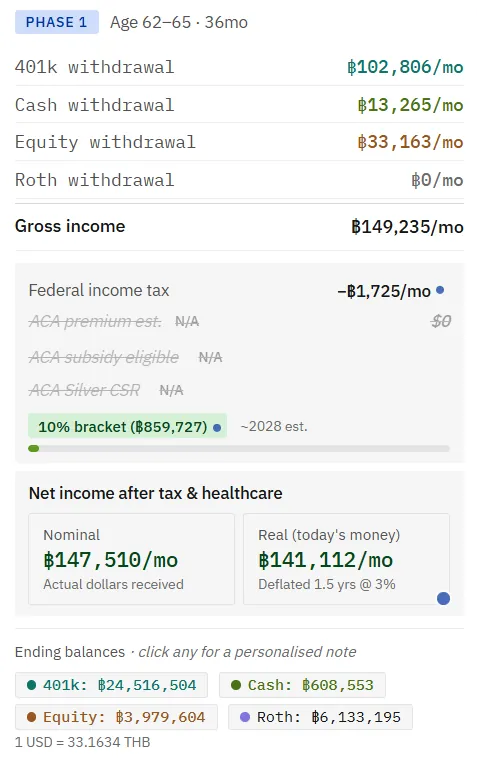
In the planner, choosing THB puts the plan in foreign-residence mode. That drops ACA premiums, Medicare premiums and IRMAA, and adds an Overseas healthcare cost field in Edit values for your monthly insurance and out-of-pocket costs, which grows each phase at your healthcare-inflation rate. If you will keep paying for Medicare Part B so you have coverage on visits home, add that premium to the same figure, because the plan no longer counts it. Leave the field at 0 and the plan assumes healthcare in Thailand is free, which is what the phase card below shows.
4. Keep US Tax Filing And Reporting In The Plan
The IRS says US citizens and resident aliens abroad are generally subject to US tax on worldwide income and must report taxable income under US tax rules.
Model:
- Social Security.
- 401k or IRA withdrawals.
- Roth withdrawals.
- Pension income.
- Taxable brokerage income.
- Rental income.
- RMD estimates.
- Filing status.
- Foreign tax credit questions.
The IRS FBAR page says US persons may need to report foreign financial accounts when their combined value exceeds $10,000 at any time during the calendar year. A retiree using Thai bank accounts should keep reporting questions on the checklist.
The planner can model US-taxpayer scenarios, but it does not file tax returns or replace US/Thai tax review.
The Thai question that has been moving: remitted income
This is the point that makes Thailand different from most retirement destinations, and it is the one worth taking to a professional first.
Thailand taxes individuals who are tax resident there, which generally means spending 180 days or more in the country in a tax year. Historically many foreign retirees relied on a timing position under which foreign income brought into Thailand in a later year was treated as outside the tax net. The Revenue Department's interpretation of remitted foreign income changed with effect from 2024, and it has continued to be revised since.
Two things follow for a retirement plan.
First, do not build a Thailand plan on a rule of thumb you heard before 2024. The position a long-term expat describes on a forum may predate the change.
Second, this is a question about timing and remittance, not just totals. When you move money into Thailand can matter as much as how much. The planner cannot see where money is held or when it crosses a border, so that part stays with your tax adviser. What you can model is the effect of their answer: if a remittance plan means drawing less in some phases and more in others, change each phase's withdrawals to match and compare the spending each pattern supports.
The planner will not tell you the Thai tax figure. It will show you what each withdrawal pattern does to your dollar balances, which is the half of the problem it can answer honestly. Get the tax number from a Thai tax professional and add it as extra withdrawals.
5. Verify Visa And Entry Rules
Thailand shortened its visa-free stay on 15 September 2026. The Tourism Authority of Thailand says US passport holders can now enter without a visa for tourism for up to 30 days, down from the 60 days allowed before, and every foreign visitor must complete the online Thailand Digital Arrival Card before arriving. Visa-free entry is for visits, not retirement: Travel.State.Gov advises retirees and anyone planning a longer stay to check visa requirements with the Royal Thai Embassy.
Entry rules have changed more than once in the past two years, so check the current position before you book, and again before you move.
For retirement planning, verify:
- Visa type.
- Age requirement.
- Financial requirement.
- Insurance requirement.
- Extension and reporting rules.
- Address reporting.
- Re-entry rules.
- Overstay penalties.
- Passport validity.
Do not model Thailand retirement as if tourist entry rules solve long-term residence. Add visa costs, insurance costs, and travel timing as assumptions.
6. Test The Plan Against A Weaker Dollar
Currency is one of the biggest planning variables.
Income may be in USD:
- Social Security.
- Pension.
- 401k or IRA withdrawals.
- Roth withdrawals.
- US brokerage withdrawals.
Spending may be in THB.
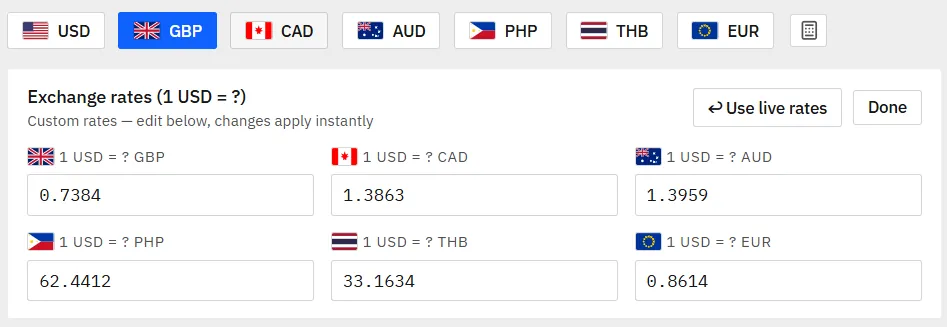
The planner keeps every amount in US dollars and uses the exchange rate to show them in baht. Changing the rate therefore changes how the plan reads in baht, not what it can afford: taxes, balances, Plan Health and Plan Confidence stay exactly the same. Custom rates are also not saved with a plan. So test currency risk in two ways.
First, read the plan at a less favorable rate. Set your own rate under Override rates, show the plan in baht with the USD and THB buttons beside Retirement phases, and check whether each phase's net monthly income still covers your Thai budget. Note the rate in Plan notes (in Saved plans).
Second, test whether the portfolio can pay for it. Build a version where the dollar withdrawals that fund your baht costs, and the overseas healthcare cost, are 10% to 15% higher, and save it beside your base plan.
Other versions worth building:
- An emergency transfer or relocation cost, entered as a Lump sums expense in the phase it falls in.
- Higher local prices: raise the inflation setting and read each phase's Real (today's money) figure. Your withdrawals are fixed dollar amounts, so higher inflation shows up there rather than in the nominal figure.
Compare:
- Net monthly income by phase.
- The lowest balance, on the Balance tab's year-by-year view.
- Ending balances, account by account.
- Plan Health.
- Plan Confidence.
- The Stress test grid, which varies returns and inflation.
Do not predict exchange rates. Test whether the plan can survive movement.
7. Add Safety And Location Assumptions
Travel.State.Gov lists Thailand as Level 1 overall as of July 7, 2026, while noting increased caution in certain areas such as near the Thai-Cambodian border and the southern provinces of Yala, Pattani, and Narathiwat.
For retirement planning, location affects:
- Housing cost.
- Healthcare access.
- Transportation.
- Insurance.
- Emergency support.
- Travel costs.
- Comfort with local services.
Model at least two location cases:
- Major city or established expat area.
- Lower-cost area with more travel or healthcare access concerns.
8. Build A Return-To-US Scenario
Every Thailand retirement plan should include a return option.
Reasons include:
- Medical care.
- Spouse death.
- Family obligations.
- Visa issue.
- Currency shock.
- Safety concern.
- Housing change.
- Long-term care needs.
Create:
- Thailand base case.
- Higher healthcare case.
- Weaker USD/THB case, entered as higher dollar costs.
- Annual US travel case.
- A return-to-US plan.
- For a couple, a survivor case from the survivor card in the What-if? tab, which works for any Married filing jointly plan.
A plan keeps one residence from start to finish, so the planner cannot switch you back to US rules at a chosen age. Build the return case as a separate US plan and read it from the age you would move back. The planner holds three saved plans and compares your current plan with one of them at a time, so export any extra versions to JSON.
The return case may change healthcare, Medicare, state tax, housing, transportation, and family support.
How To Model This In The AI Retirement Income Planner
Use this workflow:
- Select THB. This puts the plan in foreign-residence mode and leaves out ACA, Medicare and IRMAA.
- In Edit values, under US tax obligation, keep US taxpayer selected if you are a US citizen or green-card holder. The Non-US button is only for people who are not US persons, and it turns off US tax entirely.
- For a couple, click Married filing jointly in the same card. That is what shows the spouse Social Security fields. If your spouse is not a US citizen or resident, filing jointly takes an IRS election, and the planner offers only Single filer or Married filing jointly, so confirm your filing status with a tax professional.
- Enter your US Social Security, and your spouse's if you are married.
- Enter cash, taxable brokerage, tax-deferred accounts, Roth, and pensions.
- Enter the Overseas healthcare cost, including any Medicare Part B premium you will keep paying.
- Add visa, insurance, travel, and relocation costs to the withdrawals that fund them, or as Lump sums in the phase they fall in.
- Add any local tax a professional estimates as extra withdrawals.
- Choose the exchange rate you plan with, read the plan in local currency with the USD and THB buttons, and record the rate in Plan notes.
- Save a Thailand base plan.
- Save a weaker-dollar plan, with the extra cost entered in dollars.
- Save a higher-healthcare plan, with a larger overseas healthcare cost or a higher healthcare-inflation rate.
- Build the return-to-US plan as a separate US plan, and export it to JSON if the three saved-plan slots are full.
- Read Plan Health and Plan Confidence for each version.
- Read the Stress test, and use saved-plan Compare to set two versions side by side.
- Use optional AI Chat or Plan with AI to explain scenario differences.
The planner can help compare the scenarios. It does not replace professional tax, visa, healthcare, or legal review. For the tax side see expat retirement taxes; for baht conversion and how to test a weaker dollar see the currency converter.
A Thailand Retirement Scenario
Assume a single US retiree moves to Thailand at 65.
Base assumptions:
- THB planning currency.
- Social Security begins at 67.
- IRA withdrawals cover bridge years.
- Overseas healthcare costs are entered.
- Private insurance is included.
- Annual US travel is included.
- A weaker dollar is tested by raising the dollar withdrawals for baht costs.
- A separate US plan is read from age 78 for the return.
The key comparison is:
- Does the THB budget still work under a weaker dollar?
- Does healthcare become the main pressure point?
- Does delaying Social Security require too much IRA spending?
- Does returning to the US require a larger cash reserve?
- Does a higher inflation case create a Plan Health warning?
FAQ
Can a US retiree retire in Thailand?
Many US retirees consider it, but visa status, healthcare, taxes, banking, housing, safety, and currency risk need careful review before committing.
Can I receive US Social Security in Thailand?
SSA provides payment-abroad guidance and a screening tool. Payment rules can depend on country, citizenship, benefit type, and other facts, so verify directly with SSA.
Does Medicare cover healthcare in Thailand?
Medicare.gov says Medicare usually does not cover healthcare outside the US, with limited exceptions. Model local healthcare, private insurance, evacuation coverage, and return-to-US care separately.
Does the planner model Thai tax law?
No. The planner supports THB currency, foreign residence scenarios, US-taxpayer settings, overseas healthcare assumptions, exchange-rate tools, and saved-plan comparison. Local tax issues should be verified separately.
Should I plan in USD or THB?
Either works. With the plan shown in baht, the amount boxes in Edit values take baht and convert them to dollars at the current rate; with it shown in dollars, they take dollars. The plan is calculated in dollars either way, so test a weaker dollar by raising the dollar amounts your baht costs need.
What is the most important stress test?
For many US retirees, the most important tests are weaker USD/THB exchange rate, higher healthcare cost, and return-to-US scenarios.
Source Links
- Travel.State.Gov, Thailand International Travel Information: https://travel.state.gov/content/travel/en/international-travel/International-Travel-Country-Information-Pages/Thailand.html
- Thai e-Visa official website: https://www.thaievisa.go.th/
- Tourism Authority of Thailand, new visa exemption categories from 15 September 2026: https://www.tatnews.org/2026/07/thai-cabinet-approves-updated-visa-measures-pending-royal-gazette-publication/
- IRS, U.S. citizens and resident aliens abroad: https://www.irs.gov/individuals/international-taxpayers/us-citizens-and-resident-aliens-abroad
- IRS, Report of Foreign Bank and Financial Accounts (FBAR): https://www.irs.gov/businesses/small-businesses-self-employed/report-of-foreign-bank-and-financial-accounts-fbar
- SSA, Social Security Payments Outside the United States: https://www.ssa.gov/international/payments.html
- Medicare.gov, Travel outside the U.S.: https://www.medicare.gov/coverage/travel-outside-the-u.s.
- The Revenue Department of Thailand: https://www.rd.go.th/english/
- AI Retirement Income Planner: https://airetirementincomeplanner.com/
Educational Disclaimer
This article is for general education only. It is not financial, tax, investment, legal, immigration, visa, privacy, cybersecurity, healthcare, insurance, Social Security, Medicare, estate, AI safety, software, or retirement advice. Verify US and Thai tax, visa, healthcare, banking, safety, and reporting details with official sources and qualified professionals.