
Short Answer
US retirees considering the Philippines should model income in dollars, spending in pesos, healthcare outside the US, Medicare limits, Social Security payment logistics, US tax filing, foreign account reporting, visa or residency costs, and a return-to-US backup plan.
The Philippines can be appealing for lifestyle and cost reasons, but the retirement plan should not depend on a single low-cost budget estimate. Currency, healthcare, taxes, travel, family support, and housing can change the result.
Key Takeaways
- The planner supports PHP currency and foreign-residence assumptions, but it does not replace Philippine tax, visa, or legal review.
- US citizens and resident aliens abroad generally remain subject to US tax on worldwide income.
- SSA says Social Security payments outside the US can be affected by country, citizenship, and benefit type.
- Medicare usually does not cover healthcare outside the US, with limited exceptions.
- PHP spending funded by USD income should be tested against a weaker dollar, entered as higher dollar costs.
- A Philippines plan should include a return-to-US scenario and a higher-healthcare-cost scenario.

Why A Philippines Retirement Plan Needs More Than A Budget
Many people start with this question:
How much does it cost to retire in the Philippines?
That is useful, but it is too narrow. A stronger retirement model asks:
- What income is paid in USD?
- What spending happens in PHP?
- How will exchange rates affect purchasing power?
- What healthcare costs are realistic?
- What happens if Medicare does not cover local care?
- Will you keep US Medicare for return visits?
- Can Social Security payments continue?
- What US tax filing and reporting continues?
- What visa or residency path applies?
- What happens if you return to the US later?
The budget is one part of the plan. The rest is risk management.
1. Start With Spending In PHP
If the Philippines is the main retirement location, build a PHP spending plan.
Include:
- Rent or home costs.
- Utilities.
- Groceries.
- Local transportation.
- Travel inside the Philippines.
- Travel back to the US.
- Healthcare and prescriptions.
- Private insurance.
- Visa or residency costs.
- Household help, if relevant.
- Family support.
- Emergency flights.
- Currency transfer costs.
Then separate fixed spending from flexible spending. A low base budget can be fragile if it leaves no room for healthcare, travel, exchange-rate changes, or family emergencies.
2. Model US Social Security Carefully
For many US retirees, Social Security is the base income source.
SSA says retirement, survivor, or disability payments may be affected when someone leaves the United States. SSA also provides a Payments Abroad Screening Tool to help people check whether payments can continue outside the US.
Model:
- Claiming age.
- Monthly benefit.
- Spouse benefit.
- Survivor income.
- Direct deposit and currency transfer timing.
- Taxable Social Security in the US tax model.
- What happens if one spouse returns to the US.
Do not assume a Social Security payment will feel the same in every exchange-rate environment. A fixed USD payment can buy more or less PHP over time.
3. Treat Medicare As A Return-To-US Issue
Medicare.gov says Medicare usually does not cover healthcare outside the US, with limited exceptions.
That is a major planning point. A retiree living in the Philippines may need local private insurance, self-funded care, international coverage, or a plan for returning to the US for certain care.
Model:
- Local routine care.
- Private insurance.
- Prescription costs.
- Major medical events.
- Emergency evacuation.
- Annual trips to the US.
- Medicare premiums kept active for US access.
- Higher healthcare cost scenario.
- Return-to-US healthcare scenario.
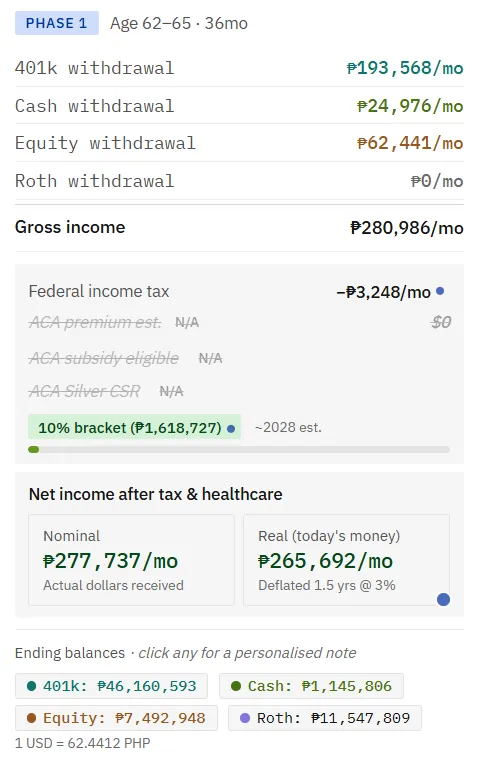
Choosing PHP puts the plan in foreign-residence mode, which leaves out ACA premiums, Medicare premiums and IRMAA, and adds an Overseas healthcare cost field in Edit values. Enter your expected monthly cost for insurance and out-of-pocket care there; it grows each phase at your healthcare-inflation rate. If you plan to keep Medicare Part B for care on visits home, include its premium in the same figure, because the plan no longer counts it. Left at 0, the plan assumes healthcare in the Philippines costs nothing, which is what the phase card below shows. Use the field for the Philippines base case, then compare a separate US plan for a return. The tax questions that apply wherever you go are in expat retirement taxes, and peso conversion is covered in the currency converter.
4. Keep US Tax Filing In The Plan
The IRS says US citizens and resident aliens abroad are generally subject to US tax on worldwide income and must report taxable income according to the Internal Revenue Code.
That means a Philippines retirement plan for a US citizen should still include US tax awareness.
Model:
- Social Security.
- 401k or IRA withdrawals.
- Roth withdrawals.
- Pension income.
- Taxable brokerage income.
- Rental income.
- RMD estimates.
- Filing status.
- Possible foreign tax credit issues.
Also keep foreign account reporting on the checklist. The IRS FBAR page says US persons may need to report foreign financial accounts when their combined value exceeds $10,000 at any time during the calendar year.
The planner can model US-taxpayer scenarios, but it does not file tax returns or replace US/Philippine tax review.
Be clear about what the planner does not do here
This matters more for the Philippines than for somewhere like the UK, so it is worth stating plainly rather than in a footnote.
The planner supports the Philippines as a foreign-residence scenario. That means it can show the whole plan in pesos at the exchange rate you choose, and it replaces the US healthcare costs (ACA, Medicare and IRMAA) with the overseas healthcare figure you enter. What it does not contain is a model of Philippine tax law. There is no local tax engine behind a PHP plan the way there is behind a UK-resident GBP plan.
That is a limitation, not a dead end. The workaround is to treat any local tax you expect as extra withdrawals rather than waiting for the planner to compute it. Get a figure from a cross-border tax professional, add it to the withdrawals that fund your spending, and the projection stays honest. What you must not do is read a Philippines plan showing only US tax and conclude that is the whole bill.
How much local tax to expect depends heavily on citizenship. Section 23 of the Philippine tax code taxes a citizen living in the Philippines on worldwide income, but taxes an alien individual, resident or not, only on income from Philippine sources. So a US retiree who is not a Philippine citizen is generally taxed there on things like interest from a local bank account or rent from a local property, not on US Social Security or 401k withdrawals. A former Filipino who has reacquired Philippine citizenship and lives there is a resident citizen, taxed on worldwide income. Confirm which applies to you before deciding what, if anything, to add as extra withdrawals.
If your plan involves the UK rather than Asia, the position is different: UK retirement planning for US expats covers a case where the planner does apply real local tax and a foreign tax credit.
5. Verify Visa And Residency Status
The Philippine Retirement Authority describes the Special Resident Retiree's Visa, or SRRV, as a special non-immigrant visa issued by the Bureau of Immigration through the PRA that allows retirees to enter and stay in the Philippines as a retirement destination.
Visa and residency rules can change. Do not build a retirement plan on a casual assumption about how long you can stay.
Verify:
- Visa type.
- Deposit or financial requirements.
- Renewal obligations.
- Health or medical documentation.
- Spouse or dependent rules.
- Travel rules.
- Address and contact update requirements.
- Local registration or ID requirements.
In the planner, use Plan notes (in Saved plans) for visa-related cost and timing assumptions. Do not treat visa approval as a calculator input.
6. Test The Plan Against A Weaker Dollar
Currency is central to a Philippines retirement plan.
Income may come from:
- US Social Security.
- US pension.
- 401k or IRA withdrawals.
- Roth withdrawals.
- US brokerage.
- Rental income.
Spending may happen mostly in PHP.
The planner keeps every amount in US dollars and uses the exchange rate to show them in pesos. Changing the rate therefore changes how the plan reads in pesos, not what it can afford: taxes, balances, Plan Health and Plan Confidence stay exactly the same. Custom rates are also not saved with a plan. So test currency risk in two ways.
First, read the plan at a less favorable rate. Set your own rate under Override rates, show the plan in pesos with the USD and PHP buttons beside Retirement phases, and check whether each phase's net monthly income still covers your Philippine budget. Note the rate in Plan notes.
Second, test whether the portfolio can pay for it. Build a version where the dollar withdrawals that fund your peso costs, and the overseas healthcare cost, are 10% to 15% higher, and save it beside your base plan.
Other versions worth building:
- An emergency transfer or relocation cost, entered as a Lump sums expense in the phase it falls in.
- Higher local prices: raise the inflation setting and read each phase's Real (today's money) figure. Withdrawals are fixed dollar amounts, so higher inflation shows up there rather than in the nominal figure.
Compare:
- Net monthly income by phase.
- The lowest balance, on the Balance tab's year-by-year view.
- Ending balances, account by account.
- Plan Health.
- Plan Confidence.
- The Stress test grid, which varies returns and inflation.
Do not forecast the exchange rate. Test how much the plan depends on it.
7. Build A Return-To-US Scenario
A Philippines base case is useful. A return-to-US case is essential.
Reasons someone may return:
- Medical care.
- Spouse death.
- Family obligations.
- Visa issue.
- Currency shock.
- Safety concern.
- Housing change.
- Long-term care needs.
Create:
- Philippines base case.
- Higher healthcare case.
- Weaker USD/PHP case, entered as higher dollar costs.
- Annual US travel case.
- A return-to-US plan.
- A survivor case, from the survivor card in the What-if? tab, which needs Married filing jointly and both Social Security amounts.
A plan keeps one residence from start to finish, so the planner cannot switch you back to US rules at a chosen age. Build the return case as a separate US plan and read it from the age you would move back. The planner holds three saved plans and compares your current plan with one of them at a time, so export any extra versions to JSON.
The return case may change healthcare, Medicare, state tax, housing, transportation, and family support. It may also change how much cash reserve is needed.
8. Keep Housing Flexible
Housing can make or break an expat retirement budget.
Model:
- Renting only.
- Buying or long-term lease assumptions, if applicable.
- Condo fees.
- Repairs.
- Furnishings.
- Moving costs.
- Temporary housing after arrival.
- Return-to-US housing costs.
If you are not already living in the Philippines, use a trial-period scenario. A six-month or one-year test stay may reveal spending patterns that no spreadsheet captures perfectly.
9. Model Family And Travel Costs
US retirees in the Philippines often have family or travel costs that a basic cost-of-living estimate misses.
Include:
- Flights to the US.
- Emergency travel.
- Family visits.
- Support for relatives.
- Gifts.
- Education support for family members.
- Extra housing space for visitors.
- Caregiving costs.
These are real retirement expenses if they are likely to occur.
How To Model This In The AI Retirement Income Planner
Use this workflow:
- Select PHP. This puts the plan in foreign-residence mode and leaves out ACA, Medicare and IRMAA.
- In Edit values, under US tax obligation, keep US taxpayer selected if you are a US citizen or green-card holder. The Non-US button is only for people who are not US persons, and it turns off US tax entirely.
- For a couple, click Married filing jointly in the same card. That is what shows the spouse Social Security fields. If your spouse is not a US citizen or resident, filing jointly takes an IRS election, and the planner offers only Single filer or Married filing jointly, so confirm your filing status with a tax professional.
- Enter your US Social Security, then your spouse's amount, claim age and current age.
- Enter cash, taxable brokerage, tax-deferred accounts, Roth, and pensions.
- Enter the Overseas healthcare cost, including any Medicare Part B premium you will keep paying.
- Add travel and visa-related costs to the withdrawals that fund them, or as Lump sums in the phase they fall in.
- Add any local tax a professional estimates as extra withdrawals.
- Choose the exchange rate you plan with, read the plan in local currency with the USD and PHP buttons, and record the rate in Plan notes.
- Save a Philippines base plan.
- Save a weaker-dollar plan, with the extra cost entered in dollars.
- Save a higher-healthcare plan, with a larger overseas healthcare cost or a higher healthcare-inflation rate.
- Build the return-to-US plan as a separate US plan, and export it to JSON if the three saved-plan slots are full.
- Read Plan Health and Plan Confidence for each version.
- Read the Stress test, and use saved-plan Compare to set two versions side by side.
- Use optional AI Chat or Plan with AI to explain scenario differences.
The planner can make the moving parts visible. It does not replace professional tax, visa, healthcare, or legal review.
A Philippines Retirement Scenario
Assume a married US couple retires to the Philippines at 66.
Base assumptions:
- PHP planning currency.
- US Social Security starts at 67 for one spouse and 70 for the other.
- US tax-deferred account withdrawals begin at 68.
- Roth is preserved for later years.
- Overseas healthcare cost is entered.
- Annual US travel is included.
- A weaker dollar is tested by raising the dollar withdrawals for peso costs.
- A separate US plan is read from age 80 for the return.
The key comparison is:
- Does the PHP budget still work under a weaker dollar?
- Does healthcare become the biggest risk?
- Does delaying Social Security increase bridge-year withdrawals too much?
- Does a survivor case create income pressure?
- Does returning to the US require a larger cash reserve?
FAQ
Can a US retiree retire in the Philippines?
Many US retirees consider it, but visa status, healthcare, taxes, banking, housing, and currency risk need careful review before committing.
Can I receive US Social Security in the Philippines?
SSA provides payment-abroad guidance and a screening tool. Payment rules can depend on country, citizenship, benefit type, and other facts, so verify directly with SSA.
Does Medicare cover healthcare in the Philippines?
Medicare.gov says Medicare usually does not cover healthcare outside the US, with limited exceptions. Model local healthcare, private insurance, and return-to-US care separately.
Does the planner model local Philippine tax rules?
No. The planner supports PHP currency, foreign residence scenarios, US-taxpayer settings, overseas healthcare assumptions, exchange-rate tools, and saved-plan comparison. Local tax issues should be verified separately. For a US retiree who is not a Philippine citizen, Philippine tax generally reaches only Philippine-source income, while a Philippine citizen living there is taxed on worldwide income.
Should I plan in USD or PHP?
Either works. With the plan shown in pesos, the amount boxes in Edit values take pesos and convert them to dollars at the current rate; with it shown in dollars, they take dollars. The plan is calculated in dollars either way, so test a weaker dollar by raising the dollar amounts your peso costs need.
What is the most important stress test?
For many US retirees, the most important tests are weaker USD/PHP exchange rate, higher healthcare cost, and return-to-US scenarios.
Source Links
- Philippine Retirement Authority, SRRV overview: https://pra.gov.ph/
- National Internal Revenue Code of the Philippines (RA 8424), Section 23: https://lawphil.net/statutes/repacts/ra1997/ra_8424_1997.html
- IRS, U.S. citizens and resident aliens abroad: https://www.irs.gov/individuals/international-taxpayers/us-citizens-and-resident-aliens-abroad
- IRS, Report of Foreign Bank and Financial Accounts (FBAR): https://www.irs.gov/businesses/small-businesses-self-employed/report-of-foreign-bank-and-financial-accounts-fbar
- SSA, Social Security Payments Outside the United States: https://www.ssa.gov/international/payments.html
- Medicare.gov, Travel outside the U.S.: https://www.medicare.gov/coverage/travel-outside-the-u.s.
- AI Retirement Income Planner: https://airetirementincomeplanner.com/
Educational Disclaimer
This article is for general education only. It is not financial, tax, investment, legal, immigration, visa, privacy, cybersecurity, healthcare, insurance, Social Security, Medicare, estate, AI safety, software, or retirement advice. Verify US and Philippine tax, visa, healthcare, banking, and reporting details with official sources and qualified professionals.