
Short Answer
Before moving abroad in retirement, model more than the local cost of living. Model worldwide income reporting, retirement-account withdrawals, Social Security, pensions, foreign tax credits, foreign bank account reporting, currency conversion, healthcare, state residency, and the cost of returning to the United States.
The goal is not to calculate a final tax return inside a retirement planner. The goal is to see which assumptions drive the plan, which years are tax-sensitive, and which questions should go to a qualified cross-border tax professional before the move.
Key Takeaways
- US citizens and resident aliens abroad are generally subject to US tax on worldwide income.
- The foreign earned income exclusion does not cover pension or annuity payments, including Social Security benefits.
- The foreign tax credit can matter when the same income is taxed by more than one country.
- FBAR and Form 8938 reporting can apply to foreign accounts and assets.
- Currency conversion is part of tax reporting and retirement cash-flow planning.
- The planner can help compare US-only, foreign-residence, higher-tax, and return-to-US scenarios.

Start With Worldwide Income
The IRS states that US citizens and resident aliens abroad are generally subject to US tax on worldwide income from all sources. That is the starting point for many US expat retirement plans.
Before moving, list every expected income source:
- Social Security.
- IRA and 401k withdrawals.
- Roth IRA withdrawals.
- Pension income.
- Annuity income.
- Taxable brokerage dividends and capital gains.
- Rental income.
- Part-time work or consulting.
- Foreign bank interest.
- Local pension or social insurance income.
- One-time lump sums.
Then ask three questions for each income source:
- Which country may tax it?
- Which currency will it be paid in?
- Which account or reporting form may be involved?
This turns "retiring abroad" into a table of modelable cash flows.
Separate Earned Income From Retirement Income
The foreign earned income exclusion gets a lot of attention in expat tax discussions. Retirees need to be careful with it because it applies to foreign earned income when requirements are met, and the IRS says foreign earned income does not include pension or annuity payments, including Social Security benefits.
That means a retired person who has little or no work income may not get the benefit they expected from the foreign earned income exclusion.
Model these categories separately:
- Work income while living abroad.
- Social Security.
- Pension income.
- IRA and 401k withdrawals.
- Roth withdrawals.
- Brokerage income.
- Rental income.
If you blend them together, the plan can make foreign-earned-income rules look more useful than they are for a retirement-income household.
Model Foreign Tax Credit Scenarios
The foreign tax credit can help when foreign taxes and US tax touch the same income. The IRS says eligible taxpayers may be able to take a credit or itemized deduction for certain foreign taxes paid or accrued to a foreign country or US possession.
For retirement planning, the question goes beyond "Will I owe US tax?" It also includes:
- Will the new country tax my pension?
- Will the new country tax IRA distributions?
- Will Social Security be taxed locally?
- Will brokerage dividends or gains be taxed locally?
- Will a treaty change the result?
- Can foreign tax credits reduce US tax?
- Are some taxes not creditable?
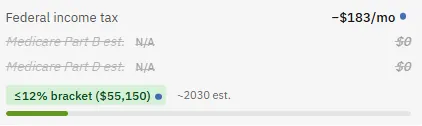
The planner can help you test a higher-tax case and a lower-tax case. For UK, Canadian and Australian residence it applies that country's income tax, with editable tax parameters; for other destinations it has no local tax field, so carry your estimate of local tax as extra withdrawals. A tax professional can then check which case is closer to the actual rules. For the wider side-by-side that sits around this tax work, see how to compare retiring in the US vs abroad.
Add Foreign Account Reporting To The Checklist
Moving abroad often means opening a local bank account. That may be practical for rent, utilities, debit card use, and emergency cash.
For US persons, FBAR reporting can apply when the aggregate value of foreign financial accounts exceeds the threshold at any time during the calendar year. FATCA Form 8938 can also apply to specified foreign financial assets when thresholds are met.
The planner is not a filing system for these forms. Still, the retirement plan should remind the household to track:
- Local checking accounts.
- Local savings accounts.
- Foreign brokerage accounts.
- Foreign pension or investment accounts.
- Maximum account values during the year.
- Currency conversion for reporting.
- Filing dates and professional review.
This is especially important when a retiree plans to hold a large local emergency reserve. The reserve may be helpful for healthcare and housing, but it can also create reporting work.
Include Currency Conversion
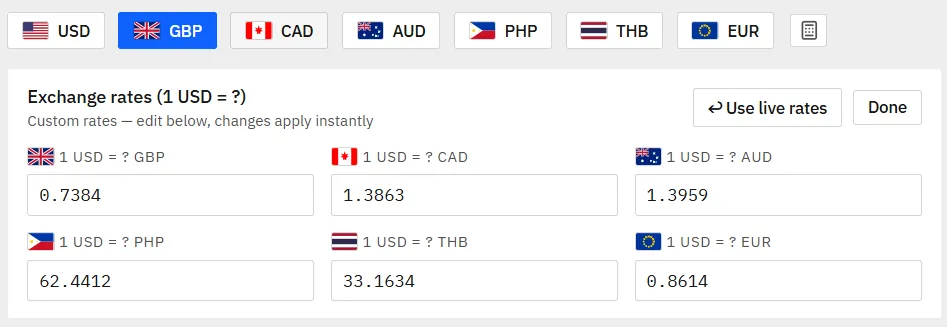
The IRS says US tax return amounts generally must be expressed in US dollars. If income or expenses are received or paid in foreign currency, those amounts may need to be translated into dollars.
A retirement plan should separate two uses of exchange rates:
- Cash-flow planning: what the household can spend in the local currency.
- Tax reporting: what must be converted into US dollars for filing and reporting.
They are related, but they are not the same planning question.
In the planner, build these as separate versions of the plan and compare them:
- Current-rate case.
- Weaker-dollar case.
- Stronger-dollar case.
- Higher local inflation case.
- Return-to-US case.
Build the weaker- and stronger-dollar cases by changing the dollar amounts of local spending and overseas healthcare, not only the exchange rate. The planner keeps every figure in US dollars and uses the rate to translate them, so a rate change on its own alters how the plan reads in local currency, not its taxes, balances or Plan Health. Custom rates are also not saved with a plan, so record the rate each version assumes in Plan notes.
Do not let one exchange-rate assumption carry the whole decision. Note too that leaving the US does not end state tax questions on its own, which state taxes in retirement covers, and that the income measure behind ACA and IRMAA thresholds is explained in what MAGI is.
Do Not Forget State Residency
A move abroad does not always end a state tax issue. Some retirees keep a home, family ties, voter registration, driver's license, business interest, rental property, or professional connection in a former state.
Before moving, model state tax as a separate assumption:
- Current state continues to tax some income.
- Current state connection is ended before the move.
- A different state becomes the US home base.
- Rental property remains in a former state.
- The retiree returns to the United States later.
This is a good example of a planning variable that belongs in scenario comparison. The actual answer belongs with a professional who understands the state involved.
Healthcare And Tax Planning Are Connected
Healthcare abroad also affects tax planning because the retirement income needed to pay for healthcare can change withdrawals, taxable income, foreign account balances, and currency needs.
Medicare coverage outside the United States is limited. If a retiree needs private international coverage, local healthcare spending, or a return-to-US healthcare plan, those costs can raise withdrawals from tax-deferred accounts.
Model:
- Local routine care.
- Private insurance premiums.
- Medical evacuation coverage.
- Higher-healthcare-cost years.
- Return-to-US healthcare costs.
- Long-term care.
Then review whether those costs create higher taxable withdrawals, larger brokerage sales, or new foreign-account reporting tasks.
Build Four Tax Scenarios Before Moving
At minimum, build four scenarios. The planner holds three in saved-plan slots, so export the fourth as a JSON file:
1. US Baseline
Keep the household in the United States. Model current federal tax, state tax, Medicare, Social Security, IRA withdrawals, Roth withdrawals, RMDs, and healthcare costs.
2. Foreign-Residence Base Case
Use the expected new country, planning currency, foreign-residence healthcare assumptions, Social Security abroad, retirement-account withdrawals, and your own estimate of local tax (outside the UK, Canadian and Australian residence settings, entered as extra withdrawals).
3. Higher-Tax Case
Increase local tax assumptions, reduce available foreign tax credits, add state-tax exposure if relevant, and let a weaker dollar raise the dollar cost of local spending. The planner applies state tax only to a US-resident plan, so in a foreign-residence version any continuing state tax is another amount to add as extra withdrawals.
4. Return-To-US Case
Move the household back to the United States later in retirement. Add US healthcare assumptions, housing transition costs, travel costs, and any state tax assumptions that apply. A plan keeps one residence from start to finish, so build this case as a US plan and read it from the age of the return.
If the move only works in the optimistic version, the plan needs more work.
How To Model This In The AI Retirement Income Planner
Use this workflow:
- Create the current US plan first.
- Save it as the baseline.
- Turn the current plan into the foreign-residence scenario, keeping the baseline in its slot.
- Select the currency for the destination. PHP, THB and EUR switch on foreign-residence mode; GBP, CAD and AUD offer a residence setting.
- Set US-taxpayer assumptions where relevant.
- Enter Social Security, pensions, IRA withdrawals, taxable-account income, Roth withdrawals, and lump sums separately.
- Enter the overseas healthcare cost.
- Choose the exchange rate you plan with, and record it in Plan notes.
- Use Plan notes for FBAR, Form 8938, treaty, state residency, and professional-review items.
- Save a higher-tax version, and build the return-to-US version as a separate US plan.
- Read the Stress test and Plan Health checks for each version.
- Compare Plan Confidence across scenarios.
Keep the scope clear. The planner is for modeling retirement income, taxes, healthcare, cash flow, and risk. It is not a substitute for country-specific filing guidance.
Example Scenario
A 62-year-old couple wants to move abroad at 65. They have:
- Social Security beginning at 67 and 70.
- A traditional IRA.
- A Roth IRA.
- A taxable brokerage account.
- A small pension.
- A former-state rental property.
- Planned local bank accounts abroad.
- Private overseas healthcare costs.
The base expat budget looks affordable. The tax-aware version asks harder questions:
- What happens if IRA withdrawals are taxed in both places?
- What if the former state still taxes rental income?
- What if local bank balances trigger reporting work?
- What if exchange rates raise the dollar cost of local spending?
- What if one spouse dies and the survivor has a different filing profile?
- What if the couple returns to the United States at age 78?
That is the value of modeling before moving. It turns one attractive lifestyle idea into a decision that can be stress tested.
FAQ
Do US retirees abroad still file US tax returns?
US citizens and resident aliens abroad are generally subject to US tax on worldwide income. Filing requirements depend on the person's facts, so the IRS and a qualified professional should be checked.
Does the foreign earned income exclusion apply to retirement income?
The IRS says foreign earned income does not include pension or annuity payments, including Social Security benefits. Retirees should separate work income from retirement income before relying on exclusion assumptions.
What is the foreign tax credit?
The foreign tax credit can apply when qualifying foreign income taxes are paid or accrued and the same income is subject to US tax. It is complex and should be reviewed by a qualified tax professional.
What tax forms should expat retirees ask about?
Common discussion items include Form 1040, Form 1116, Form 2555 if earned income applies, FBAR, Form 8938, and any country-specific filings. The correct list depends on the facts.
Can the planner calculate every expat tax rule?
No. The planner can help model scenarios, currencies, income streams, healthcare costs, and tax assumptions. It is not a country-specific tax filing engine.
Source Links
- IRS US citizens and resident aliens abroad: https://www.irs.gov/individuals/international-taxpayers/us-citizens-and-resident-aliens-abroad
- IRS foreign earned income exclusion: https://www.irs.gov/individuals/international-taxpayers/foreign-earned-income-exclusion
- IRS foreign tax credit: https://www.irs.gov/individuals/international-taxpayers/foreign-tax-credit
- IRS FBAR information: https://www.irs.gov/businesses/small-businesses-self-employed/report-of-foreign-bank-and-financial-accounts-fbar
- IRS FATCA reporting summary for US taxpayers: https://www.irs.gov/businesses/corporations/summary-of-fatca-reporting-for-us-taxpayers
- IRS foreign currency and exchange rates: https://www.irs.gov/individuals/international-taxpayers/foreign-currency-and-currency-exchange-rates
- SSA payments outside the United States: https://www.ssa.gov/international/payments.html
- Medicare travel outside the United States: https://www.medicare.gov/coverage/travel-outside-the-u.s.
- AI Retirement Income Planner: https://airetirementincomeplanner.com/
Educational Disclaimer
This article is for general education only. It is not financial, tax, investment, legal, immigration, visa, privacy, cybersecurity, healthcare, insurance, Social Security, Medicare, estate, AI safety, software, or retirement advice. Confirm US, state, foreign, treaty, account-reporting, healthcare, residency, and currency details with official sources and qualified professionals.