
Quick Answer
Retirement income planning is the work of turning what you have saved into a monthly income that survives taxes, healthcare costs, inflation, and a long life.
That is the whole definition. Everything else is detail about how.
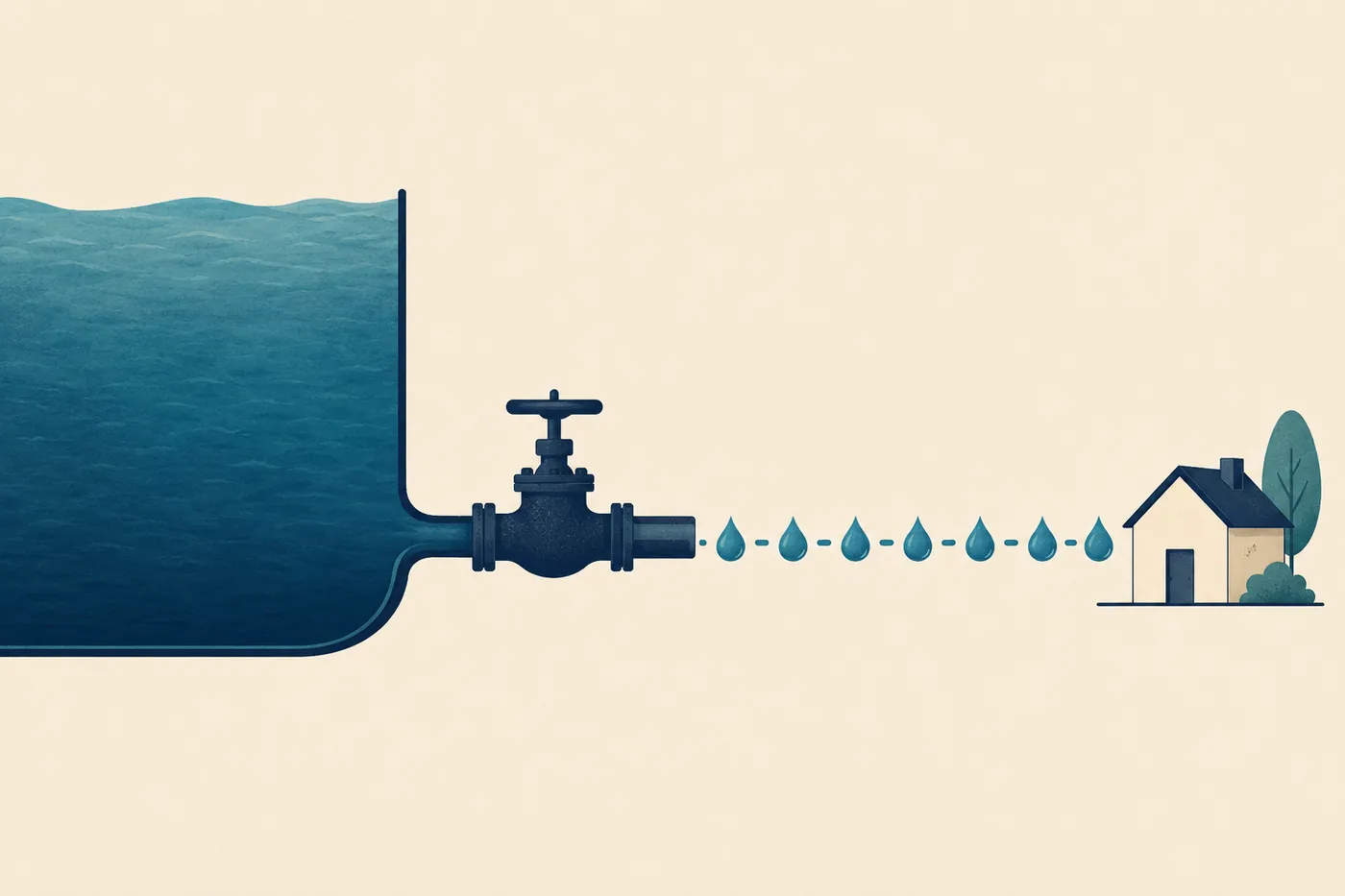
It is a different job from the one most people have been doing for thirty years. Saving for retirement asks how big is the pile? Retirement income planning asks what does the pile pay me, after everything takes its share, for as long as I need it to? The first is a number. The second is a schedule.
Key Takeaways
- Saving is about accumulation; income planning is about decumulation — the harder half, and the one with no do-over.
- A retirement income plan answers four questions: how much can you spend, where each dollar comes from, what it costs you in tax and healthcare, and what happens if things go badly.
- The output is not a single number. It is a schedule that changes shape as Social Security, Medicare, and required withdrawals arrive.
- It usually starts around five to ten years before you stop working, because the most valuable moves need that runway.
- It is never finished. A plan built once and filed away stops describing your life within a year or two.
Why It Is a Different Job From Saving
During your working life, the mechanics are simple and forgiving. You contribute, the market does what it does, and time absorbs your mistakes. A bad year at 40 is repaired by the twenty-five that follow it.
Retirement inverts every one of those properties:
- Contributions stop and withdrawals start. The portfolio no longer heals itself with new money.
- Sequence begins to matter. Two retirements with identical average returns can end very differently depending on when the bad years land, because withdrawals during a downturn sell more shares to raise the same cash.
- Taxes become a live decision rather than a deduction. Which account you draw from changes what you owe, every single year.
- Healthcare becomes a variable cost driven by your own income — ACA subsidies before 65, Medicare premiums and surcharges after.
- There is no do-over. You cannot work another five years to fix a plan discovered to be wrong at 78.
That last point is the real reason income planning exists as a separate discipline. The consequences of getting it wrong arrive slowly, late, and irreversibly.
The Four Questions a Retirement Income Plan Answers
1. How much can you actually spend?
Not what you have — what you can draw, monthly, without running out. This is the headline number, and it is the one most likely to be wrong when it comes from a savings calculator, because gross withdrawals are not spendable income. How much you can spend is a question about net, after everything below.
2. Where does each dollar come from?
Retirement income is rarely one stream. It is usually several, starting and stopping at different ages: part-time work, a pension, taxable brokerage, traditional accounts, Roth accounts, Social Security, sometimes a lump sum from a property. Which account funds a given year is a decision with consequences — see which account to withdraw from first.
3. What does it cost to receive it?
Every dollar drawn passes through three tolls before it becomes spendable: federal tax, state tax, and healthcare. Those tolls are not fixed percentages — they respond to how much you draw and from where, which is what makes taxes, ACA subsidies and healthcare a planning problem rather than an accounting one.
4. What happens if it goes badly?
A plan that works only on average is not a plan. The useful version has been tested against poor early returns, higher inflation, one spouse dying earlier than expected, and a long life — because the way plans actually fail is a combination of ordinary disappointments rather than one catastrophe.
Why the Answer Is a Schedule, Not a Number
The single most common misconception is that a retirement income plan produces one figure — a safe withdrawal rate, a monthly amount — that applies for thirty years.
It cannot, because retirement income does not have one shape. It has phases, and the transitions between them are large:
- Before Social Security, the portfolio does all the work, income is usually at its highest draw, and ACA subsidies are in play if you are under 65.
- At 65, Medicare replaces private insurance, and the healthcare cost line changes character entirely.
- When Social Security starts, a large, inflation-linked, partly-taxable stream switches on and the portfolio's job shrinks.
- At the RMD age, withdrawals stop being optional, which can push income up in exactly the years you wanted it low.
- In survivor years, one Social Security payment stops and the survivor usually files single — the same income, taxed harder.
A plan that does not change shape across those boundaries is describing someone else's retirement. This is why the planning is done in phases rather than as a single average.
When Does It Start?
Earlier than most people expect, and for a specific reason: the most valuable moves need runway.
Roth conversions, for example, are usually best in the low-income window between stopping work and starting Social Security — a window that has already closed by the time most people go looking for it. The same goes for managing income under an ACA subsidy cliff, or deciding when to claim Social Security, or arranging which accounts hold which assets.
Five to ten years before you stop working is a reasonable point to start. If you are already retired, the answer is now, because the phases ahead of you still have decisions in them.
What a Plan Actually Looks Like
A retirement income plan, done properly, is a small set of concrete things:
- A month-by-month projection of income, from now until a deliberately long age.
- A statement of where each year's income comes from, account by account.
- The tax and healthcare cost of that specific pattern, rather than a flat assumption.
- A set of tested alternatives — spend a little more, retire a year earlier, claim Social Security later — so the trade-offs are visible instead of theoretical.
- A stress test, showing what the plan does when the first five years disappoint.
- A date to look at it again.
Notice what is not on that list: predictions about the market, a single magic percentage, and any claim to certainty. A good plan is a decision-making instrument, not a forecast.
Who Does It
Three broad routes, and all three are legitimate:
- An adviser builds and maintains the plan for you. The cost is a fee, usually recurring; the benefit is that someone else carries the work and, sometimes, the discipline.
- A spreadsheet is free and completely transparent. The cost is your time, and the risk that a formula error nobody catches quietly shapes a thirty-year decision.
- Planning software sits between them: it does the arithmetic, you keep the decisions. The relevant question is whether the software models the things that actually decide the outcome — taxes and healthcare — or only the balance.
There is no correct choice among these. There is a wrong one, which is doing none of them and treating a savings balance as an income plan.
The Part Nobody Says Out Loud
Retirement income planning is not primarily a math problem. The math is the easy half, and it has been solved for decades.
The hard half is that the plan has to be yours — you have to understand it well enough to change it when your life changes, and to hold your nerve when a bad year arrives and every instinct says to cut everything. A plan you cannot question is a plan you will abandon at the worst possible moment.
That is why the useful thing to have at the end of this work is not a document. It is a model you can ask questions of: what if I spend more, what if I retire a year earlier, what if this goes wrong. If you want the procedure rather than the definition, how to set up a retirement income plan walks through it step by step.
FAQ
Is retirement income planning the same as retirement planning?
Not quite. "Retirement planning" usually covers the whole arc, including the saving years. Retirement income planning is specifically the second half: converting the accumulated money into a durable income. The two need different tools, and a calculator built for the first is usually a poor fit for the second.
What is decumulation?
The technical name for the same idea — the phase where you draw down what you built up. It is used mostly by professionals, and it exists because the mechanics really are different enough to deserve their own word.
Do I need a financial adviser to do this?
No, but you do need a method. The arithmetic is genuinely involved — taxes interacting with healthcare thresholds interacting with withdrawal order across thirty years — so doing it by intuition does not work. An adviser, a carefully built spreadsheet, or planning software are all ways of supplying the method.
How often should a retirement income plan be updated?
At least annually, and immediately after anything that changes the picture: a market move large enough to matter, a health change, a move to another state, a change in tax law, or the death of a spouse. Plans go stale quietly, which is why an annual review earns its place.
Is a retirement income plan just a safe withdrawal rate?
No. A withdrawal rate is one simplifying rule of thumb, useful for a sanity check and not much else. It assumes a steady draw from an undifferentiated pot, which is precisely what a real retirement is not — the pot has tax characteristics, and the draw changes shape at Social Security, Medicare, and RMD boundaries.
Educational Disclaimer
This article is for general education only. It is not financial, tax, investment, legal, Social Security, Medicare, estate, or retirement advice. It describes a planning discipline in general terms and is not specific to your circumstances. Tax rules, healthcare rules, and thresholds change. Confirm current details and decisions with qualified professionals before acting.