
Short Answer
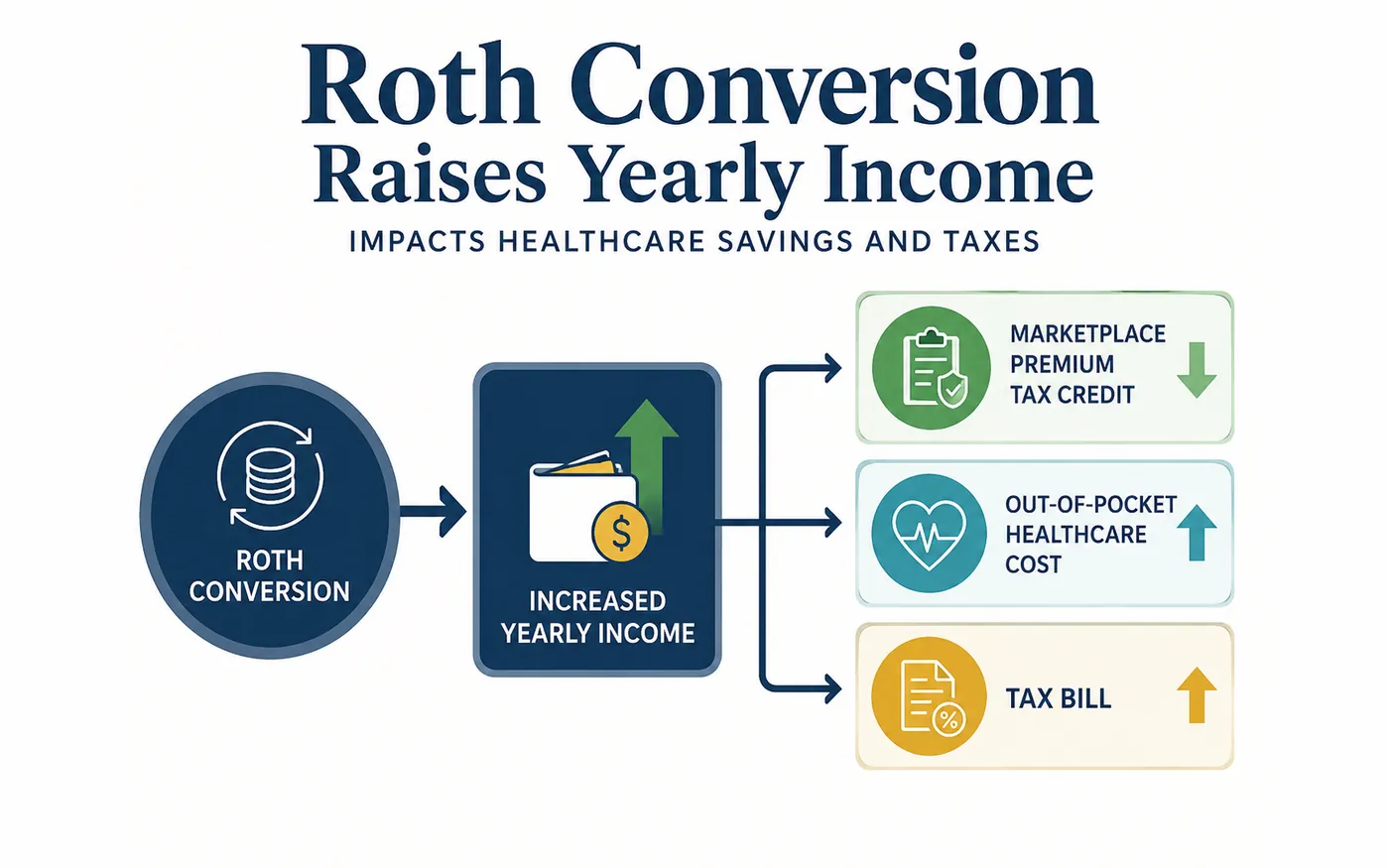
Yes. A Roth conversion can affect ACA subsidies because it can raise household income for the year.
HealthCare.gov says Marketplace savings are based on your income estimate for the year you want coverage, not last year's income. The measure it uses is MAGI, and there is more than one definition of it: the Marketplace version is not the one Medicare applies later. HealthCare.gov also says retirees may qualify for premium tax credits and lower out-of-pocket costs based on income and household size.
If you retire before Medicare and use Marketplace coverage, a Roth conversion may reduce your premium tax credit or other savings.
That does not mean Roth conversions are bad before Medicare. It means they need to be modeled with healthcare costs, not only tax brackets.
Why Roth Conversions Matter For Early Retirees
Many early retirees have a window between leaving work and starting Medicare.
HealthCare.gov says if you retire before age 65 and lose job-based health coverage, you can use the Health Insurance Marketplace to buy a plan. The tier worth protecting is the Silver cost-sharing band, covered in the Silver ACA plan advantage before 65. Losing job-based coverage can qualify you for a Special Enrollment Period.
That bridge period often creates lower-income years. Lower-income years can look attractive for Roth conversions because wages may be gone and Social Security may not have started yet.
But those same years may also be ACA Marketplace years.
So the conversion question becomes:
Is the tax benefit of converting worth the possible healthcare cost change?
How A Roth Conversion Changes Income
A Roth conversion moves money from a pre-tax retirement account into a Roth account. The wider case for doing it before required distributions start is in Roth conversions before RMDs.
The IRS says rollovers generally let taxpayers move retirement savings from one plan or IRA to another, and if the money is not rolled over, the payment is generally taxable except for qualified Roth distributions and already-taxed amounts.
When you convert pre-tax money to Roth, the converted amount usually adds taxable income for the year.
That income may affect:
- Federal tax
- State tax
- Marketplace premium tax credits
- Cost-sharing reductions
- Future RMDs
- Future Medicare IRMAA
- Social Security taxation later
That is why Roth conversion planning before Medicare is a tax and healthcare decision.
Marketplace Savings Are Based On Estimated Income
HealthCare.gov says you can start with adjusted gross income and update it for expected changes when estimating household income for Marketplace coverage. It also says savings are based on your income estimate for the year you want coverage.
That matters because retirees often have income that can be controlled or timed:
- IRA withdrawals
- 401k withdrawals
- Roth conversions
- Capital gains
- Part-time work
- Pension start date
- Social Security claiming age
HealthCare.gov also says IRA or 401k withdrawals generally count as income.
If a conversion changes the income estimate, it may change healthcare savings.
Two lines matter most. Silver cost-sharing reductions stop at 250% of the federal poverty level. For 2026 coverage, the premium tax credit stops entirely at 400%, because the larger credits that had removed that cliff expired at the end of 2025. A conversion that carries income over either line can cost far more than its tax.
The Common Mistake: Converting Without Checking The Subsidy
The common mistake is looking only at tax brackets.
Example:
A retiree says, "I have room in a lower tax bracket, so I should convert more this year."
That might be true.
But if that retiree is also using Marketplace coverage, the better question is:
What happens to the tax bill and the healthcare cost together?
A conversion can still be worth doing. But a $20,000 conversion, $40,000 conversion, and $80,000 conversion may produce very different healthcare results.
A Roth Conversion And ACA Subsidy Example
Suppose a couple retires at 62 and needs Marketplace coverage until Medicare at 65.
They have:
- Cash savings
- Taxable brokerage
- Traditional IRA
- Roth IRA
- Social Security planned at 67
- No pension
They want to convert traditional IRA money to Roth from age 62 to 64.
They compare:
- No conversion
- $15,000 annual conversion
- $30,000 annual conversion
- $60,000 annual conversion
The $60,000 conversion may reduce future RMDs more than the smaller conversion. It may also increase current taxes and reduce Marketplace savings.
The best answer is the one that improves the whole plan, not the one that maximizes the conversion amount.
Roth Conversions Before Medicare Can Still Make Sense
It is easy to overcorrect and say, "Never do Roth conversions before Medicare."
That is too simple.
Roth conversions before Medicare may still help if:
- Future RMDs look large.
- The household has a large traditional IRA.
- The retiree wants tax diversification.
- The conversion helps survivor planning.
- Future tax rates are a concern.
- Cash is available to pay conversion taxes.
- Marketplace cost changes are acceptable.
The point is to compare the full tradeoff.
When To Be Careful
Be extra careful if:
- You rely heavily on premium tax credits.
- You qualify for cost-sharing reductions.
- Your income is near 250% or 400% of the federal poverty level.
- You are doing a large one-year conversion.
- You also have capital gains that year.
- You have part-time work income.
- You plan to claim Social Security before Medicare.
- You are close to Medicare and may later face IRMAA planning issues.
The conversion may still be reasonable, but it should not be a surprise.
When To Convert: Before 65, Or After Medicare Starts
Roth conversions do not have to be the same amount every year.
You might compare:
- No conversion in ACA years, then conversions after Medicare starts
- Smaller conversions during ACA years
- Larger conversions only in a year with lower healthcare cost exposure
- Conversions before retirement while still on employer coverage
- Conversions after Medicare starts but before RMDs
- Conversions spread over several years
Each version changes taxes, healthcare, future RMDs, and account balances.
How To Model A Roth Conversion Against ACA Subsidies
Use this workflow in the AI Retirement Income Planner:
- Enter your retirement age. The planner starts Medicare at 65, or at the earlier age you set under Income streams if you are on SSDI.
- Check the ACA figures in the Tax parameters card on Edit values. The planner estimates your Marketplace premium from your income, using those poverty-level thresholds and premium caps, so there is no premium to type in.
- Enter account balances by tax type: cash, taxable, Roth, and tax-deferred.
- Enter Social Security claiming ages and pension income if any.
- Build a baseline with no Roth conversion.
- Use What-if? to test conversion sizes for a pre-Medicare phase. Its chart shows the extra tax at each size and marks where a conversion would cross the ACA subsidy cliff.
- Read the pre-Medicare phase cards. Each shows whether the plan stays eligible for the premium tax credit and for Silver cost-sharing reductions.
- On the Tax & ACA tab, "Where your plan sits on the cliffs" charts your income against the subsidy cliff.
- Enter the size you like in that phase's Roth conversion field, save the plan, and use Saved plans to compare it with the baseline.
- Review Balance to see future pre-tax and Roth balances.
- Check the years after RMDs start (at 73, or 75 if you were born in 1960 or later) for RMD pressure.
- Open Plan Health for the ACA Subsidy Protected and CSR / Subsidy Headroom checks.
- Review Confidence and ending balances.
The planner's job is not to decide the conversion for you. Its job is to make the tradeoff visible.
Questions To Ask Before Converting During ACA Years
- Am I using Marketplace coverage this year?
- What household income estimate did I use?
- Will IRA or 401k withdrawals count as income?
- How much income will the conversion add?
- Will I also have capital gains?
- Will I have part-time work income?
- Will I claim Social Security before Medicare?
- How much tax will the conversion create?
- How much healthcare savings might change?
- Will the conversion reduce future RMD pressure?
- Does the conversion improve survivor planning?
- Do I have cash to pay the tax?
- Should I convert less this year and more later?
FAQ
Can a Roth conversion affect ACA premium tax credits?
Yes. A Roth conversion can increase household income for the year, and HealthCare.gov says Marketplace savings are based on income and household size.
Do IRA or 401k withdrawals count as income for Marketplace coverage?
HealthCare.gov says generally yes. Roth conversions from pre-tax retirement accounts can also add income because the converted amount is usually taxable.
Should I avoid Roth conversions while on Marketplace coverage?
Not automatically. Some retirees may still benefit from smaller conversions or carefully timed conversions. The tax and healthcare effects should be modeled together.
Is the ACA subsidy based on last year's income?
HealthCare.gov says Marketplace savings are based on your income estimate for the year you want coverage, not last year's income.
Can Roth conversions help later RMDs?
They can. Moving money from a pre-tax account to a Roth account may reduce future pre-tax balances and future RMD pressure, but the conversion can create current tax and healthcare cost effects.
Should I ask a tax professional before converting?
Yes. Roth conversions during ACA years can affect taxes and healthcare costs. A tax professional can help check the current rules and reporting details.
Sources
- HealthCare.gov, Health Coverage For Retirees: https://www.healthcare.gov/retirees/
- HealthCare.gov, Saving Money On Health Insurance: https://www.healthcare.gov/lower-costs/
- IRS, Rollovers Of Retirement Plan And IRA Distributions: https://www.irs.gov/retirement-plans/plan-participant-employee/rollovers-of-retirement-plan-and-ira-distributions
- IRS, Topic No. 451, Individual Retirement Arrangements: https://www.irs.gov/taxtopics/tc451
Educational Disclaimer
This article is for general education only. It is not financial, tax, investment, legal, healthcare, insurance, Social Security, Medicare, estate, or retirement advice. Tax rules, benefit rules, healthcare costs and thresholds change over time, and any projection depends on assumptions that may not hold. Screenshots show a sample plan with invented figures and are illustrative only. Verify important figures with official sources such as IRS.gov, SSA.gov, Medicare.gov and HealthCare.gov, and confirm decisions with a qualified professional before acting.