
Quick Answer
AI retirement advice needs verified numbers because retirement planning is sensitive to exact facts.
A useful retirement plan depends on:
- Ages.
- Filing status.
- Account balances.
- Account types.
- Spending needs.
- Social Security timing.
- Pension details.
- Healthcare costs.
- Roth conversion amounts.
- RMD timing.
- Tax brackets.
- State taxes.
- Inflation.
- Investment assumptions.
- Survivor income.
- One-time expenses.
If those numbers are wrong, the AI explanation can still sound polished, but the plan may be wrong.
The safer workflow is:
- Verify the inputs.
- Run the calculator.
- Compare scenarios.
- Ask AI to explain the calculated result.
- Check rules through official sources.
- Review and approve any change yourself.

Key Takeaways
- AI can explain retirement planning, but it does not make unverified inputs reliable.
- OpenAI's ChatGPT FAQ says outputs may be inaccurate, untruthful, or otherwise misleading at times.
- Investor.gov warns that AI-related hype and unrealistic claims can be used to lure investors.
- NIST's AI Risk Management Framework is designed to help manage risks from AI systems.
- Retirement planning can change materially when one number changes.
- Verified numbers should come before AI explanations.
- The AI Retirement Income Planner uses calculator-backed outputs, Plan Health, scenarios, and user-approved AI proposals to keep AI connected to the plan.
Why Exact Numbers Matter
Retirement planning is not one big question. It is a chain of connected calculations.
One number can affect many other numbers.
For example:
- A Roth conversion can raise taxable income.
- Higher taxable income can affect ACA costs before Medicare.
- Higher income can affect Medicare IRMAA later.
- Social Security timing can affect early withdrawals.
- Early withdrawals can affect balances.
- Balances can affect RMDs.
- RMDs can affect taxes.
- Taxes can affect spendable income.
- Survivor income can change when one Social Security benefit stops.
That chain is why "Can I retire?" is not a safe AI-only question.
The useful question is more specific:
What happens to taxes, healthcare, Social Security, balances, and survivor income if I change this one assumption?
That question needs verified numbers and a calculator.
AI Can Explain Bad Inputs Too Well
AI is good at language.
That is helpful when the output is grounded in correct numbers. It is risky when the inputs are wrong.
If a user gives AI the wrong Social Security amount, wrong tax filing status, wrong healthcare cost, or wrong account balance, AI may still produce a confident explanation, the same limitation covered in whether ChatGPT can help with retirement planning.
The answer may sound reasonable because the writing is clear.
But clear writing is not proof.
This is the core risk:
AI can make an unverified scenario easier to believe.
That does not mean AI is useless. It means AI should explain calculated results, not replace the verification step, which is why AI needs a retirement calculator underneath the explanation.
Numbers That Need Verification
Before asking AI to explain a plan, verify the major inputs.
Important numbers include:
- Current age and spouse age.
- Retirement start age.
- Life expectancy or plan end age.
- Monthly spending.
- Housing cost.
- Healthcare cost.
- Account balances.
- Cash reserve.
- Taxable brokerage balance.
- Roth balance.
- Traditional IRA or 401(k) balance.
- Pension income.
- Social Security estimate.
- Social Security claim age.
- Inflation assumption.
- Investment return assumption.
- Tax filing status.
- State tax assumption.
- Roth conversion amount.
- RMD start age.
- One-time expenses.
- Expected inheritance, downsizing, or windfall.
The point is not to make the plan perfect. The point is to avoid building a confident story on shaky facts.

Official Sources Still Matter
Some retirement planning numbers should be checked against official sources.
Examples:
- Social Security estimates and rules through SSA.
- Medicare premiums and rules through Medicare.gov.
- ACA Marketplace rules through HealthCare.gov or a state Marketplace.
- Federal tax rules through IRS.
- State tax rules through state revenue agencies.
- RMD rules through IRS.
- Foreign tax, currency, or residency rules through official country sources where relevant.
AI may help explain what a rule means, but it should not be the source of record.
OpenAI's ChatGPT FAQ says outputs may be inaccurate, untruthful, or otherwise misleading at times. It also says ChatGPT can occasionally produce incorrect answers and make up facts.
For retirement planning, that matters because a wrong rule can change the whole answer.
Investor Hype Is A Separate Risk
Verified numbers also protect users from hype.
Investor.gov warns that bad actors use the popularity and complexity of AI to lure victims into scams. It also warns investors to be wary of AI-related claims that sound too good to be true.
This matters for retirement planners because AI language can make a weak claim sound modern or sophisticated.
Be careful with any tool, person, or promotion that says AI can:
- Remove retirement risk.
- Pick winning investments.
- Replace verification.
- Eliminate taxes through a simple trick.
- Solve Social Security timing without household facts.
- Produce a retirement plan without assumptions.
- Skip professional review for high-stakes issues.
A serious retirement plan should welcome questions about inputs, assumptions, and sources.
Verified Numbers Create Better AI Prompts
AI prompts improve when they include verified planner output.
Weak prompt:
text
Should I convert to Roth?
Better prompt:
text
I am using AI for education and scenario review only.
My planner tested a $20,000 annual Roth conversion from age 62 to 64.
It increased current taxes, changed MAGI, and reduced later tax-deferred balances.
Explain what changed and list assumptions I should verify.
Do not choose for me.
The second prompt gives AI a calculated result to explain.
It also keeps the user in control.
Example: Social Security Timing
Social Security timing is a good example of why verified numbers matter.
A vague AI prompt might ask:
text
Should I claim Social Security at 62 or 70?
That prompt is missing:
- Benefit amount at each age.
- Spouse benefit.
- Survivor benefit.
- Portfolio withdrawals before claiming.
- Tax filing status.
- Longevity assumption.
- Healthcare costs.
- Pension income.
- Cash reserve.
- Household spending.
A safer workflow is:
- Get Social Security estimates.
- Enter the claim-age assumptions into the planner.
- Compare the scenarios.
- Review monthly income, taxes, balances, and survivor results.
- Ask AI to explain what changed.
AI can summarize the tradeoff. The planner supplies the math.
Example: Roth Conversions
Roth conversions can look simple in conversation and complex in numbers.
A conversion can affect:
- Current-year tax.
- MAGI.
- ACA exposure.
- Medicare IRMAA.
- RMD pressure.
- Roth balance.
- Tax-deferred balance.
- Cash used to pay tax.
- Survivor tax exposure.
If AI does not have verified numbers, it may talk about Roth conversions in general.
That is not enough.
The useful question is:
What does this conversion amount do inside this household plan?
That requires calculator output.
Example: Healthcare Before Medicare
Early retirement before Medicare is another area where verified numbers matter.
A person retiring at 62 may need to model:
- ACA Marketplace coverage.
- COBRA.
- Spouse employer coverage.
- Private insurance.
- MAGI.
- Roth conversions.
- Capital gains.
- Cash withdrawals.
- Social Security timing.
- State rules.
AI can explain the categories, but the plan depends on numbers.
If the healthcare assumption is too low, the whole early-retirement scenario may look easier than it is.
What "Verified" Means In Practice
Verified does not mean perfect.
It means the input has a source and a reason.
Examples:
- Social Security estimate from an SSA statement.
- Medicare premium from Medicare.gov.
- Tax assumption from IRS or planner tax-rate lookup.
- Spending estimate from actual household expenses.
- Account balance from a current statement.
- Healthcare estimate from a Marketplace or insurer quote.
- Pension amount from a benefit statement.
- Exchange rate assumption from a stated date and source.
- Survivor spending assumption documented in notes.
If an input is a guess, label it as a guess.
Then test a low, base, and high version.
How The AI Retirement Income Planner Helps
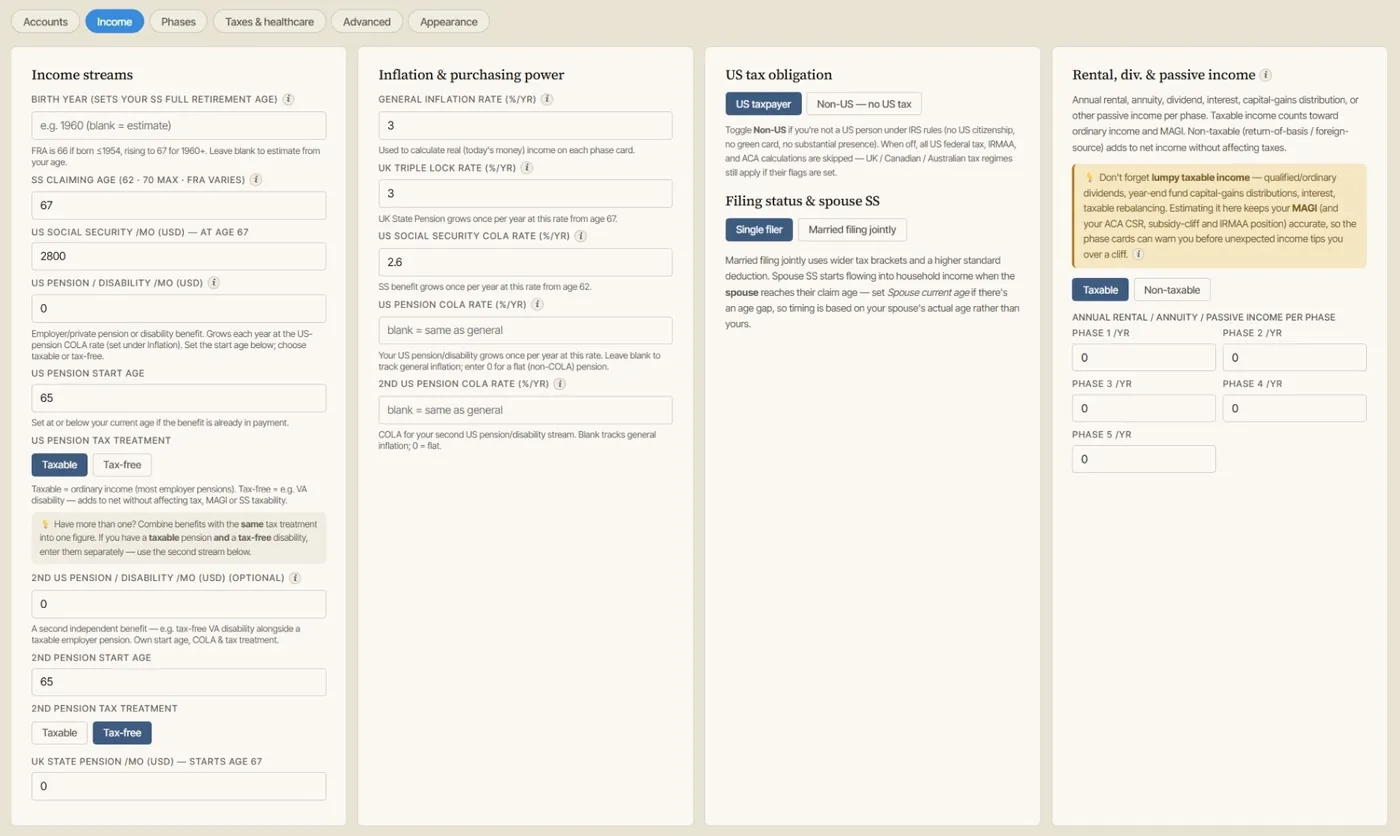
The AI Retirement Income Planner is designed around calculator-backed planning.
The deterministic planning engine can model:
- Income.
- Withdrawals.
- Taxes.
- Healthcare.
- Social Security.
- Pensions.
- Account balances.
- Roth conversions.
- RMD estimates.
- Scenarios.
- Stress tests.
- Monte Carlo.
- Historical backtesting.
- Survivor planning.
The optional AI features, including the Plan with AI sidebar, can then help explain the result.
Useful features include:
- AI Chat for plan questions.
- Plan review.
- Learn-the-planner mode.
- Plan with AI sidebar.
- User-approved AI proposals.
- Plan Health checks.
- Plan Confidence score.
- What-if tools.
- Scenario comparison.
- Report preview and notes.
This structure matters because AI does not have to invent the plan. It can explain the plan the calculator produced.
A Verification Workflow
Use this workflow before relying on an AI explanation:
- Gather current financial facts.
- Label guesses separately from verified inputs.
- Enter the numbers into the planner.
- Save the base scenario.
- Run Plan Health.
- Compare one scenario at a time.
- Ask AI to explain the calculated difference.
- Check official sources for rule-based claims.
- Review high-stakes decisions with qualified professionals.
- Save notes and export the plan.
That workflow keeps AI useful and bounded, and it is the same habit behind how to use AI safely for retirement planning.
FAQ
Why does AI retirement advice need verified numbers?
Because retirement planning is sensitive to exact inputs. Taxes, healthcare, Social Security, withdrawals, Roth conversions, RMDs, account balances, and survivor income can all change when one number changes.
Can AI explain a retirement plan without exact numbers?
AI can explain general concepts without exact numbers, but it cannot reliably evaluate a household plan without verified inputs and calculator output.
What numbers should I verify first?
Start with account balances, spending, Social Security estimates, healthcare costs, tax filing status, retirement age, pension income, Roth conversion assumptions, and major one-time expenses.
What official sources should I use?
Use SSA for Social Security, IRS for tax and RMD rules, Medicare.gov for Medicare, HealthCare.gov or state Marketplaces for ACA, and state revenue agencies for state tax assumptions.
How should AI be used after numbers are verified?
Use AI to explain Plan Health items, summarize scenario differences, list assumptions to verify, and prepare questions for professionals.
How does the AI Retirement Income Planner help?
It calculates the plan first, then optional AI features can explain the result, support scenario review, and propose user-approved changes.
Source Links
- OpenAI, ChatGPT General FAQ: https://help.openai.com/en/articles/6783457-chatgpt-general-faq
- Investor.gov, Artificial Intelligence and Investment Fraud: https://www.investor.gov/introduction-investing/general-resources/news-alerts/alerts-bulletins/investor-alerts/artificial-intelligence-fraud
- NIST, AI Risk Management Framework: https://www.nist.gov/itl/ai-risk-management-framework
- AI Retirement Income Planner official site: https://airetirementincomeplanner.com/
- AI-Ready Retirement Income Planner product overview: https://webnomad.webflow.io/pages/ai-ready-retirement-income-planner
- Local capability audit used for product scope:
15-Planner-Capabilities-Audit.md
Educational Disclaimer
This article is for general education only. It is not financial, tax, investment, legal, healthcare, insurance, privacy, cybersecurity, Social Security, Medicare, estate, AI safety, software, or retirement advice. AI output and planner projections depend on inputs and assumptions, and real-world outcomes can differ.