
Short Answer
Yes, ChatGPT can help with retirement planning, but only in the right role.
ChatGPT can help you:
- Understand retirement planning concepts.
- Turn a vague concern into a checklist.
- Prepare questions for a tax, insurance, or financial professional.
- Compare the tradeoffs in different scenarios.
- Draft notes about a retirement plan.
- Learn how to use a retirement planning tool.
- Think of what-if scenarios to test.
ChatGPT should not be the final authority on:
- Social Security claiming.
- Roth conversion amounts.
- Medicare or ACA choices.
- Tax calculations.
- Investment allocation.
- Withdrawal order.
- Annuity purchases.
- Whether you can retire.
The safest workflow is to use ChatGPT for explanation and organization, then run the numbers in a real retirement planner and verify rules through official sources.

Key Takeaways
- ChatGPT can be useful for learning, checklists, summaries, prompts, and scenario ideas.
- ChatGPT should not replace calculator math, official sources, or professional review.
- OpenAI's ChatGPT FAQ says outputs may be inaccurate, untruthful, or misleading at times.
- OpenAI's data controls explain how users can manage whether conversations help improve models.
- Investor.gov warns that AI-generated information can be inaccurate, incomplete, misleading, faulty, or made up.
- Retirement planning needs verified numbers for taxes, healthcare, Social Security, withdrawals, and risk.
- The AI Retirement Income Planner uses optional AI assistance beside a structured retirement model, with user-approved proposals.
What ChatGPT Is Good At In Retirement Planning
ChatGPT is strongest when the task is language-heavy.
That includes:
- Explaining terms.
- Summarizing tradeoffs.
- Listing missing inputs.
- Creating checklists.
- Rewriting notes in plain English.
- Drafting questions.
- Helping compare scenarios after the numbers are calculated.
This can be useful because retirement planning has a lot of vocabulary.
For example:
- RMD.
- IRMAA.
- MAGI.
- ACA subsidy.
- Roth conversion.
- Sequence-of-returns risk.
- Provisional income.
- Medicare Part B.
- Cost-sharing reduction.
- Drawdown strategy.
Many people get stuck before they even reach the calculator.
ChatGPT can help them get unstuck.
What ChatGPT Is Weak At
ChatGPT is not a retirement calculator by itself.
OpenAI's ChatGPT FAQ says ChatGPT can produce outputs that are inaccurate, untruthful, or otherwise misleading at times. It also says ChatGPT can make up facts.
That matters in retirement planning.
A confident AI answer can still be wrong about:
- Current tax rules.
- Social Security details.
- Medicare premiums.
- ACA income rules.
- State taxes.
- RMD timing.
- Roth conversion effects.
- Portfolio returns.
- Healthcare costs.
- Product features.
- Personal facts.
Retirement planning also requires precise inputs.
If ChatGPT does not know your account balances, filing status, spouse age, tax details, healthcare costs, Social Security estimates, and withdrawal assumptions, it cannot calculate your plan.
Even if you provide those details, the result should still be verified.
Why Retirement Planning Needs More Than AI Text
Retirement planning is a connected system.
Consider one common question:
"Should I do Roth conversions before Social Security and RMDs?"
A useful answer has to look at:
- Current tax bracket.
- Future tax brackets.
- Traditional IRA balance.
- Roth balance.
- Cash available to pay taxes.
- RMD age.
- Medicare IRMAA risk.
- ACA Marketplace income if before Medicare.
- Social Security timing.
- Survivor tax risk.
- State tax.
- Investment returns.
- Spending needs.
ChatGPT can explain the checklist.
A retirement planner should calculate the scenario, which is why AI needs a retirement calculator underneath it.
That difference matters.
Better Ways To Use ChatGPT
Use It To Explain A Concept
Good prompt:
"Explain IRMAA in plain English for someone planning retirement. Include why Roth conversions and RMDs can matter. Keep it educational and general."
Useful output:
- Definition.
- Why income matters.
- What to verify.
- What to model.
Use It To Build An Input Checklist
Good prompt:
"I want to retire at 62 before Medicare. What inputs should I gather before modeling healthcare, Social Security, taxes, and withdrawals?"
Useful output:
- Account balances.
- Social Security estimates.
- Healthcare premiums.
- Taxable income sources.
- COBRA or Marketplace quotes.
- Roth conversion assumptions.
- Cash reserve.
Use It To Compare Tradeoffs
Good prompt:
"Compare the tradeoffs between using cash versus IRA withdrawals during ACA years before Medicare. Keep the answer educational."
Useful output:
- Cash may keep taxable income lower.
- IRA withdrawals may raise income.
- Preserving IRA balances can affect future RMDs.
- Roth conversions may interact with ACA income.
Use It To Draft Professional Questions
Good prompt:
"Based on a plan with Roth conversions before Medicare, list questions I should ask a tax professional."
Useful output:
- What income counts?
- Which year matters?
- How will conversions affect ACA income?
- Could future IRMAA apply?
- How should estimated taxes be handled?
Use It To Summarize Planner Results
Good prompt:
"Here are the results from my retirement planner. Summarize the differences between Scenario A and Scenario B, and list assumptions I should verify."
Useful output:
- Scenario summary.
- Weak points.
- Missing assumptions.
- Next scenarios to test.

Risky Ways To Use ChatGPT
Avoid prompts like:
- "Tell me exactly when I should retire."
- "How much should I convert to Roth this year?"
- "Which fund should I buy?"
- "Should I claim Social Security at 62?"
- "Can I afford to retire?"
- "Which Medicare plan should I choose?"
- "How much can I safely withdraw forever?"
- "Give me a tax strategy for the rest of retirement."
These questions need current rules, precise inputs, calculations, and often professional review, which is why AI retirement advice needs verified numbers before you rely on it.
ChatGPT can help frame the question.
It should not become the answer.
Privacy Questions Before Using ChatGPT
Retirement planning data can be sensitive.
Before pasting details into ChatGPT, ask:
- Do I need to include real names?
- Do I need exact account balances, or can I round numbers?
- Am I sharing Social Security estimates?
- Am I sharing healthcare or family details?
- Are model training controls set the way I want?
- Am I using a personal plan, business plan, or temporary chat?
- Can I get the same benefit with anonymized assumptions?
OpenAI's Data Controls FAQ says users can choose whether conversations help improve models. It also says Temporary Chats are deleted from OpenAI systems after 30 days, are not used to train models, may be reviewed only to monitor abuse, and do not get saved in history or create memories.
Privacy settings and product terms can change, so users should check current settings before sharing sensitive planning data.
How ChatGPT Fits With A Retirement Calculator
Use this workflow:
- Ask ChatGPT what inputs to gather.
- Enter the inputs into a retirement planner.
- Run the plan.
- Ask ChatGPT to explain the planner output in plain English.
- Ask ChatGPT for scenarios to test.
- Run those scenarios in the planner.
- Compare taxes, healthcare, balances, Social Security, and risk.
- Verify official rules.
- Review high-stakes choices with qualified professionals when appropriate.
This workflow uses ChatGPT where it helps and keeps the math in the planner.
How The AI Retirement Income Planner Is Different From ChatGPT Alone
ChatGPT alone is a general AI assistant.
The AI Retirement Income Planner is a structured retirement planning file with optional AI assistance.
The planner includes:
- Retirement phases.
- Cash, taxable, Roth, and tax-deferred accounts.
- Social Security and spouse Social Security.
- Pensions.
- Part-time income.
- Roth conversions.
- RMD estimates.
- Tax & ACA tools.
- Medicare and IRMAA context.
- Healthcare inflation.
- Scenarios.
- Stress tests.
- Monte Carlo.
- Historical backtesting.
- Drawdown strategies.
- Plan Health.
- Confidence scoring.
- Report preview.
The AI surfaces can help explain and propose changes, but the planner supplies the structure and calculations.
That distinction is the heart of safer AI retirement planning.
What The Planner's Optional AI Can Do
The audited planner includes:
- AI Chat tab for plan questions.
- Plan review.
- Learn-the-planner mode.
- Proposal workflows.
- Plan with AI sidebar for working alongside tabs.
- User-approved AI proposals.
This means AI can help with:
- Understanding fields.
- Learning the planner.
- Reviewing assumptions.
- Suggesting scenarios.
- Explaining Plan Health.
- Drafting report commentary.
- Proposing edits for user review.
The user stays in control.
Important AI Limits In The Planner
The planner supports optional AI assistance.
The audited local planner lists provider surfaces for:
- Anthropic Claude.
- OpenAI.
- Google Gemini.
- OpenRouter.
- Local Ollama.
- A Custom OpenAI-compatible field with Content-Security-Policy limits for arbitrary custom hosts.
Important privacy and network notes:
- Optional AI/API features can make network calls when the user chooses to use them.
- Ollama can run locally without a cloud API key.
- The core planner can be used without AI.
- The planner is offline-capable once opened, but optional AI features, model discovery, tax-rate lookup, help-content audit, exchange-rate fetching, and linked videos require network access.
Use AI deliberately.
Example: Retiring At 62 Before Medicare
Suppose a couple wants to retire at 62 before Medicare.
They ask ChatGPT:
"Can we retire at 62 before Medicare?"
A useful AI response should not say yes or no.
It should ask for:
- Retirement spending.
- Account balances.
- Cash reserves.
- Social Security estimates.
- Healthcare coverage options.
- ACA income assumptions.
- Taxable brokerage gains.
- Roth balances.
- Traditional IRA or 401k balances.
- Pension income.
- State tax context.
- Desired survivor protection.
Then the couple should model:
- Retirement at 62.
- Retirement at 64.
- Social Security at 62, full retirement age, and 70.
- ACA years funded with cash.
- ACA years funded with IRA withdrawals.
- Roth conversions before Medicare.
- Higher healthcare inflation.
- Poor early market returns.
- Survivor scenario.
ChatGPT can explain each scenario.
The planner should calculate them.
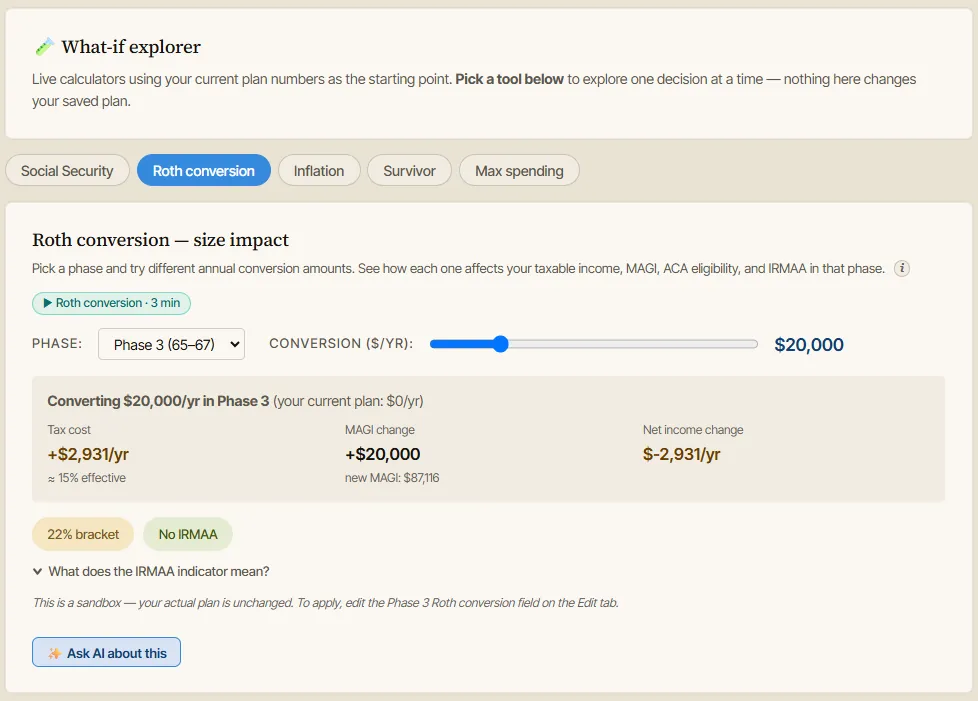
Example: Roth Conversion Question
Prompt:
"Should I convert $50,000 to Roth this year?"
ChatGPT should not answer that as a standalone yes or no.
Better prompt:
"Explain what I should model before deciding whether a $50,000 Roth conversion makes sense. Include taxes, ACA, IRMAA, RMDs, Social Security, and survivor planning."
Then run the conversion in a planner.
Look at:
- Current-year tax.
- ACA income if before Medicare.
- Future RMDs.
- Future IRMAA exposure.
- Ending balances.
- Survivor results.
- Cash available to pay tax.
That is a better workflow.
Common Mistakes
Mistake 1: Asking ChatGPT For A Final Answer
Ask it to explain, organize, or challenge assumptions. Do not make it the final authority.
Mistake 2: Skipping The Calculator
Retirement planning requires numbers. Use a planner to calculate the scenario.
Mistake 3: Sharing Too Much Personal Data
Use rounded or anonymized data when possible, and check data controls before sharing sensitive details.
Mistake 4: Ignoring Current Rules
Tax, Medicare, ACA, and Social Security rules can change. Use official sources.
Mistake 5: Treating AI Fluency As Accuracy
A clear answer can still be wrong.
Mistake 6: Letting AI Change A Plan Without Review
Use user-approved proposals. Review every change before applying it.
Educational Disclaimer
This article is educational only. It is not financial, tax, investment, legal, healthcare, insurance, privacy, cybersecurity, Social Security, estate, AI safety, or retirement advice. ChatGPT output may be wrong, incomplete, outdated, or poorly matched to your personal facts. Use official sources, planner calculations, and qualified professionals before making retirement decisions.
FAQ
Can ChatGPT help with retirement planning?
Yes. ChatGPT can help explain concepts, organize inputs, draft questions, summarize scenarios, and suggest what to test. It should not replace a retirement calculator or professional review for high-stakes decisions.
Can ChatGPT tell me if I can retire?
It can help list the factors that affect the answer. It should not be the final judge. The answer depends on spending, account balances, taxes, healthcare, Social Security, withdrawals, risk, and personal facts.
Can ChatGPT calculate Social Security timing?
ChatGPT can explain claiming-age tradeoffs, but Social Security timing should be checked against SSA information and modeled in a retirement planner, especially for couples and survivor planning.
Can ChatGPT help with Roth conversions?
It can explain the tradeoffs and help build a checklist. Conversion amounts should be tested in a tax-aware planner and reviewed with qualified professionals when appropriate.
Is it safe to paste retirement details into ChatGPT?
Be careful. Avoid sharing unnecessary personal details, consider rounded numbers, review current data controls, and understand whether conversations may be stored, reviewed, or used to improve models.
Does ChatGPT always know current tax and Medicare rules?
No. Rules can change, and AI outputs can be wrong or outdated. Verify current rules with official sources.
How is the AI Retirement Income Planner different from ChatGPT alone?
The planner provides structured retirement calculations for taxes, healthcare, Social Security, withdrawals, scenarios, and risk. Optional AI helps explain, review, and propose user-approved changes.
Do I have to use AI in the planner?
No. AI assistance is optional. The core planner can be used without AI.
Source Links
- OpenAI Help: What is ChatGPT?: https://help.openai.com/en/articles/6783457-chatgpt-general-faq
- OpenAI Help: Data Controls FAQ: https://help.openai.com/en/articles/7730893-data-controls-faq
- OpenAI Privacy Policy: https://openai.com/policies/row-privacy-policy/
- Investor.gov: Artificial Intelligence and Investment Fraud Investor Alert: https://www.investor.gov/introduction-investing/general-resources/news-alerts/alerts-bulletins/investor-alerts/artificial-intelligence-fraud
- NIST AI Risk Management Framework: https://www.nist.gov/itl/ai-risk-management-framework
- AI Retirement Income Planner official site: https://airetirementincomeplanner.com/
- WebNomad product overview: https://webnomad.webflow.io/pages/ai-ready-retirement-income-planner